ICELAND
When: January 2026
Northern Lights. Waterfalls. Lava fields. Glaciers. Snowy landscapes. These are the things I hoped to see on this trip. And with the exception of snowy landscapes, I did!
Yes, I went to Iceland in January and there was NO SNOW (at least where I traveled). According to ChatGPT, 2026 is the third time in recorded history that Reykjavik has had zero days of snow in January. The past two events were in 1940 and 1929.
Where: Around the Southwest Part of the Country
I spent a few days on my own in Reykjavik, then joined my “Winter Adventures in Iceland” group, organized by Wilderness Travel.
Jump To:
Winter Adventures In Iceland Tour:
Days 1 & 2 • Days 3 & 4 • Days 5 & 6 • Days 7 & 8
Want to Know More?
I highly recommend reading “How Iceland Changed the World: The Big History of a Small Island” by Egill Bjarnason. It’s fascinating!
Random Travel Tips
These are just a few of my travel tips. I have no affiliation with any of the services or resources for which I provide links—it is simply to share what I learned when I was planning my trip.
Communicating
English is commonly spoken. The Icelandic language is classified as Scandinavian, and it is derived from Old Norse. My linguistic triumph on this trip was learning to pronounce Eyjafjallajökull (AY-yah-fyat-lah-YOH-kuhtl). Unlike these news anchors: https://youtu.be/3joAMvlLkBs?si=WGIDz1Oo6xJWEf5F
Other than that, I only learned:
Takk (tahk): “thank you”
Já (yow): “yes”
Þetta reddast (thet-ta red-dast): “it will all be OK”
Jökull (yuh-kutl) : glacier
Foss (fawss): waterfall
Staying Connected
I used a Breeze eSim on this trip, which I purchased via the Icelandic Air website. All my hotels had good WiFi.
Money
I never needed local currency, everywhere I went preferred credit cards.
Transportation
To get from Keflavik Airport to various locations in Reykjavik city center, Flybus is recommended.
Reykjavik—weather allowing, of course—is a very walkable city. I used a taxi once, when I did not feel like walking 40 minutes in the rain to get from the Perlan museum back to my hotel, but otherwise I walked everywhere. It does not seem that there is much in the way of public transportation. I asked at my hotel about the bus system, and the answer was “we don’t really use it.”
Once I joined my tour group and headed out into the countryside, I and my fellow travelers were chauffeured about by our trip leader in a workhorse of a truck nicknamed “Valkyrie.” I do love not having to drive myself in a foreign country, and I personally am not brave enough to rent a car and drive in Iceland in the winter.
Climate
“Unpredictable” and “changes quickly” seem to be the terms most often used when discussing Icelandic weather. Also “windy.” Also “really, really windy.” Also “Seriously, the wind can knock over a bus.” On my trip, it was not as cold as I expected. Temperatures were mostly in the low 30’s (°F). Wind chill made it feel colder, of course. Our coldest morning it was 19°F, but it was a sunny day and soon warmed up. In fact, I never used all the layers of clothing I packed. Although I missed out on the “winter wonderland” experience—because there was NO SNOW—I think I was very lucky with weather during my travels.
Reykjavik
My hotel for my first few days in Reykjavik faced a small park where the trees glittered with lights to counteract the long hours of darkness.
Hotel Borg
The Black Cone,
Monument to Civil Disobedience
I came across this in the park in front of Hotel Borg, which also borders the National Parliament. The plaque reads “When the government violates the rights of the people, insurrection is for the people and for each portion of the people the most sacred of rights and the most indispensable of duties.”
—Declaration of the Rights of Man and Citizen (1793)
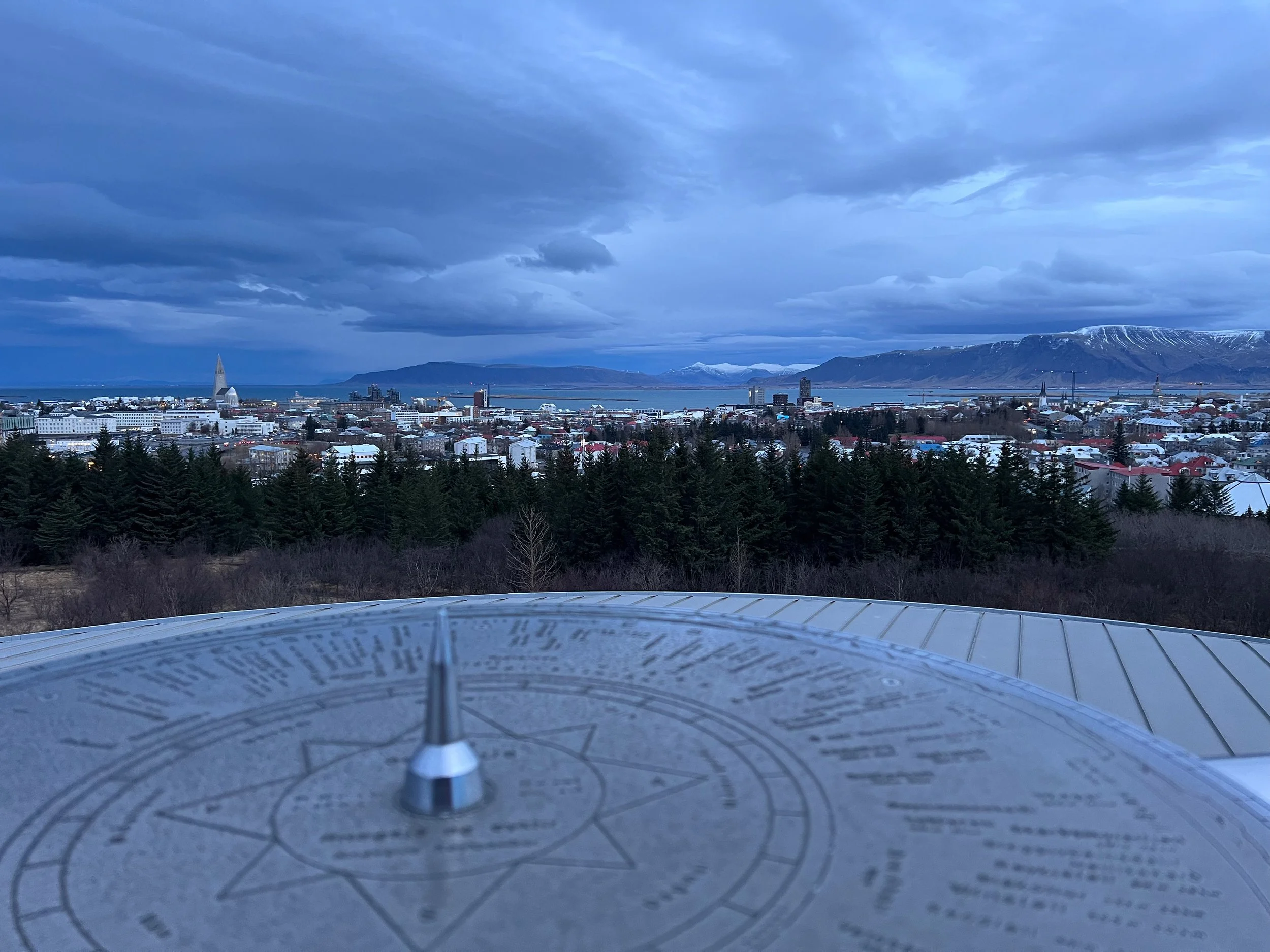
This natural history museum was a wonderful place to spend time. There are exhibits on Iceland’s geological history, a re-created ice cave (temperature inside it is -5°C), a 3D film that takes you inside a volcano, and a planetarium with a show about the northern lights. The glass domed top is a fabulous place to take a break. There is a 360° outdoor observation deck, and a nice café which slowly revolves to give you panoramic views as you have your beer & pizza (as I did).
Perlan Musuem
This sign was inside the ice cave at Perlan. It reads “Ok is the first Icelandic glacier to lose its status as a glacier. In the next 200 years all our glaciers are expected to follow the same path. This monument is to acknowledge that we know what is happening and what needs to be done. Only you know if we did it. August 2019, 415 ppm CO2”
A Letter to the future
This was created from actual glacial ice—the black layers are ash from past volcanic eruptions.
Inside the Ice Cave
Lovely sculpture outside Perlan.
The Dancers
The Lava Show uses this furnace to re-melt lava gathered from the 1918 Katla eruption.
Lava Show Furnace
The molten lava is then poured down a chute into a small auditorium, where an enthusiastic Lava Master gives a presentation “combining thrilling visuals with expert narration and deep geological insight.”
Flowing Lava
Horses were the first true love in my life, so I arranged a visit and trail ride at Laxnes Horse Farm. Icelandic horses are famous for their natural-born gaits, which include the basic walk, trot, and gallop as well as tölt and pace. Learn more about them here.
Icelandic Horses, Laxnes Horse Farm
Walking Around Reykjavik
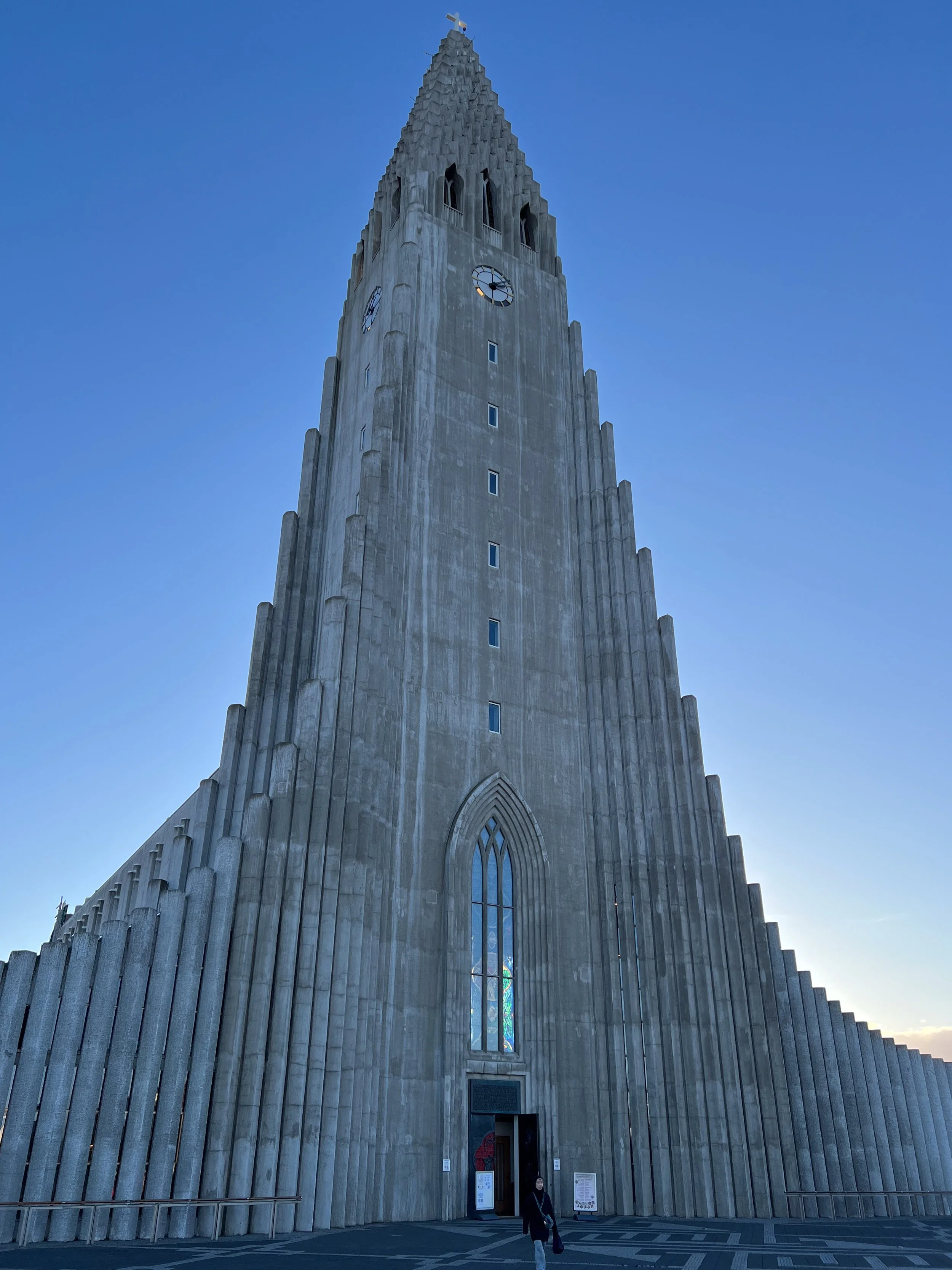
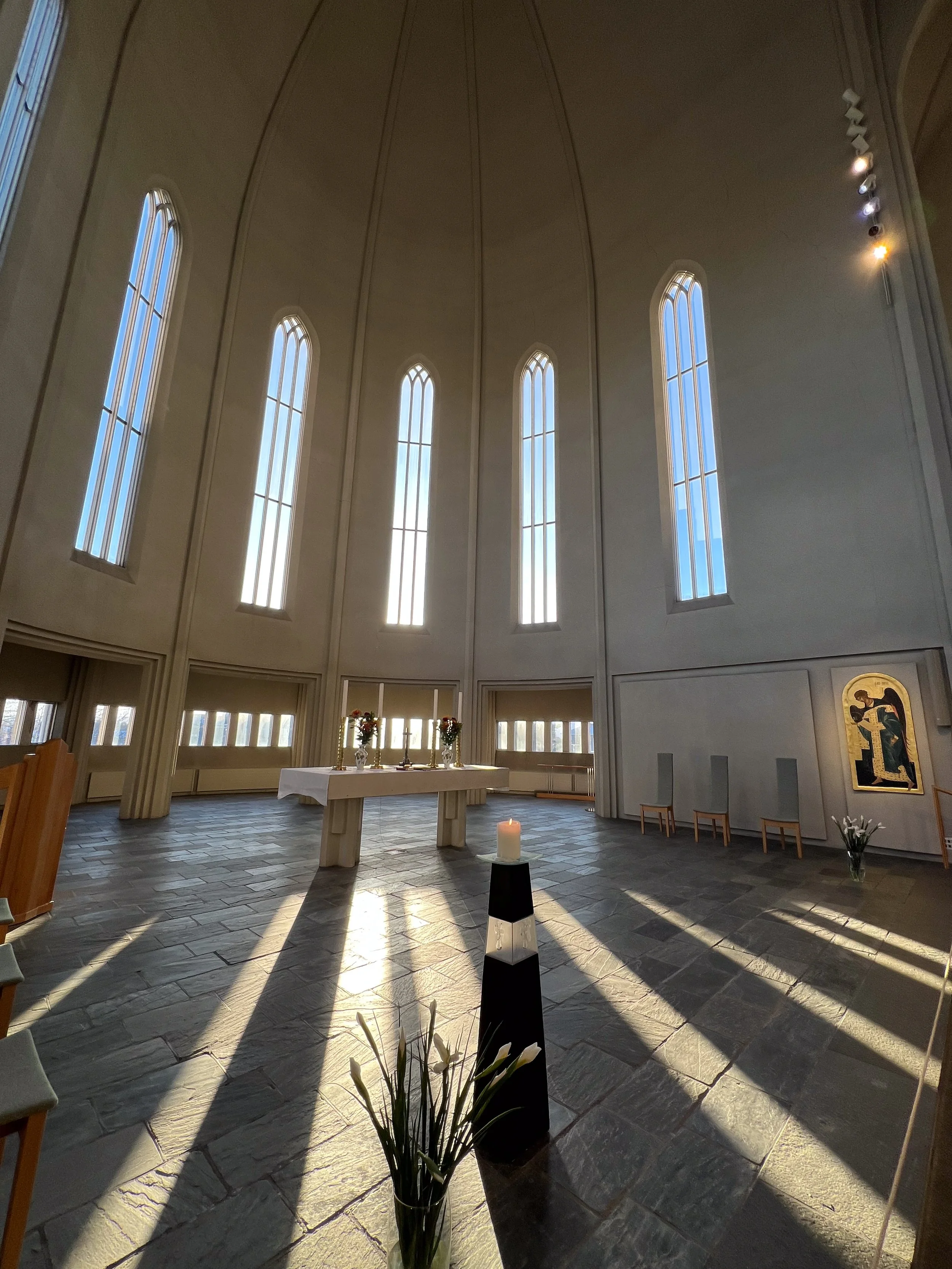
After my morning at Laxnes Horse Farm, I took a self-guided walking tour of Rekyjavik. I visited the iconic Hallgrimskirkja church. It’s stark exterior evokes the basalt columns integral to Iceland’s landscape, and the interior is simple and austere. For a fee, you can take an elevator to the top for the views.
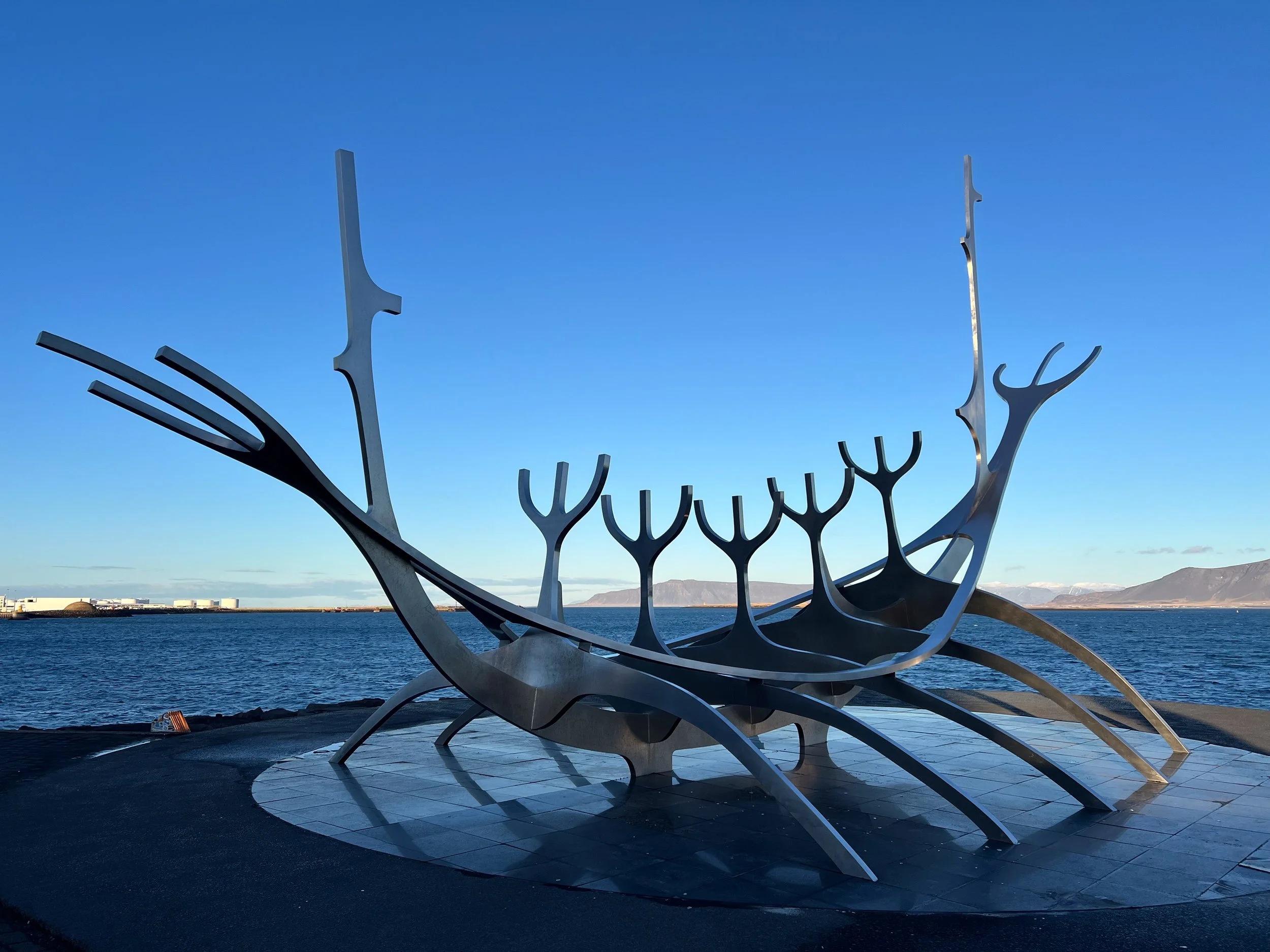
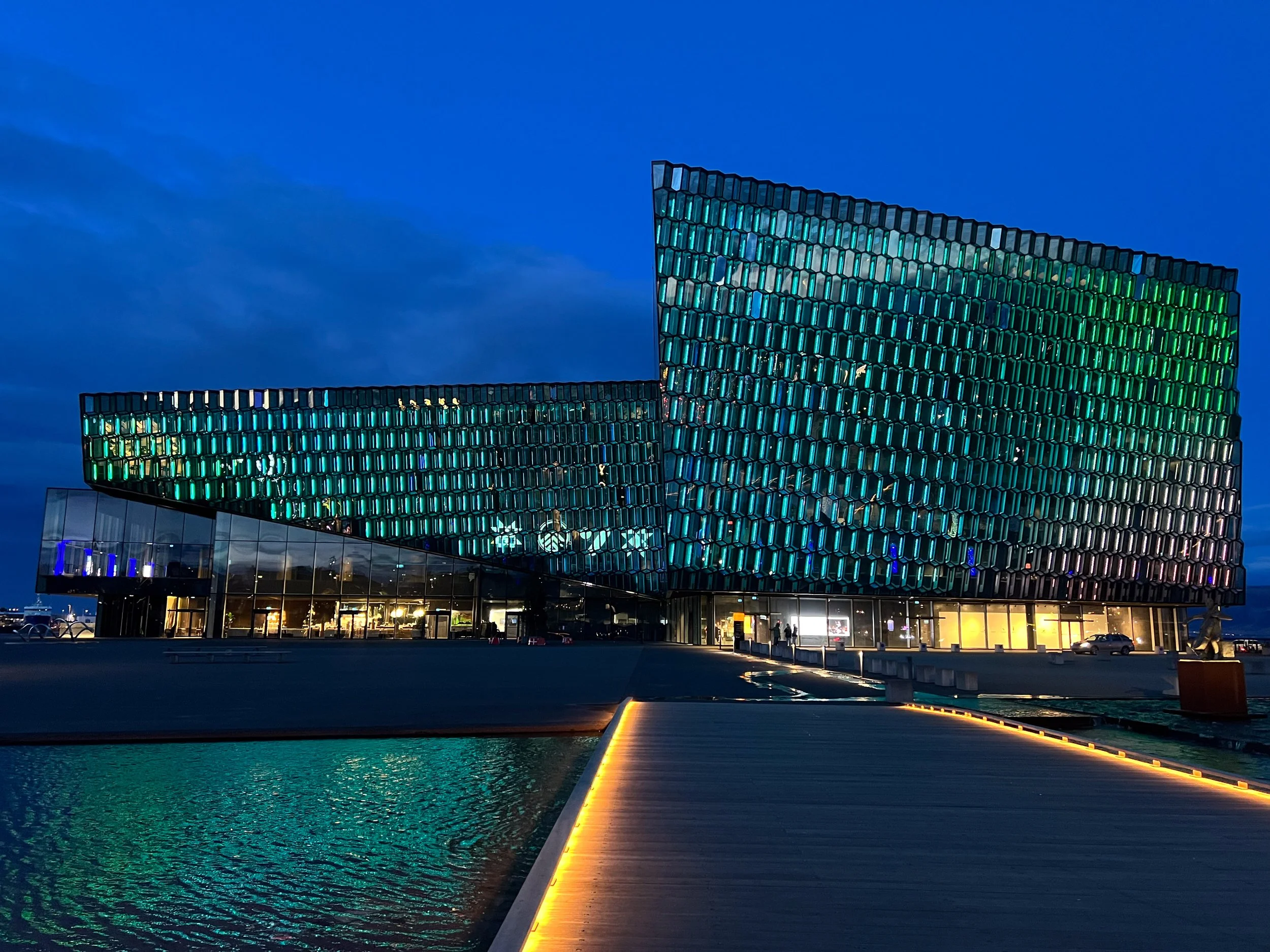
At the harbor I stopped to admire the Sun Voyager sculpture and wandered around the wonderful Harpa Concert Hall. I returned to Harpa a couple of nights later to see the comedy show “How To Be Icelandic in 60 Minutes,” which was a good laugh.
World in Words Museum
This little museum is part of the Árni Magnússon Institute for Icelandic Studies. The manuscript collection is preserved jointly by Iceland and Denmark, and it is on the UNESCO World Heritage List in the “Memory of the World” category.
Einar Jónsson Sculpture Garden
This is adjacent to the Hallgrimskirkja.
Winter Adventures in Iceland
January 25th, Day 1:
No Snow Means No Snowshoeing
I knew that in Iceland the weather rules the day, and therefore the itinerary for this trip might change. Sure enough, our first activity was supposed to be snowshoeing over lava fields in the Blue Mountains, but since there was NO SNOW, our trip leader, Ragnar, had to come up with a Plan B.
We headed to Grindavik, a small fishing village that has been largely abandoned since 2023 due to ongoing seismic activity and lava eruptions. Some businesses are still allowed to operate there, such as the restaurant where we had lunch, but it is basically a ghost town surrounded by lava fields.
Our first hike was up a short but steep hill, which gave us a chance to look down on the Svartsengi Geothermal Power Plant and the adjacent Blue Lagoon resort. The lagoon is man-made, and the water is actually a byproduct of the power plant. The milky blue color of the water is due to its high silica content.
After our hike we made our way to Hotel Ranga, which has an on-site observatory. If conditions are promising, a local astronomer opens it to give a tour of the night sky. This happened our first night, but it clouded over so quickly he was soon limited in what he could show us. We did, however, get our first faint look at northern lights, although the cloud cover made for a poor showing.
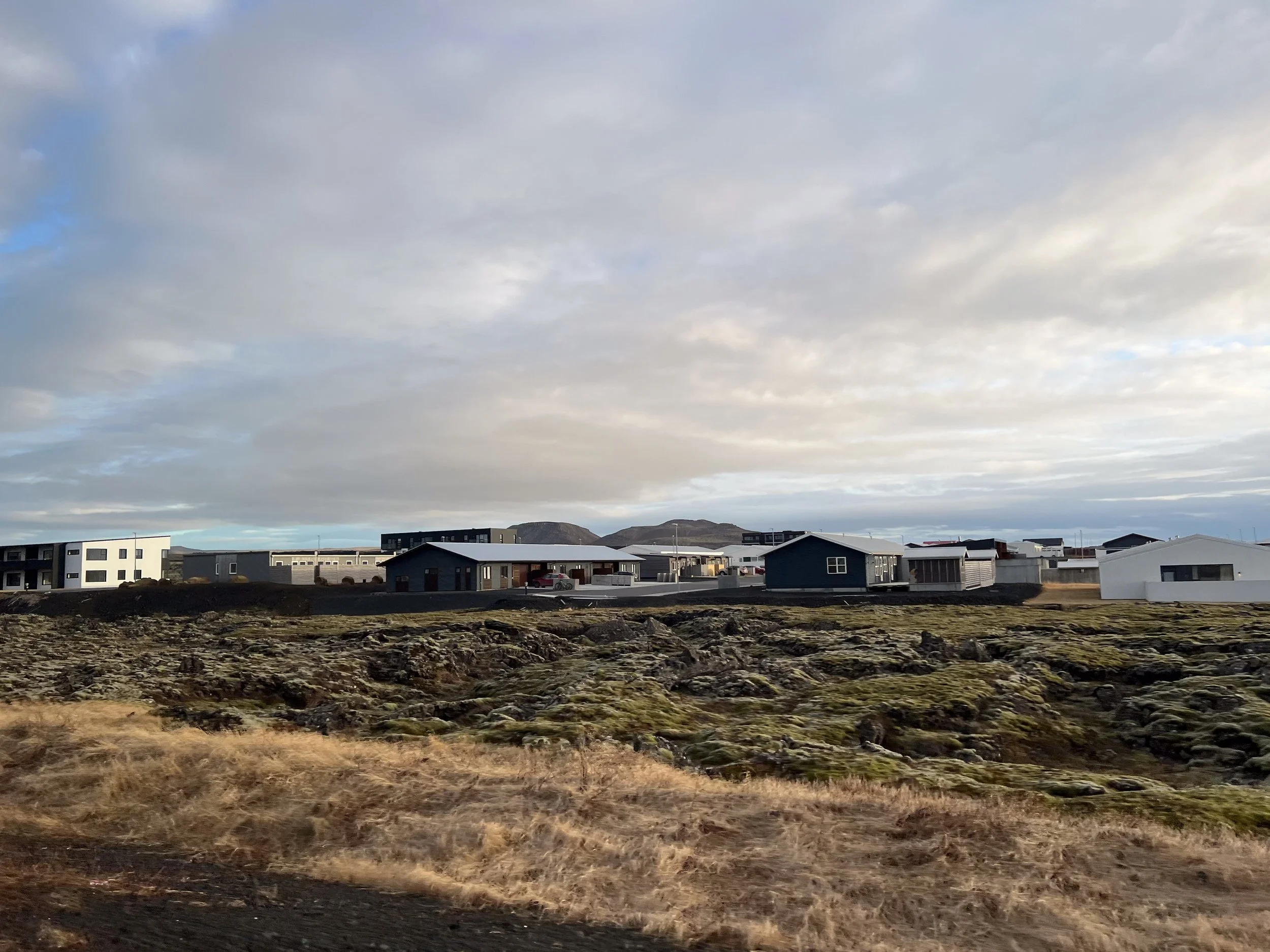
Lava Flow at Grindavik
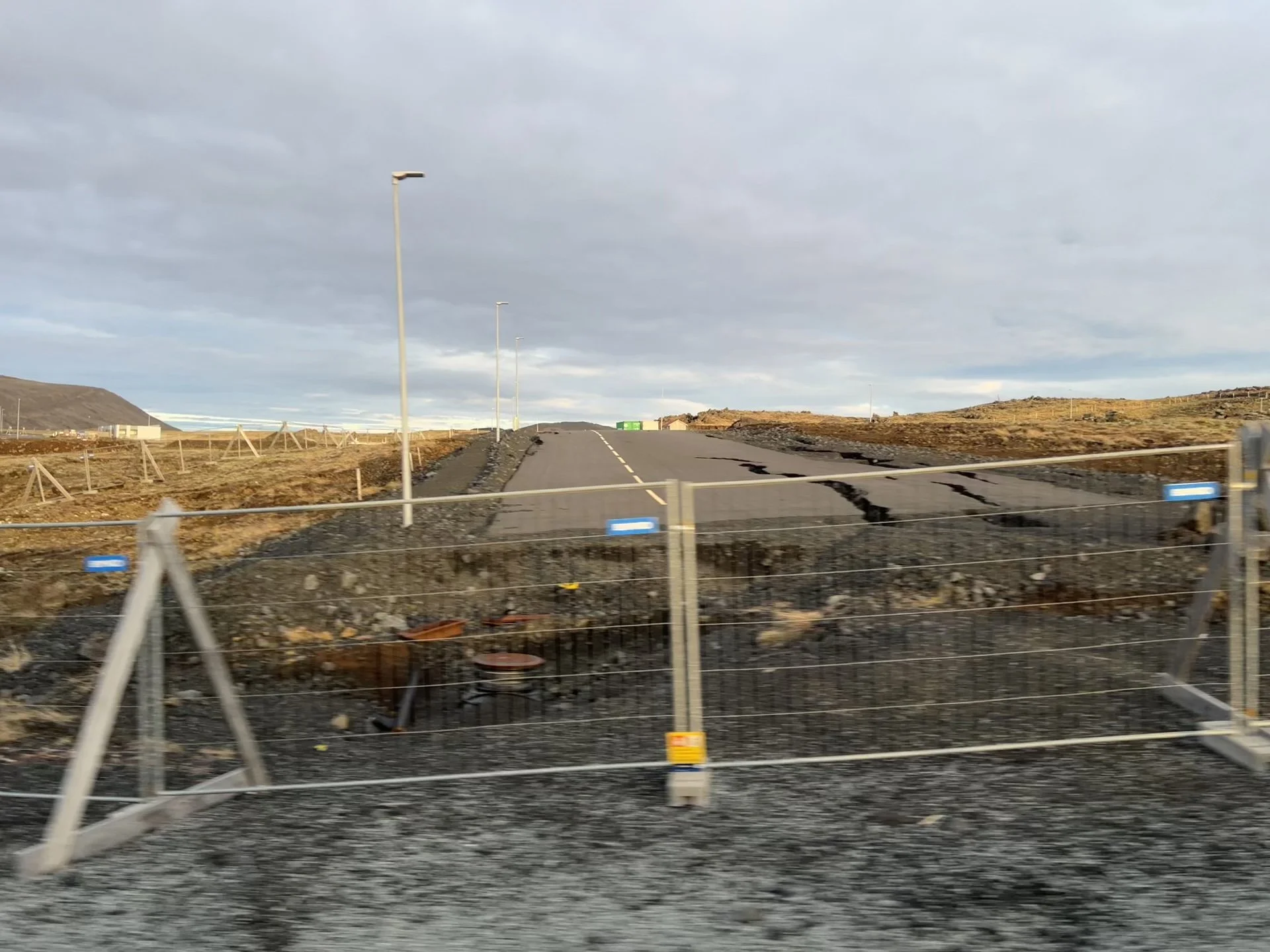
Ongoing Seismic Activity
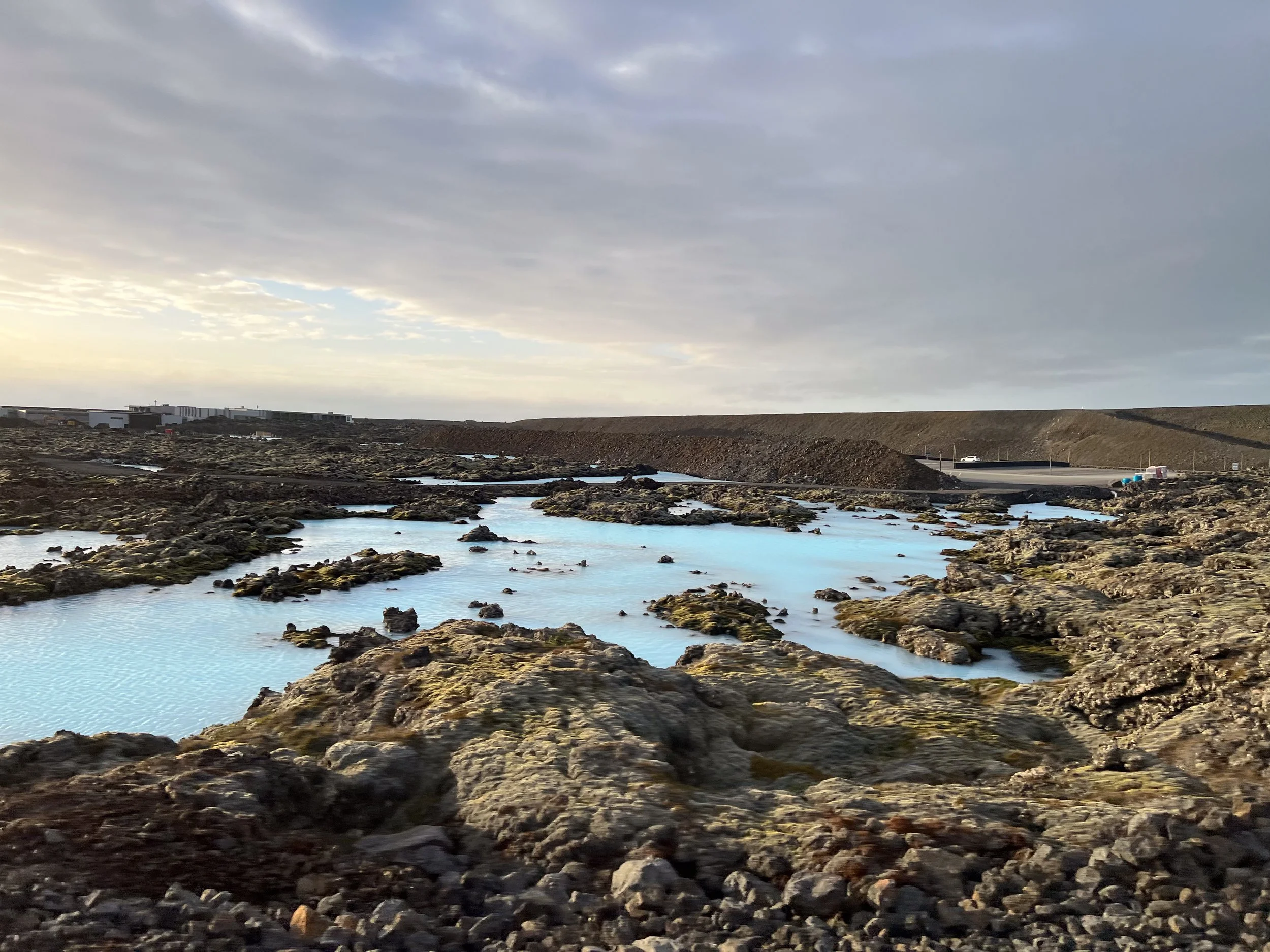
Blue Puddle (the same silica-rich water runoff from the power plant that is used to create the Blue Lagoon).
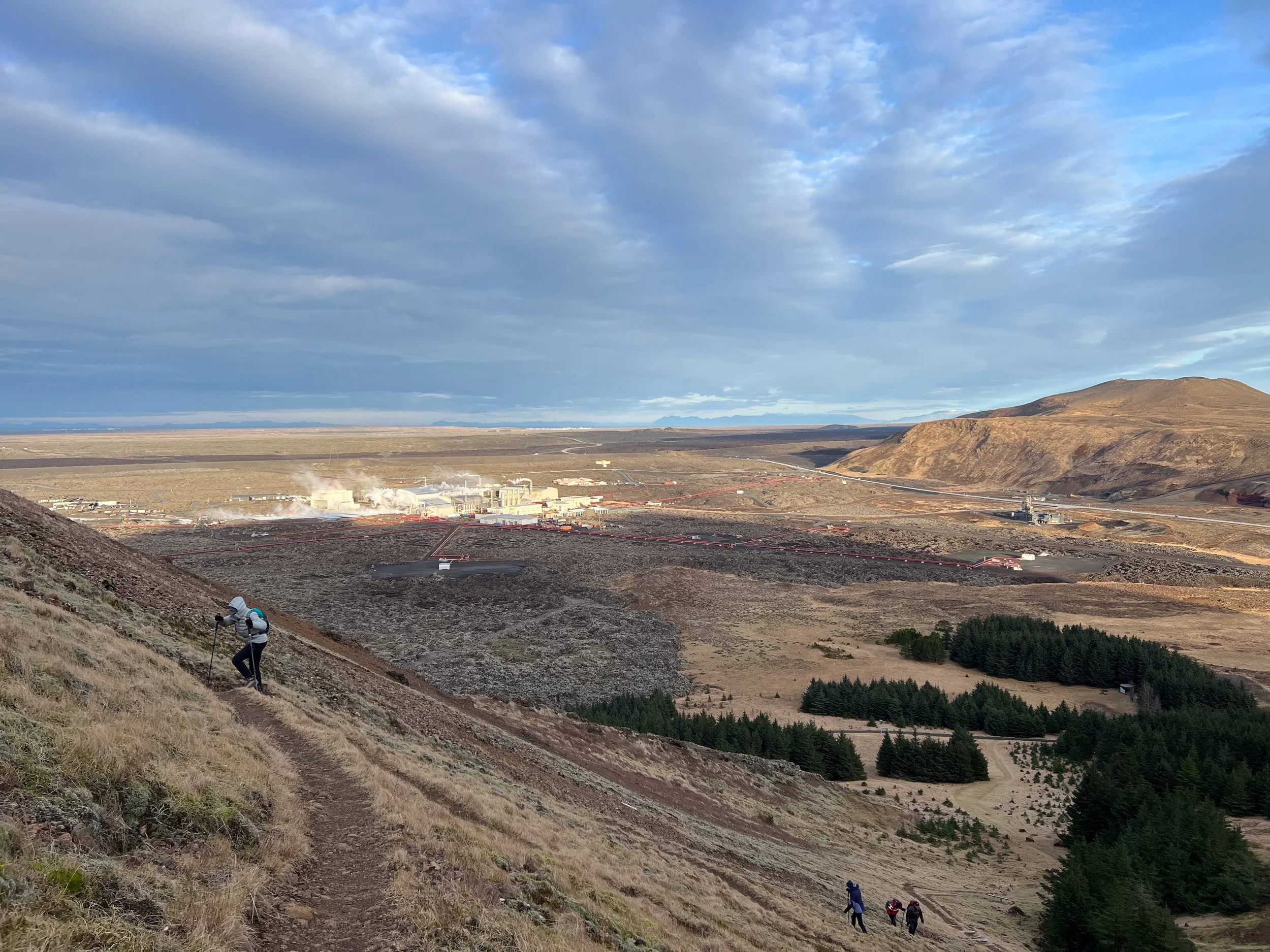
First Hike: Short but Steep!
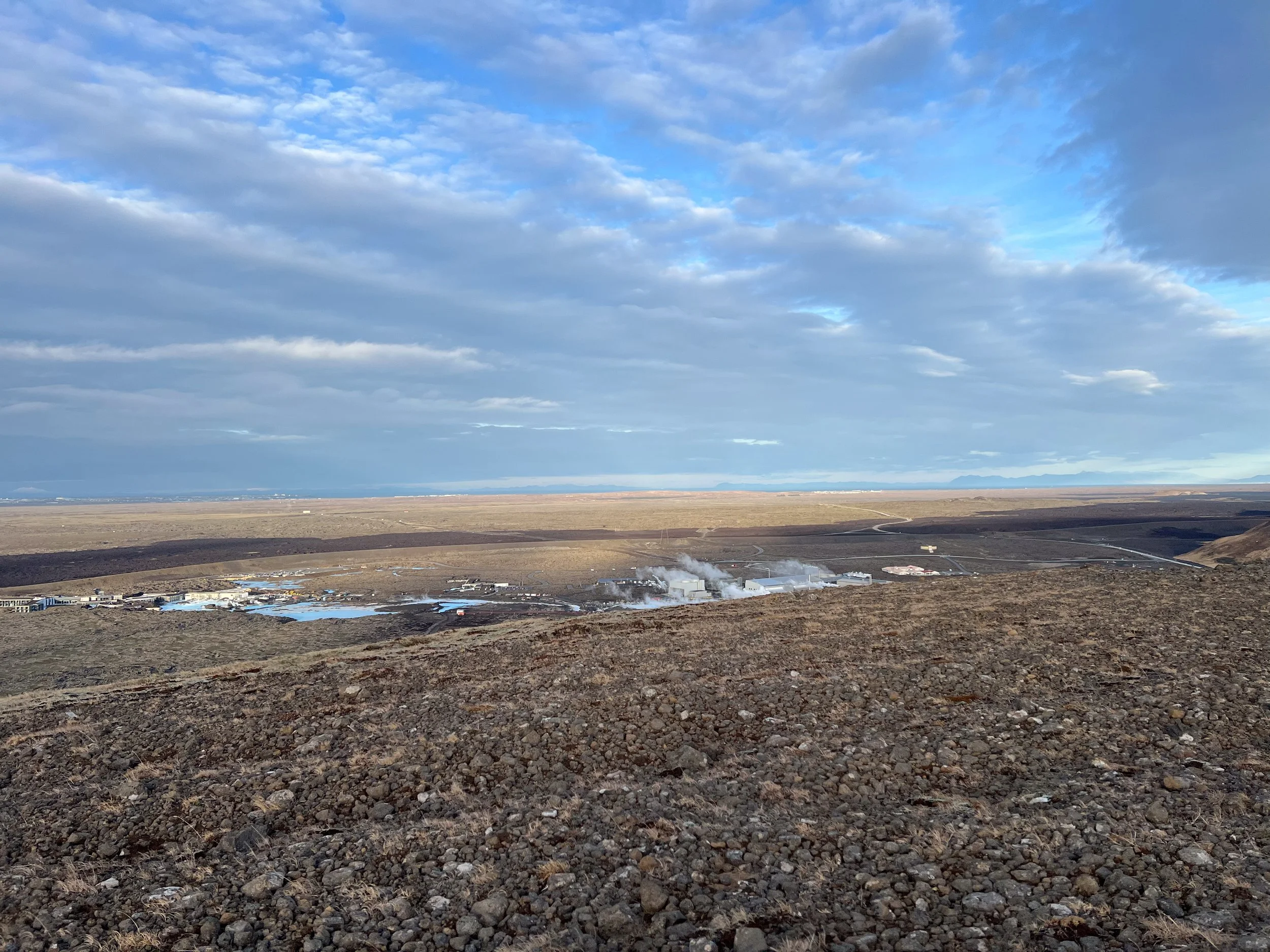
Overlooking Svartsengi Geothermal Power Plant and the Blue Lagoon.
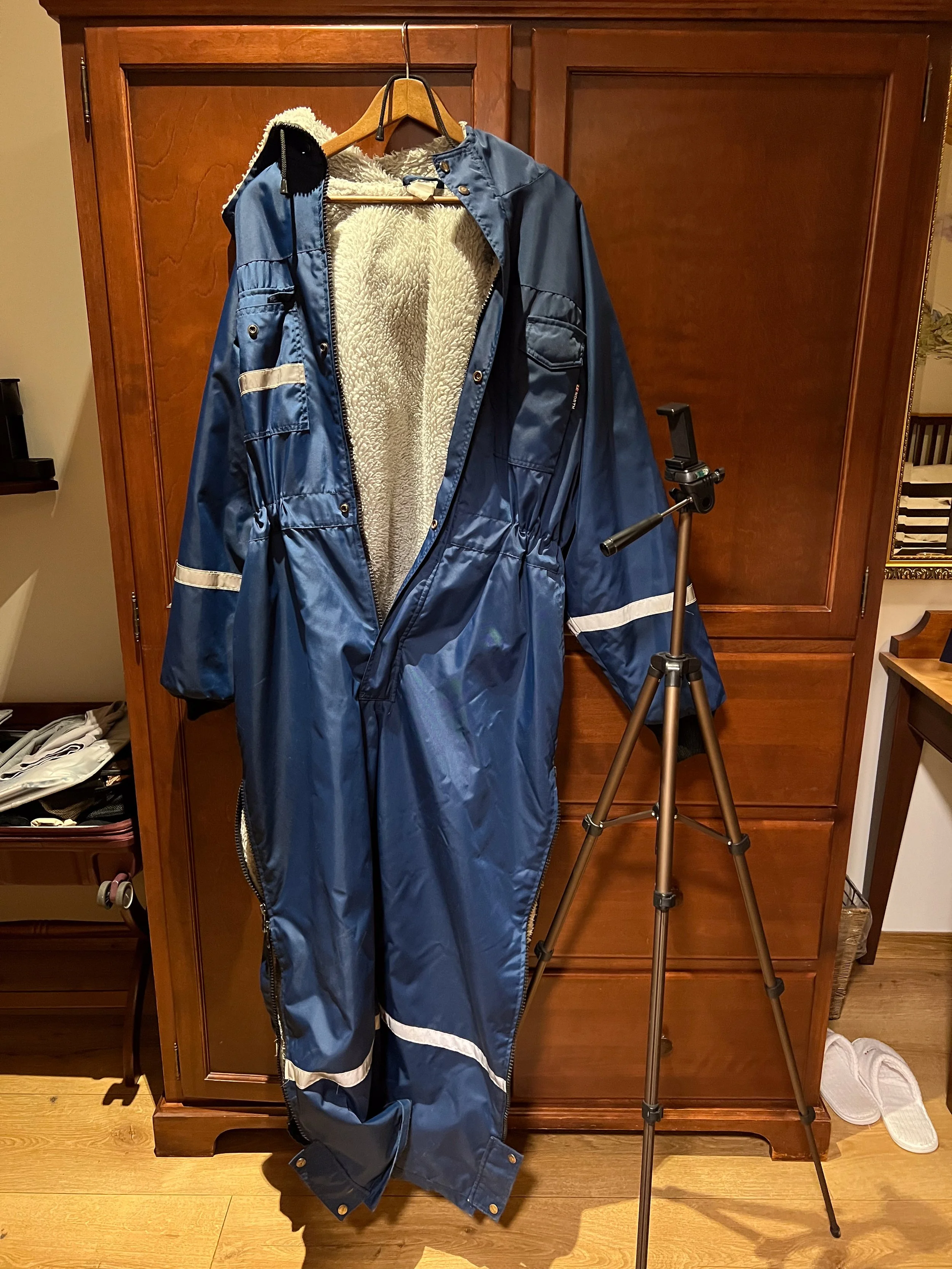
The cozy snowsuit provided by the hotel for stargazing and northern lights viewing. The tripod is mine, and I'm glad I packed it.
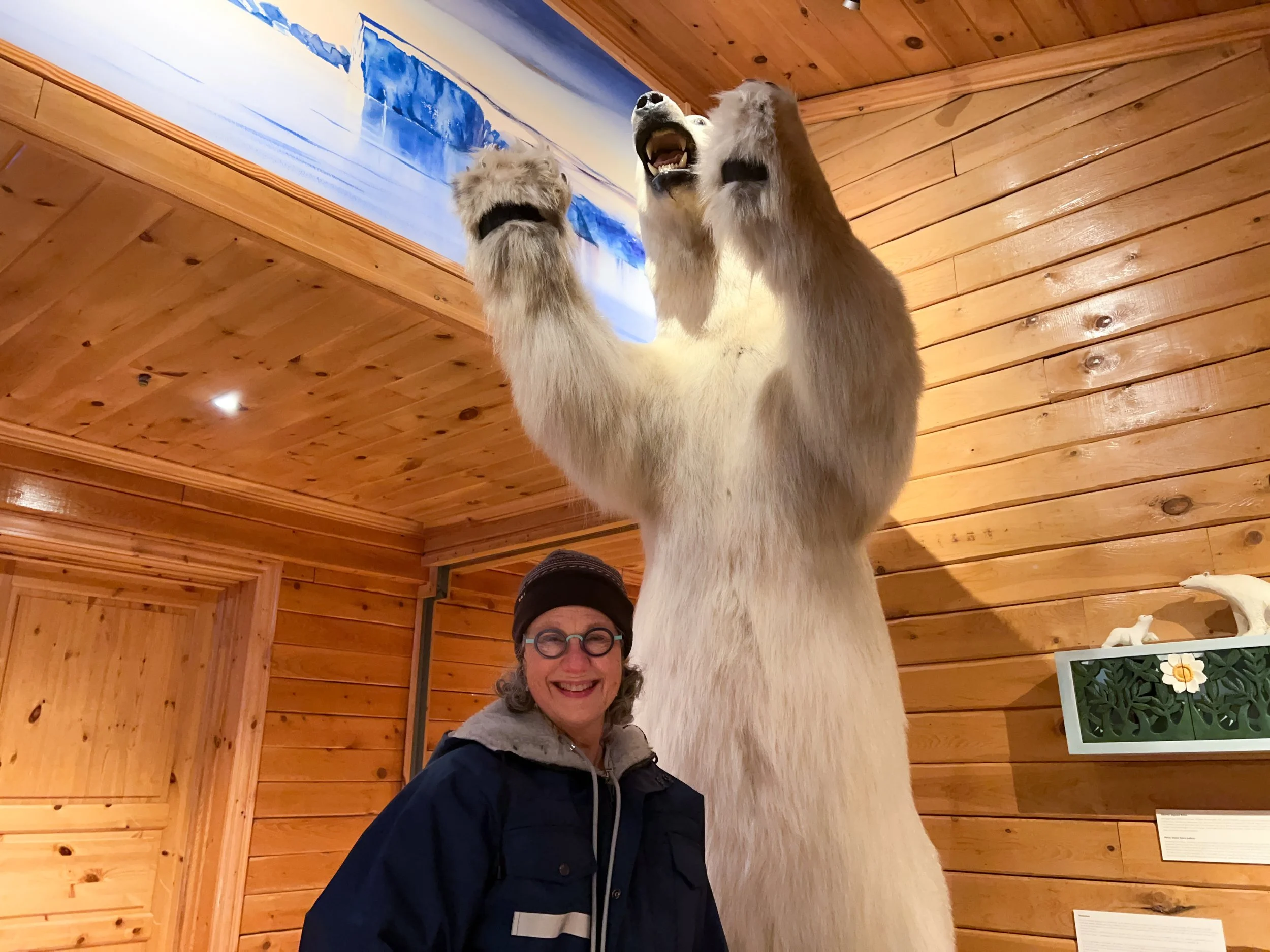
Me with Hrammur, who drifted over to Iceland from Greenland. Polar bears are not found in Iceland unless they are very, very lost.
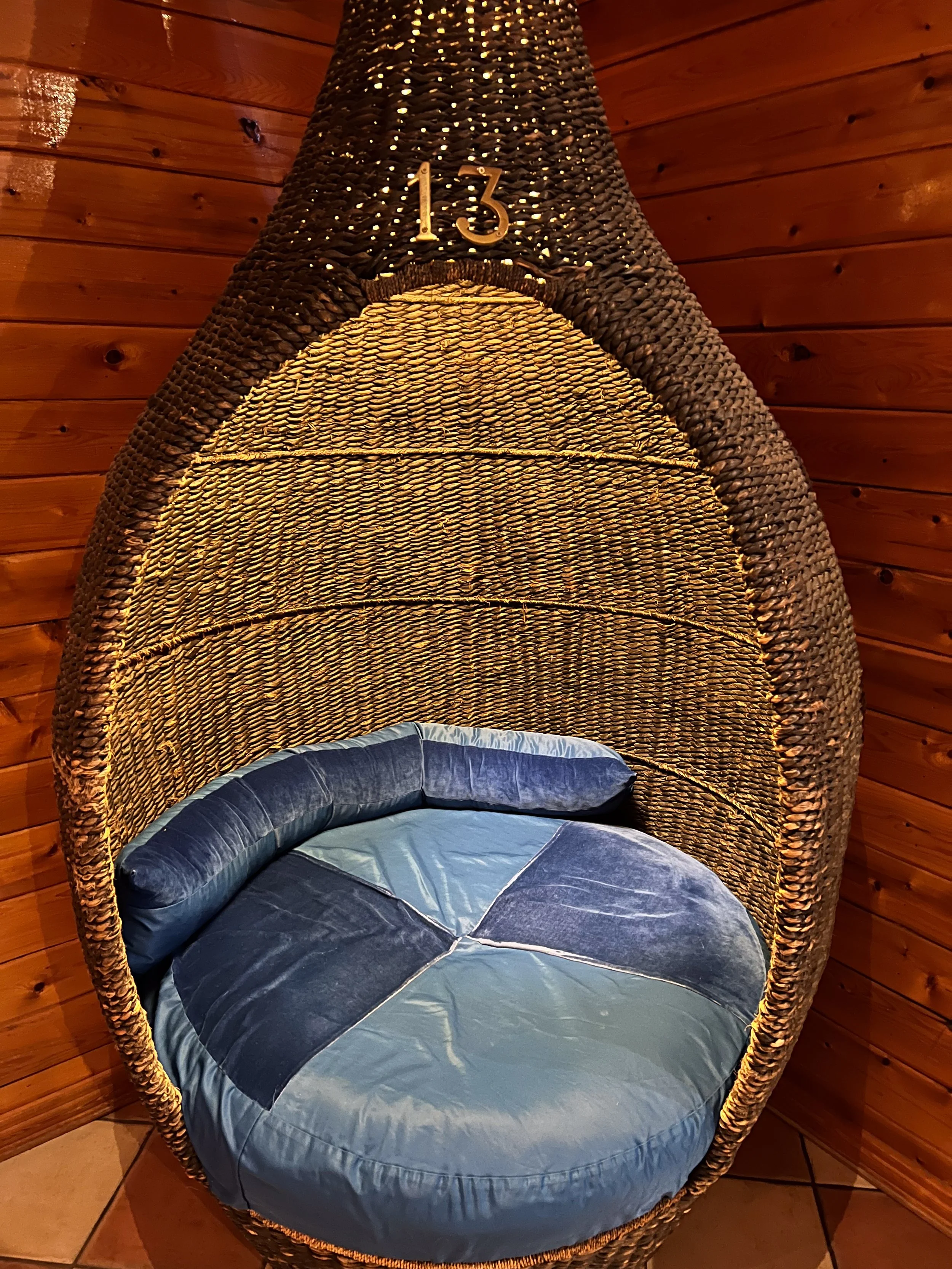
Hotel Ranga's whimsical Room 13.
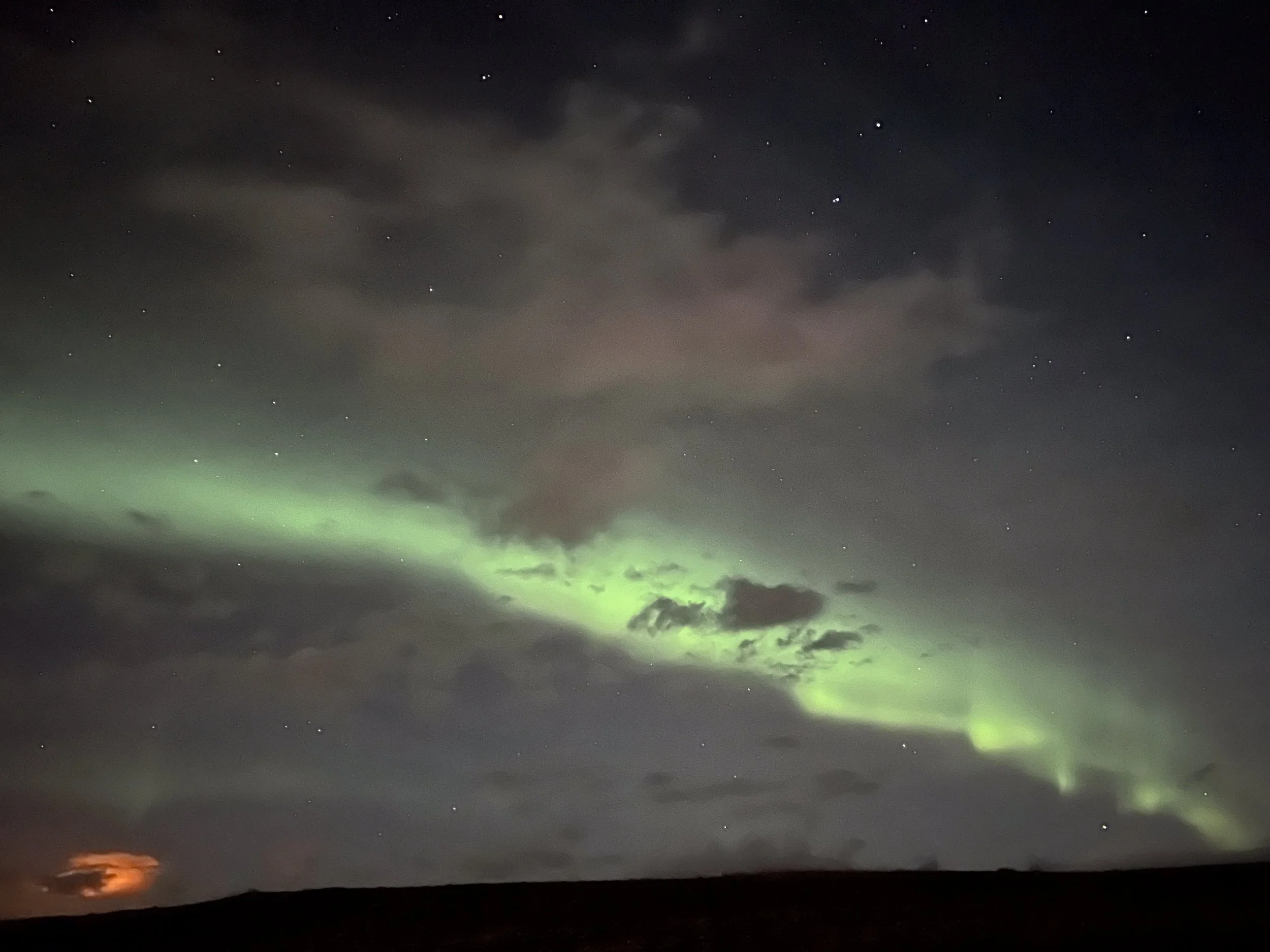
First northern lights sighting. The orange glow in the lower left is light pollution from a nearby greenhouse.
January 26th, Day 2:
Wind & Rain Mean No Glacier Visit
Today we were supposed to don crampons, ice axes, helmets, and harnesses in order to walk out on a glacier. But once again the weather required a Plan B. High winds and rain were expected over the glacier, so we went to Thor’s Valley (þórsmörk in Icelandic). I cannot comment on what the glacier walk would have been like, but Thor’s Valley was rugged and beautiful and we had the place to ourselves. I’d say it was an excellent Plan B.
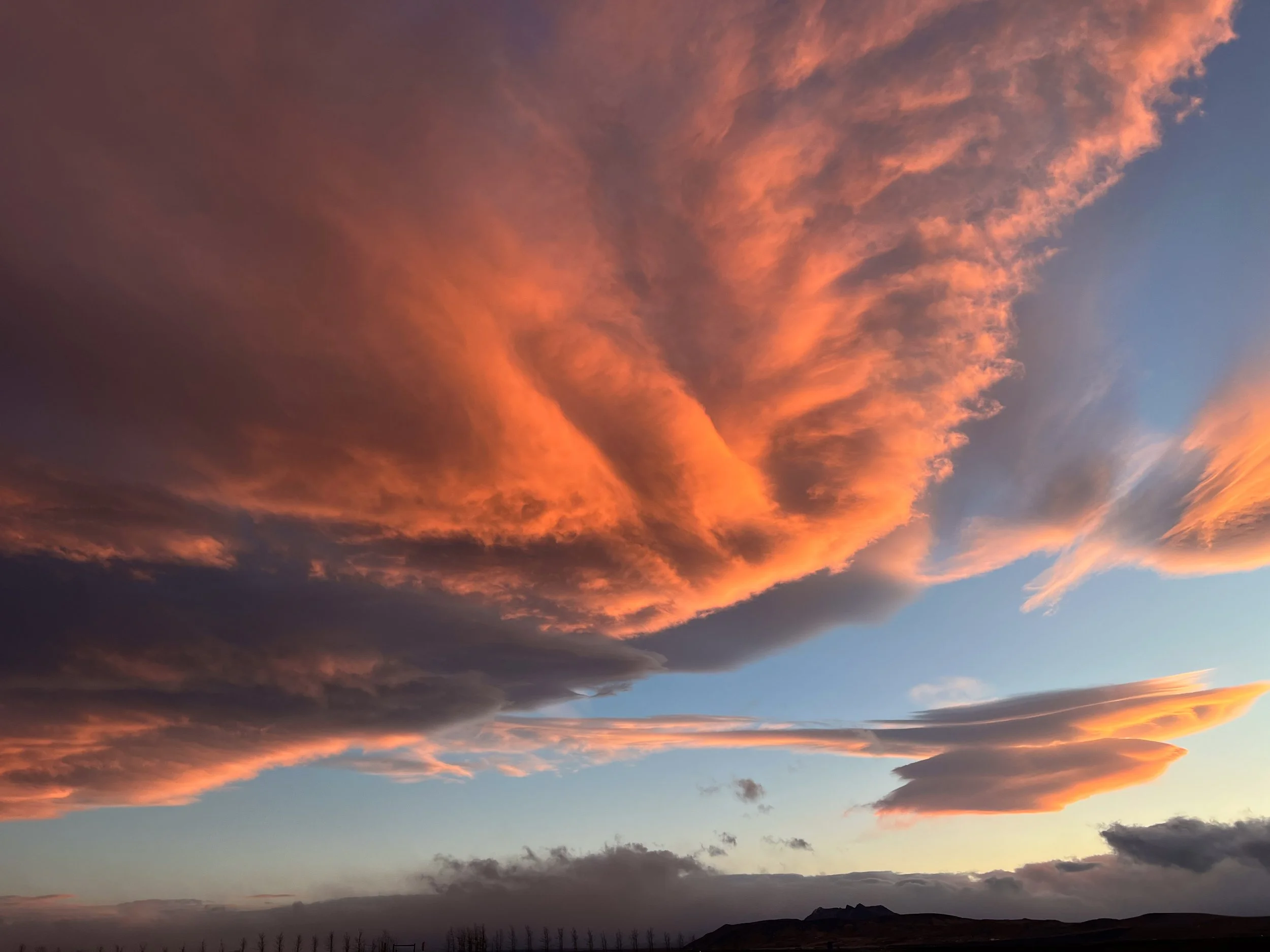
Morning Sky
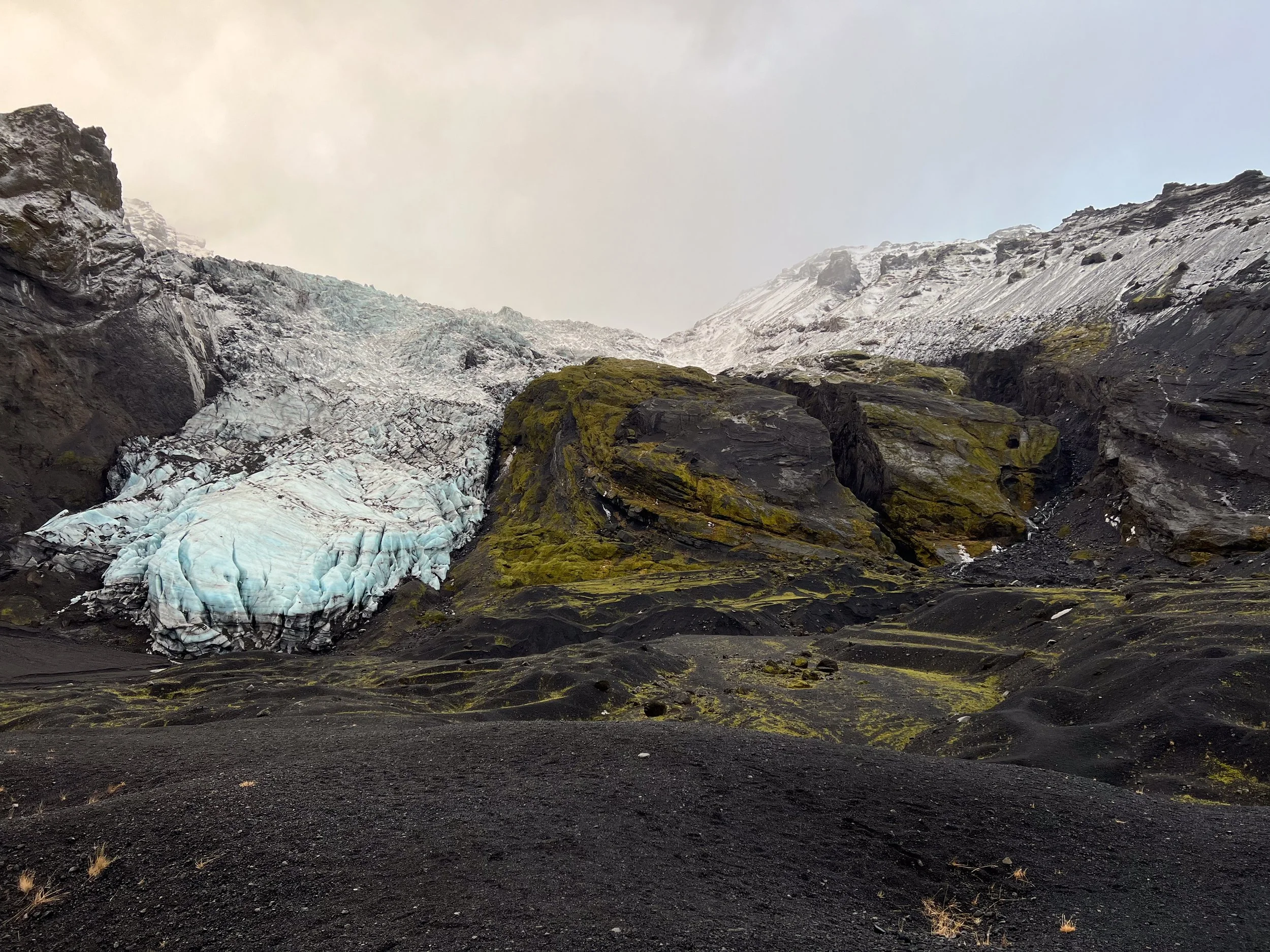
Gígjökull—Outlet Glacier for Eyjajfjalljökull
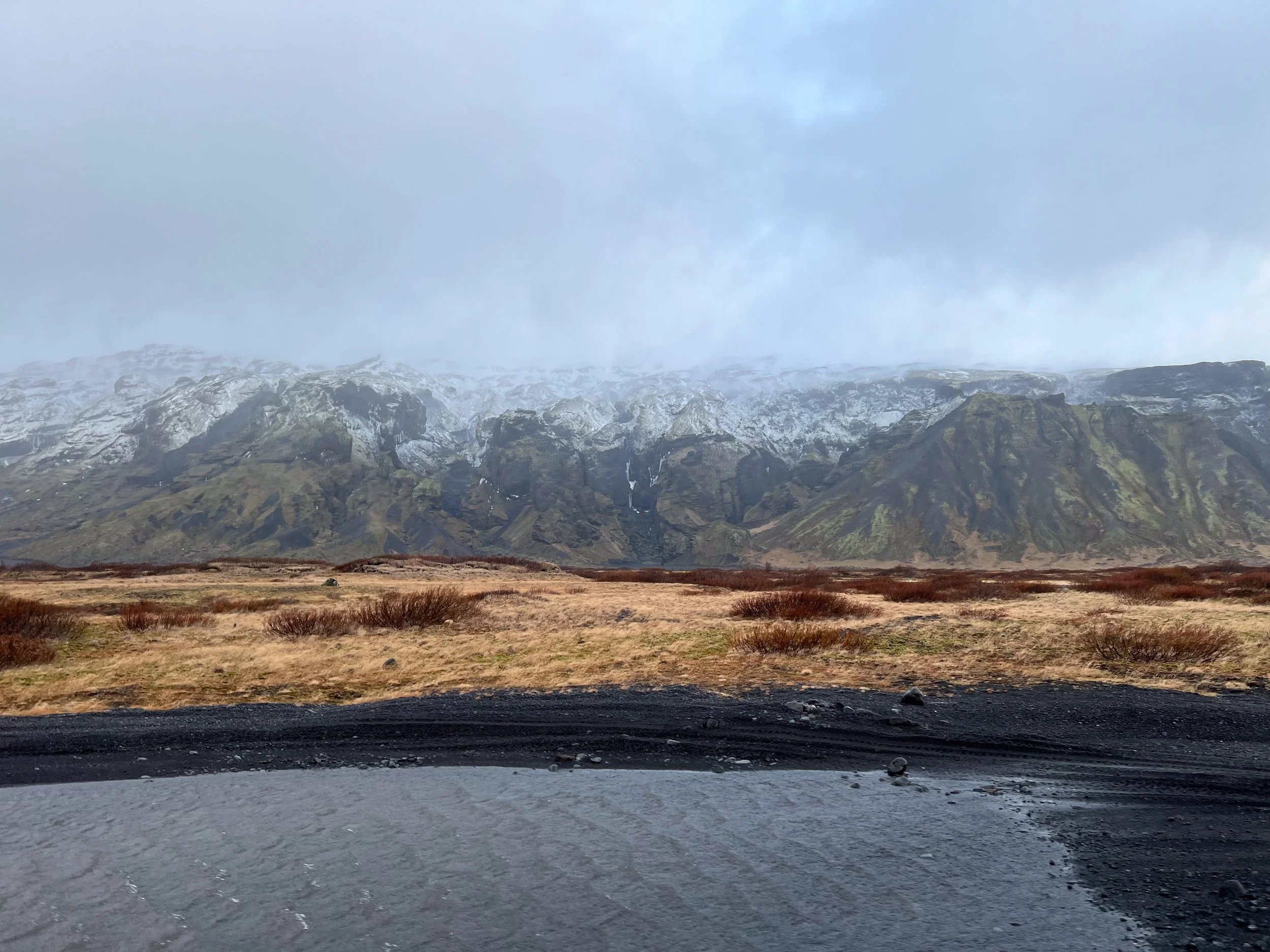
Thor's Valley
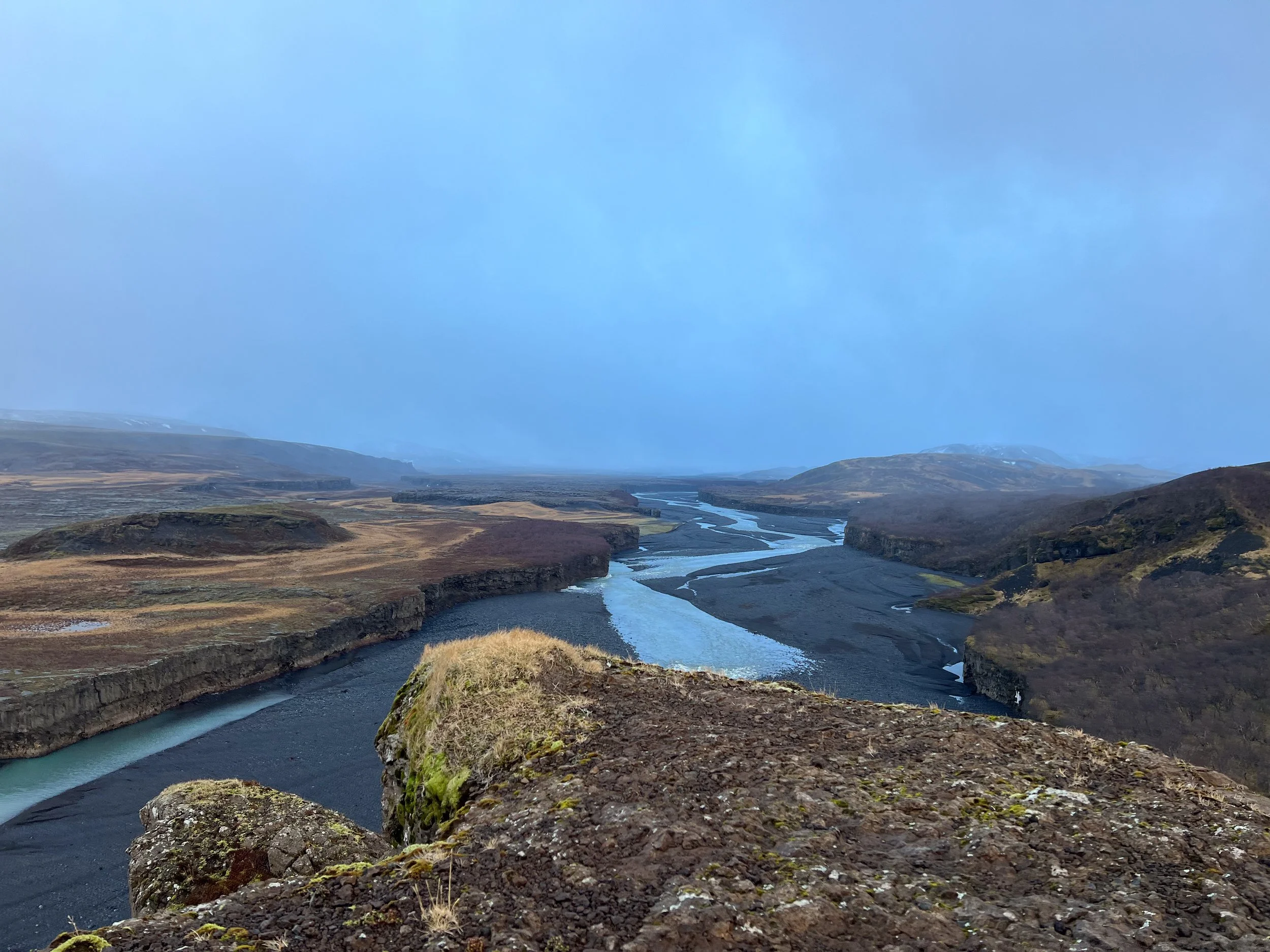
Overlook, Thor's Valley
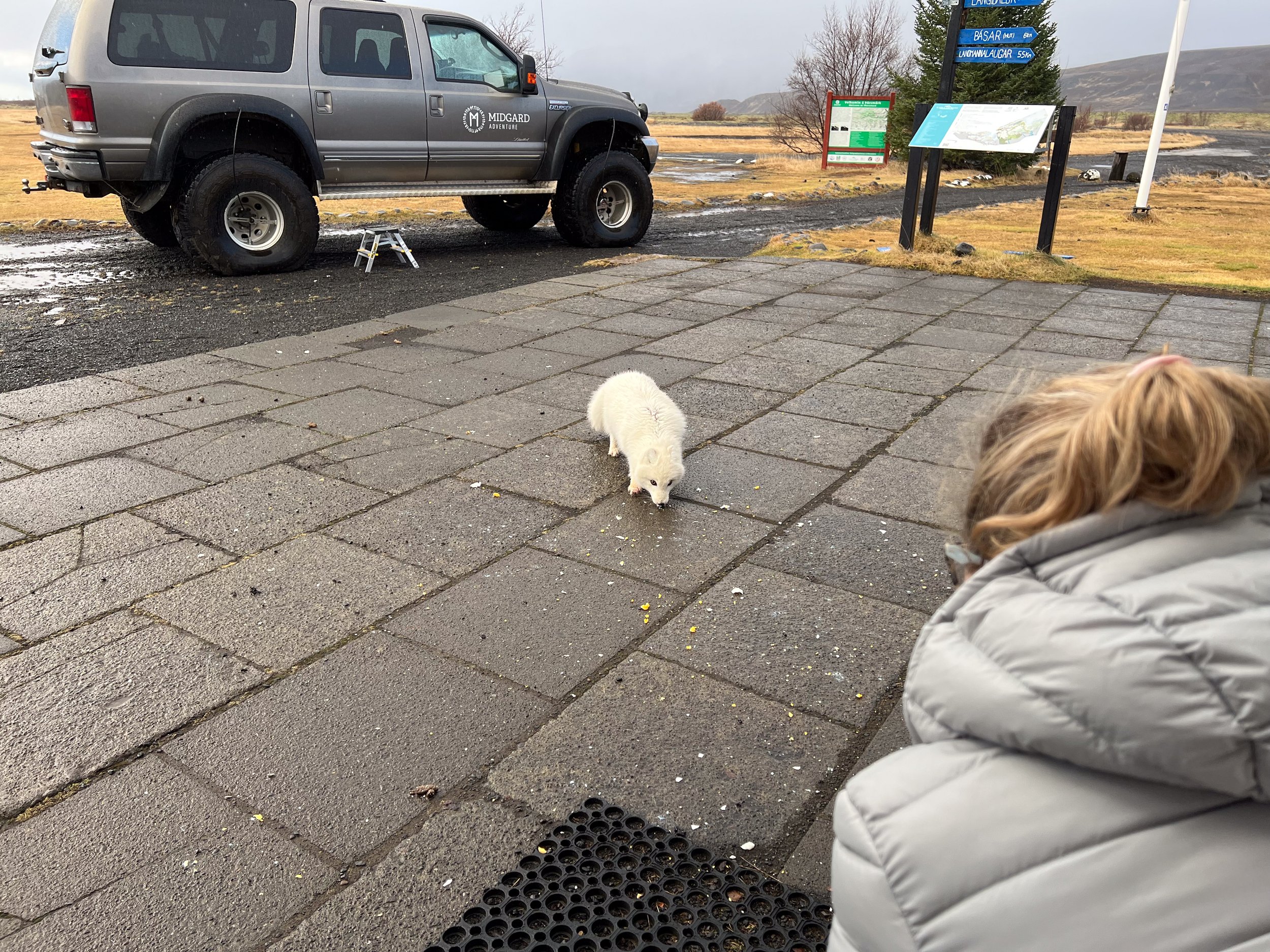
We stopped for lunch at a campground, where the arctic foxes know humans = food.
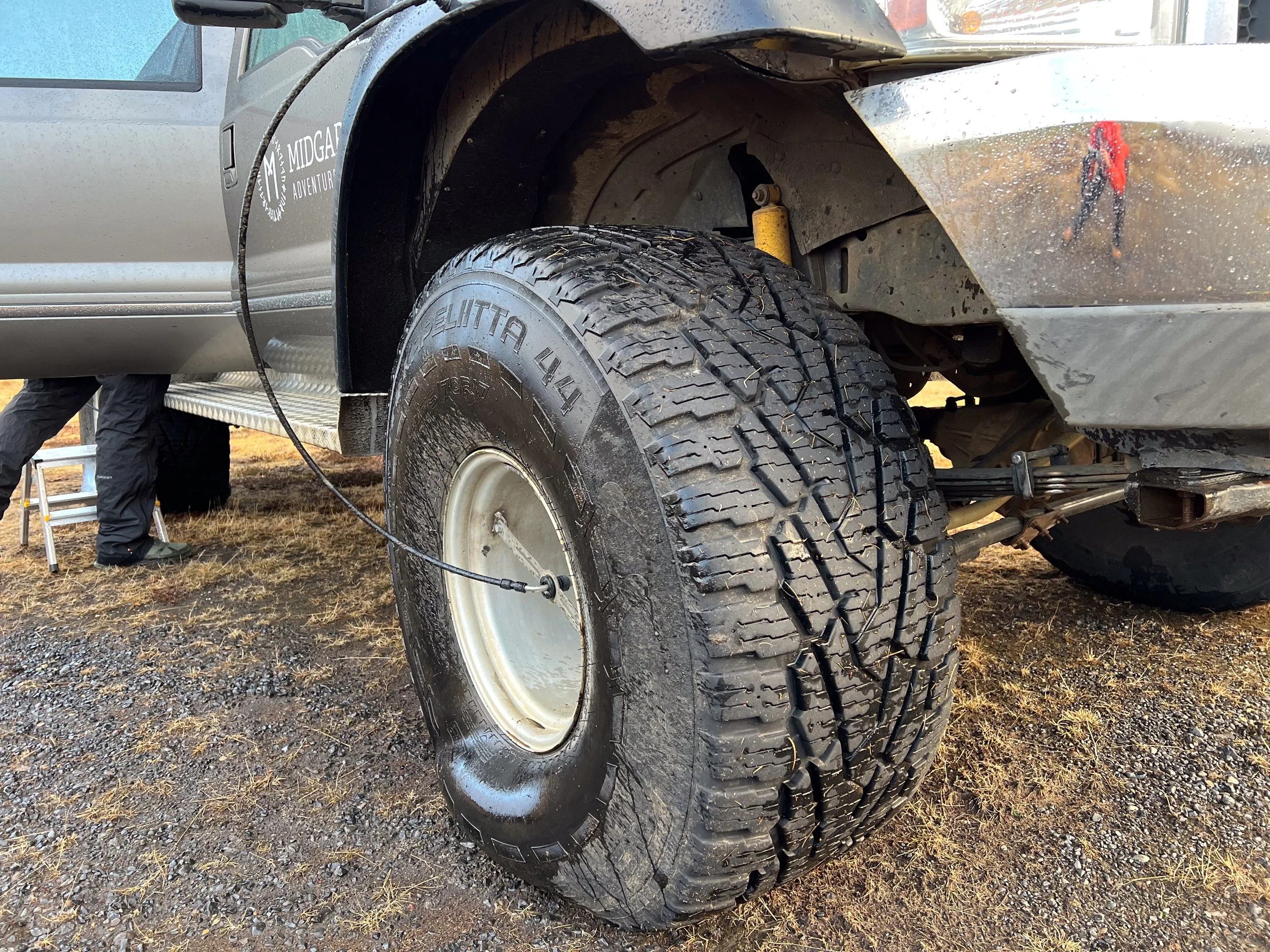
Not a flat—low tire pressure for navigating rocks and rivers. Note the tube leading from the truck's chassis to the tire. I was fascinated by this system, which allows the driver to change the tire pressure from inside the cab.
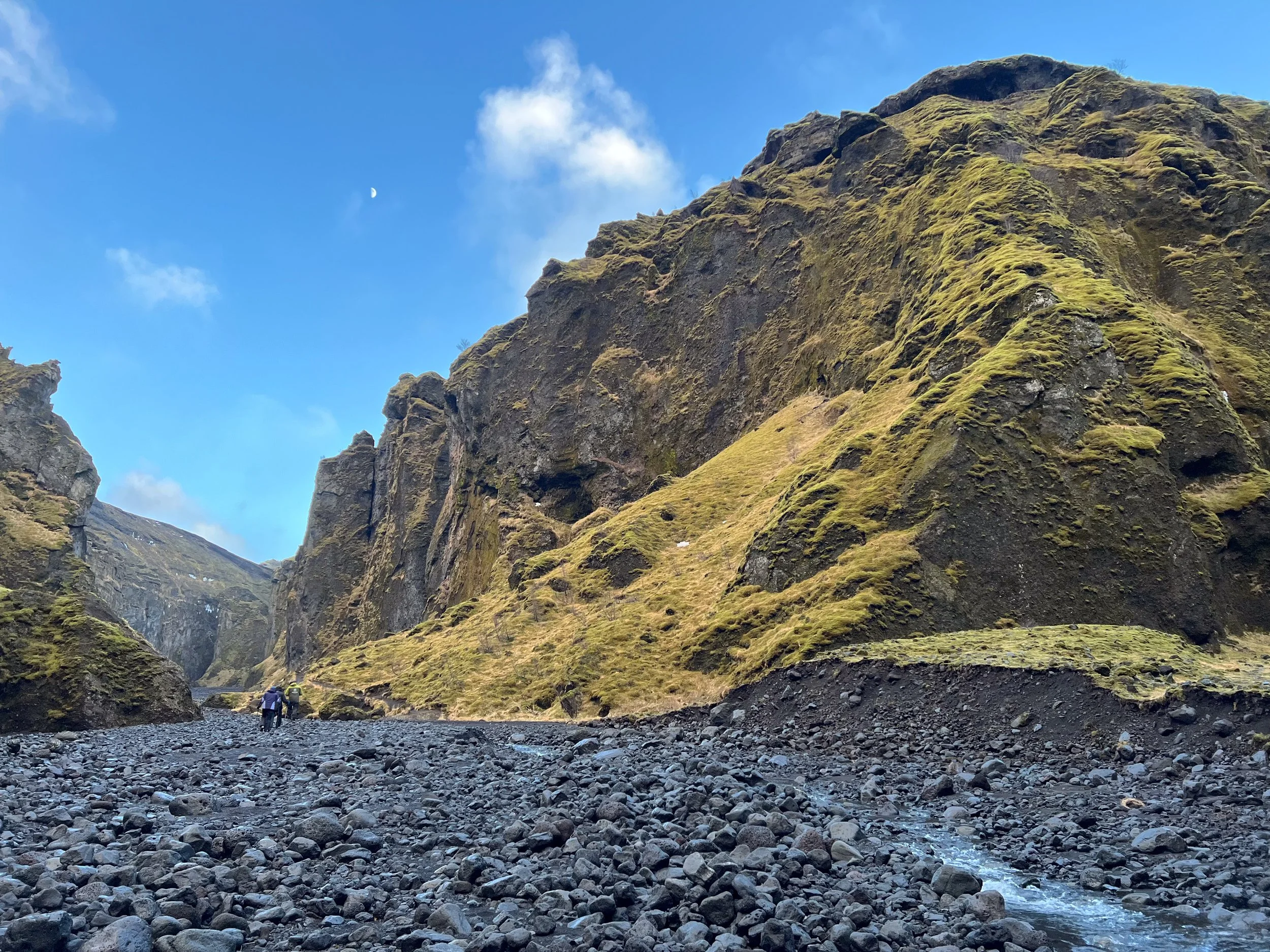
Moon Over Stakkholtsgjá Canyon
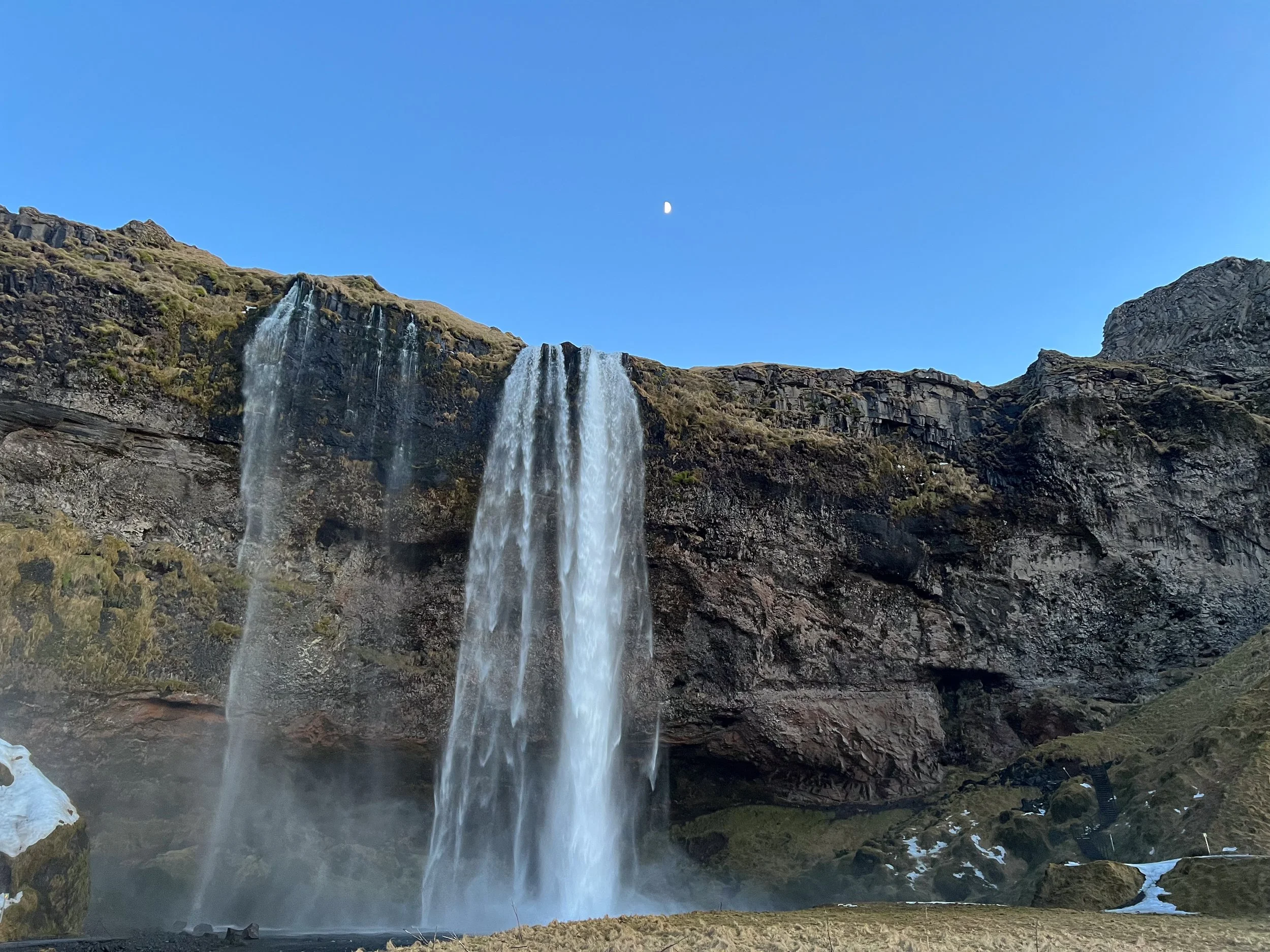
Seljalandsfoss
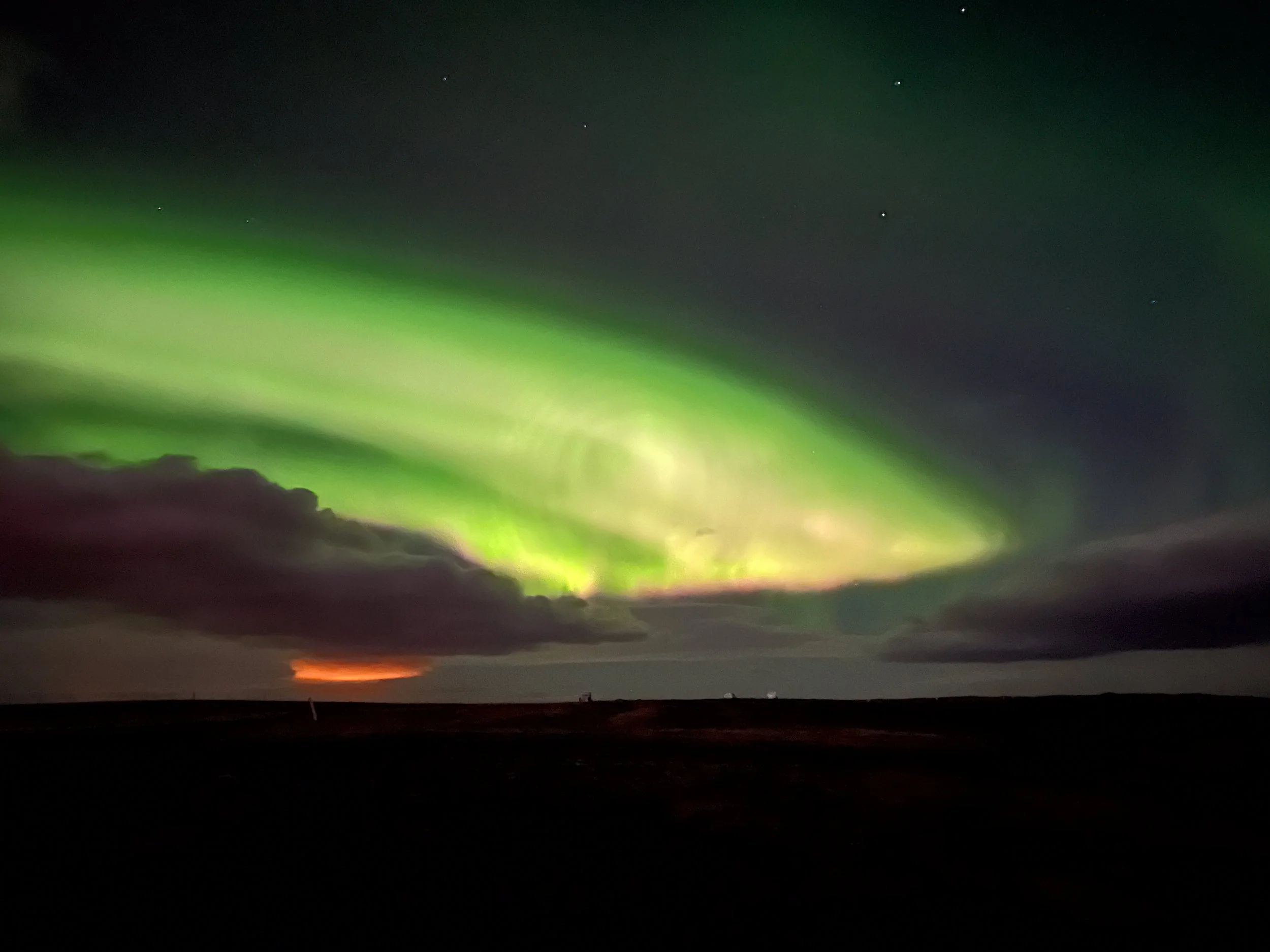
Northern Lights at Hotel Ranga. The reality is that the colors, as seen by the human eye, were not nearly as vivid.
Listen to the Wind!
All my photos and videos were taken on an iPhone 13 Pro. I was using my tripod when I filmed this, but you will still notice some camera shake because even though I was leaning on the tripod to stop it being blown into the far distance, it was not enough to keep it perfectly steady!
January 27th, Day 3:
We Actually Follow Plan A
Today we were able to follow the planned itinerary, and it was a busy one! Our first stop was Gullfoss, a huge series of cascading waterfalls. It was stunning, but the winds were still gale-force (according to the Beaufort scale, gale force winds “impede walking,” and that’s what I estimate we were experiencing!), so we did not linger as long as I would have liked.
Nearby is the town of Geysir, and we stopped long enough to see a small eruption before moving on to have lunch in a tomato-growing greenhouse.
After lunch we visited Thingvellir National Park, the site of Europe’s oldest parliament, dating to 930AD. The divide between the Eurasian and North American tectonic plates runs through the park, so it also means we crossed from one side to the other. Current estimates are that the plates are drifting apart 2 cm per year.
Today we changed hotels again, moving on to Hotel Húsafell.
On the way to Gulfoss.
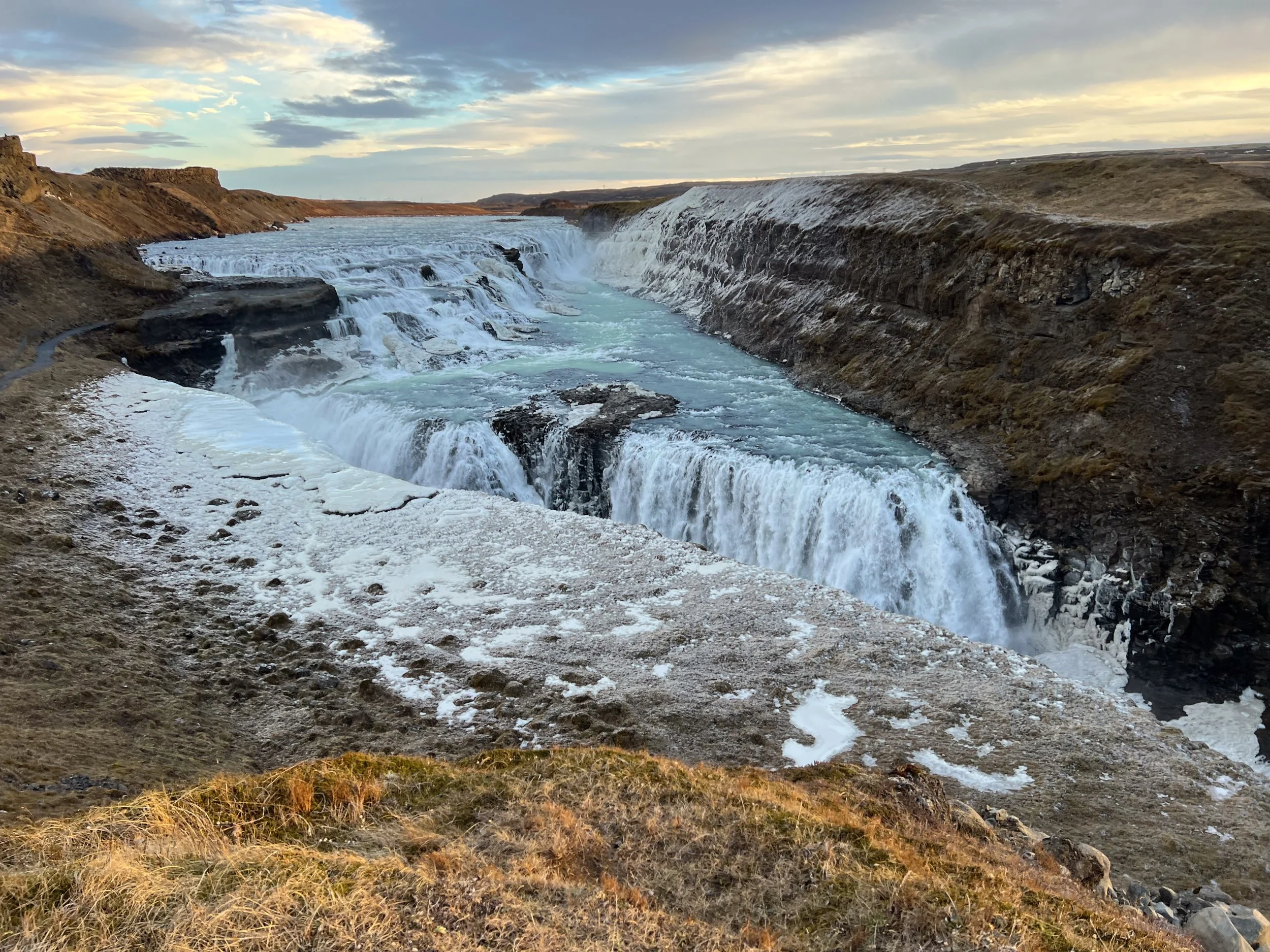
Gullfoss
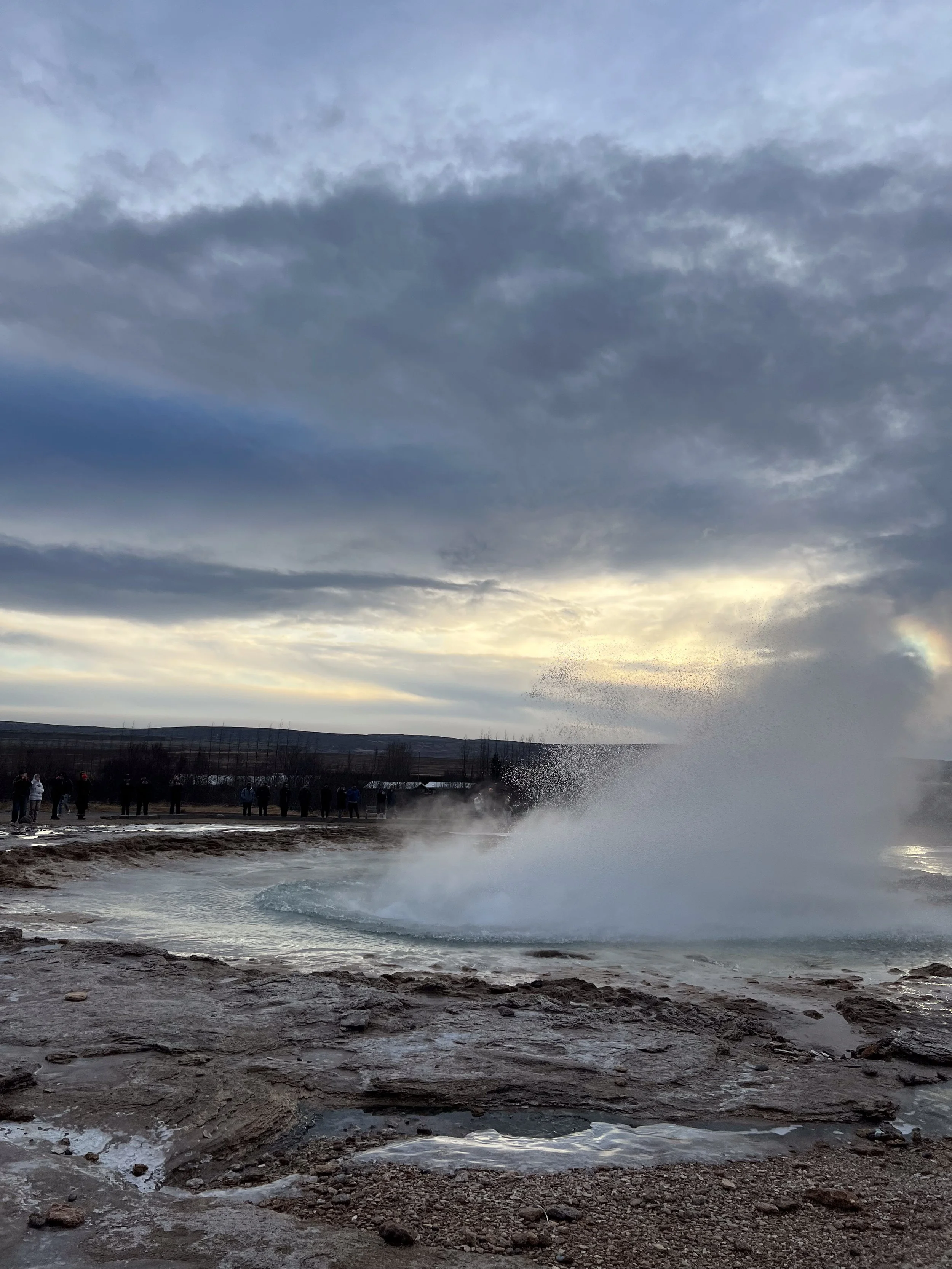
Geysir
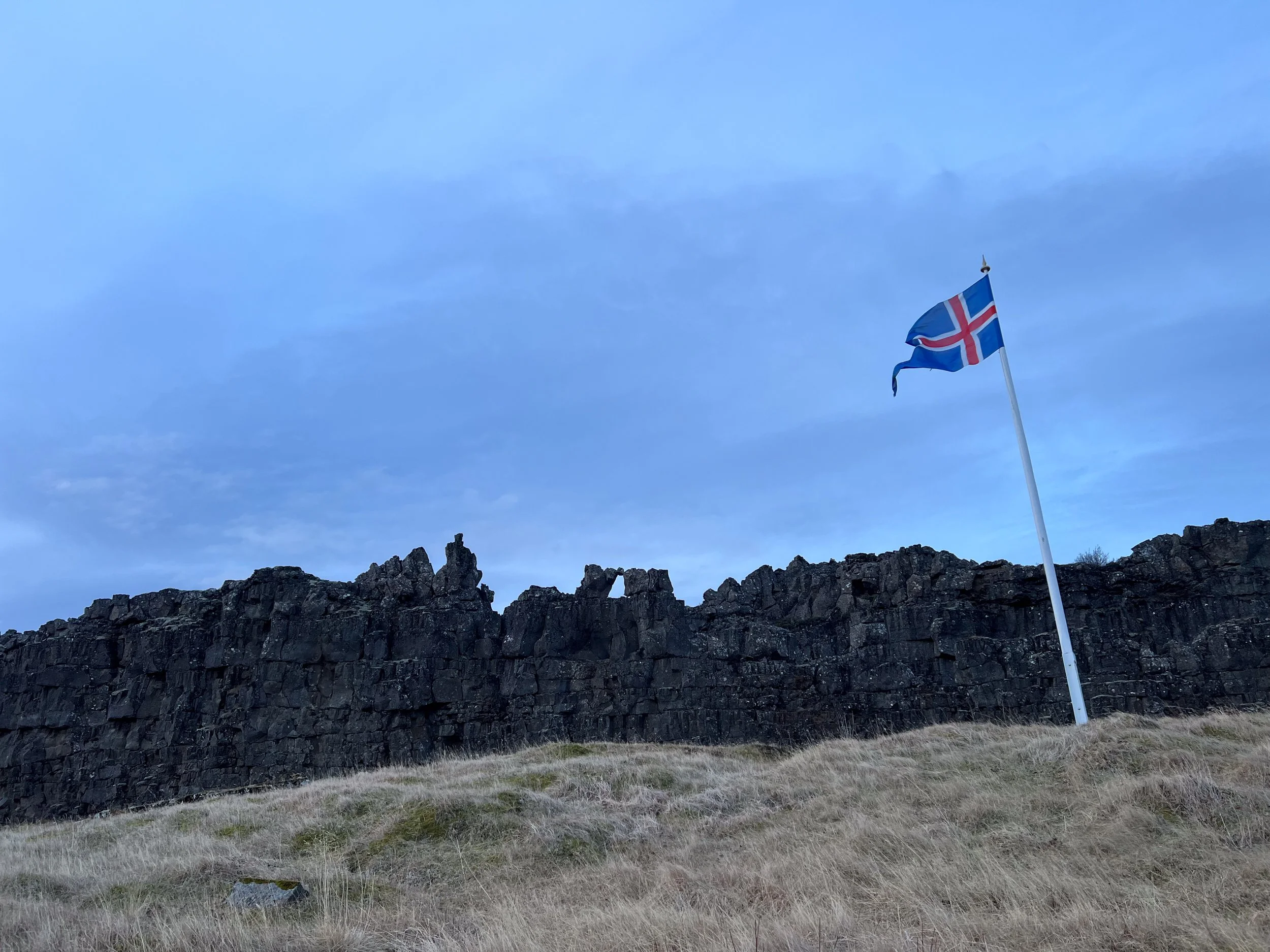
Thingvellier National Park
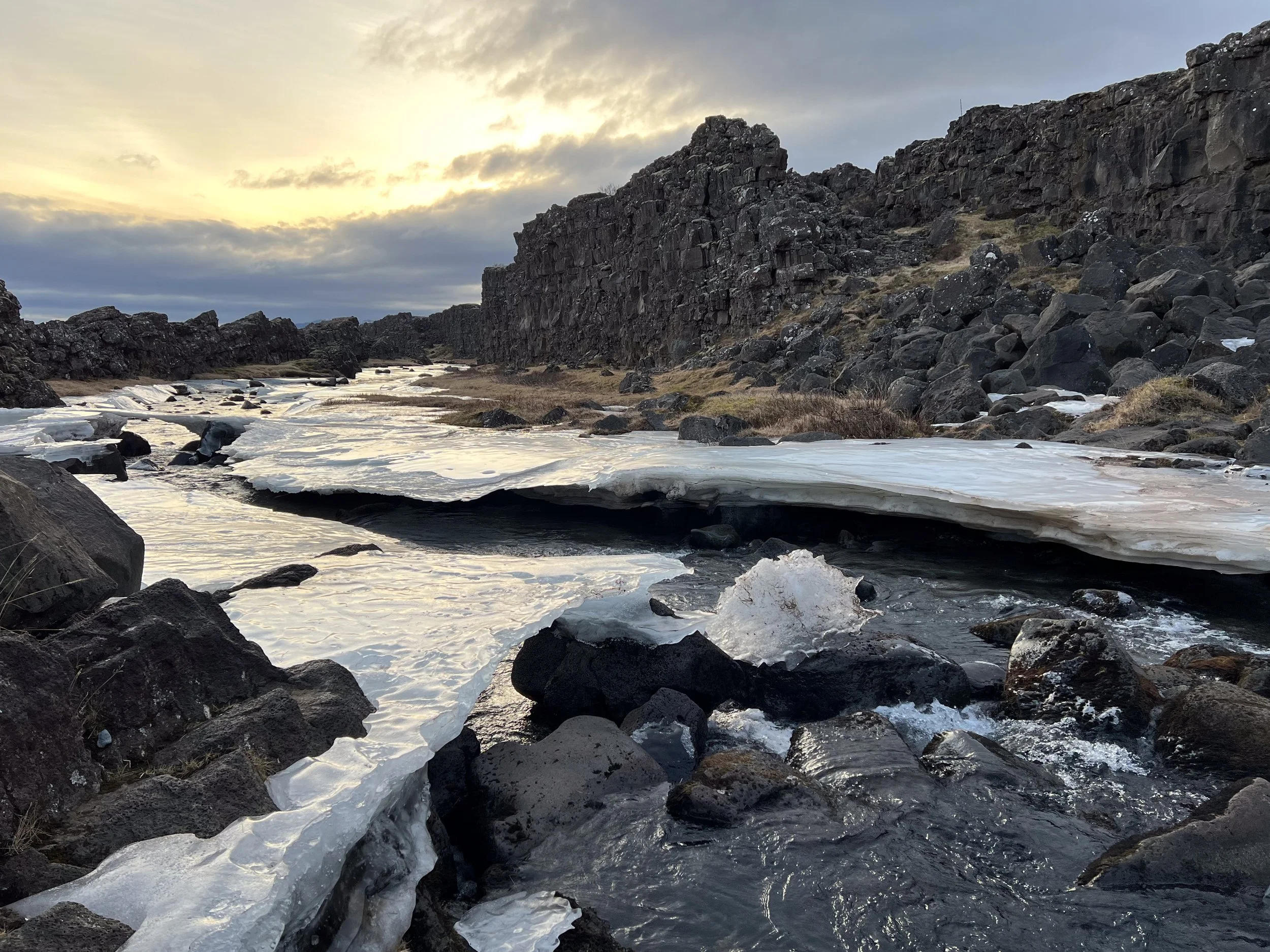
Thingvellier National Park
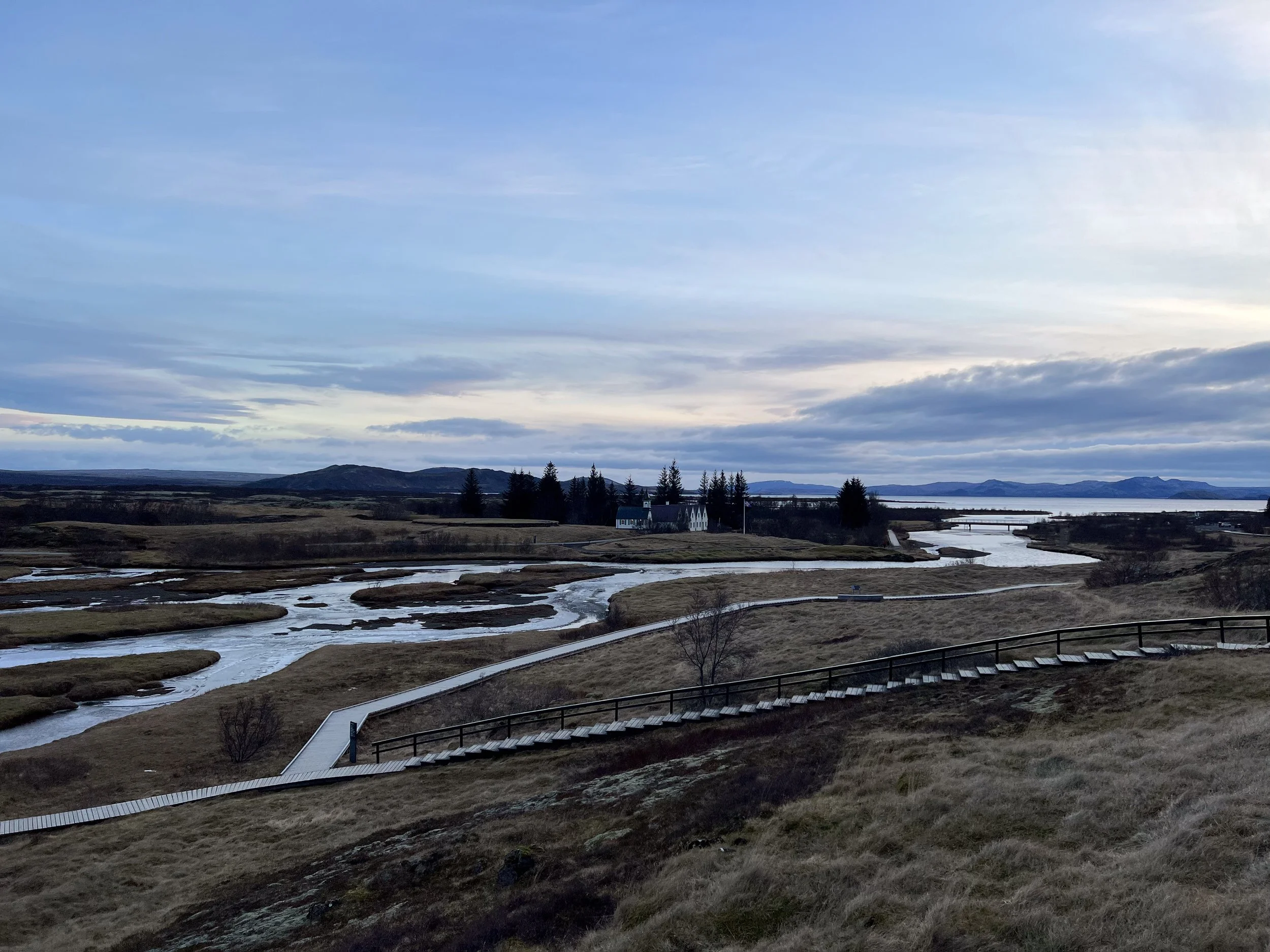
Thingvellier National Park. The building seen in the distance is the summer residence of the Prime Minister.
January 28th, Day 4:
Lava Tube, Hiking, Northern Lights
Hotel Húsafell is only a few minutes drive from the Hallmundarhraun lava field, underneath which is the Vidgelmir lava tube - at 1.5 miles long, it is the largest in Iceland. We had a tour of the lava tube in the morning, and in the afternoon we hiked a nearby hill overlooking Baejargil canyon.
Tonight we had our best northern lights show! Ragnar, our trip leader, was closely monitoring the aurora forecast via the excellent IcelandAtNight website, and it turned out that the lights started during dinner (conveniently in between the main and dessert courses!), so we all dashed off to grab coats (and tripod in my case) and headed outside. It wasn’t the most spectacular display ever, but it was wonderful and our little group was happy!
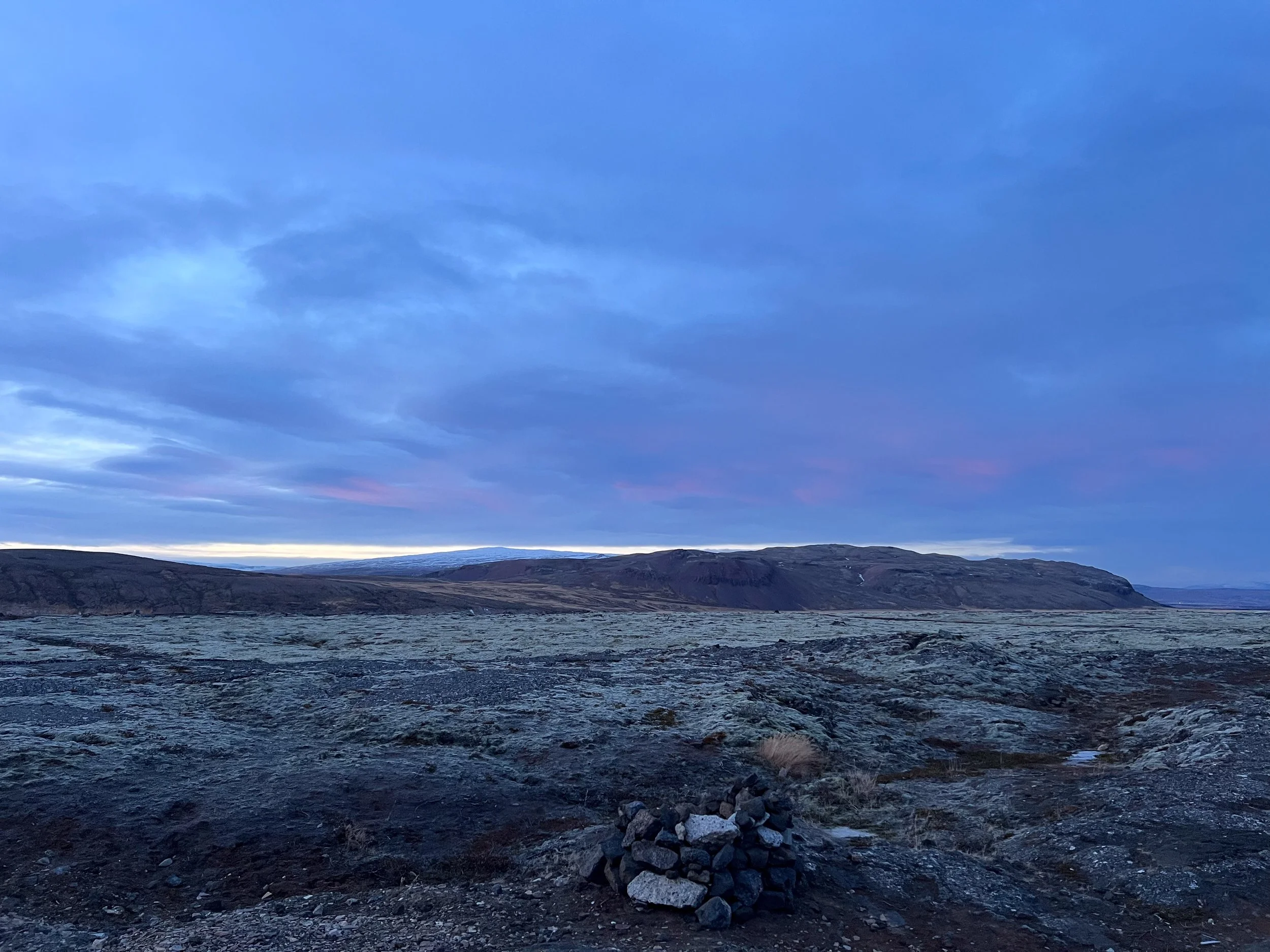
Hallmundarhraun Lava Field
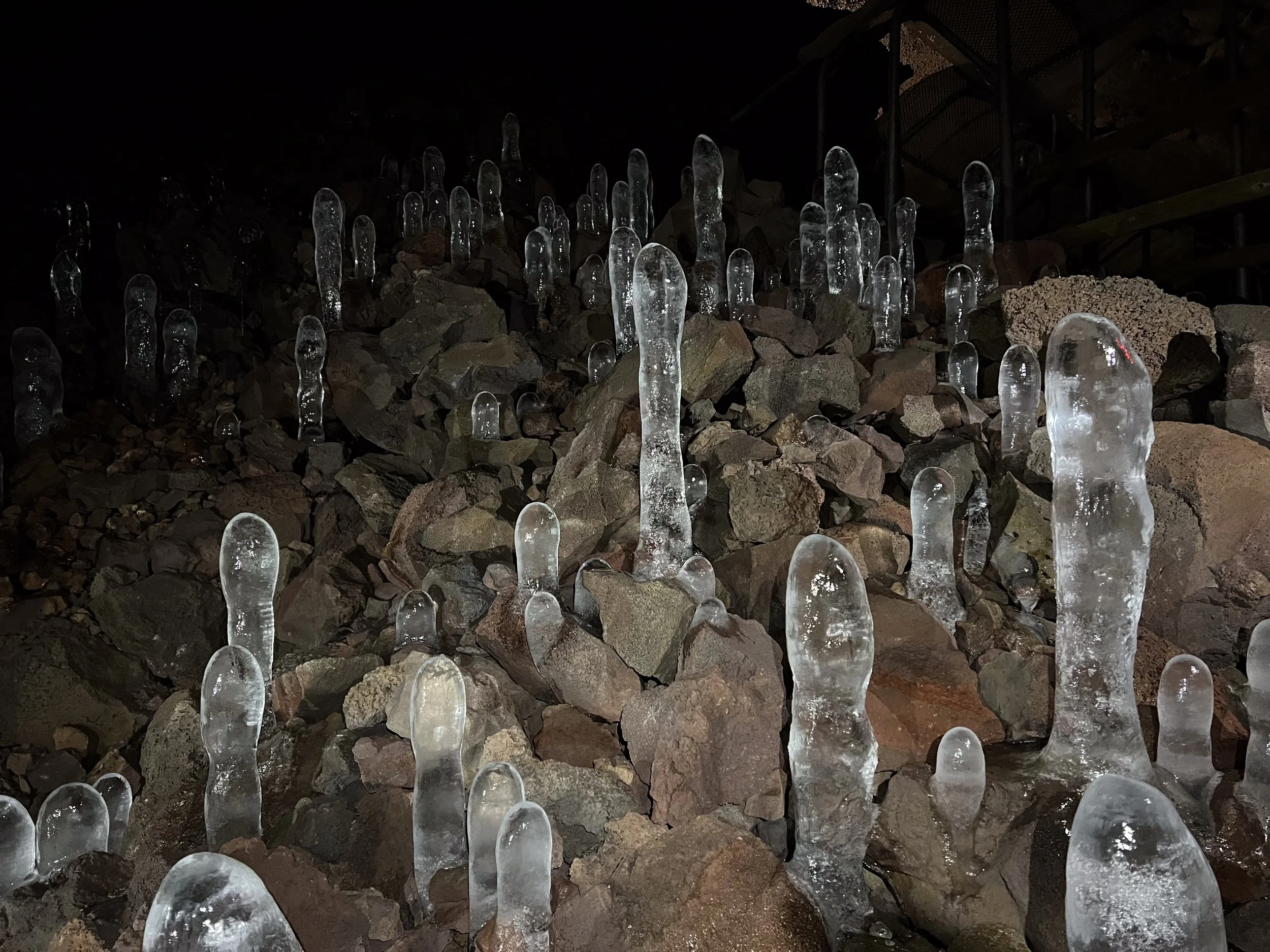
Ice Stalagmites in the Lava Tube
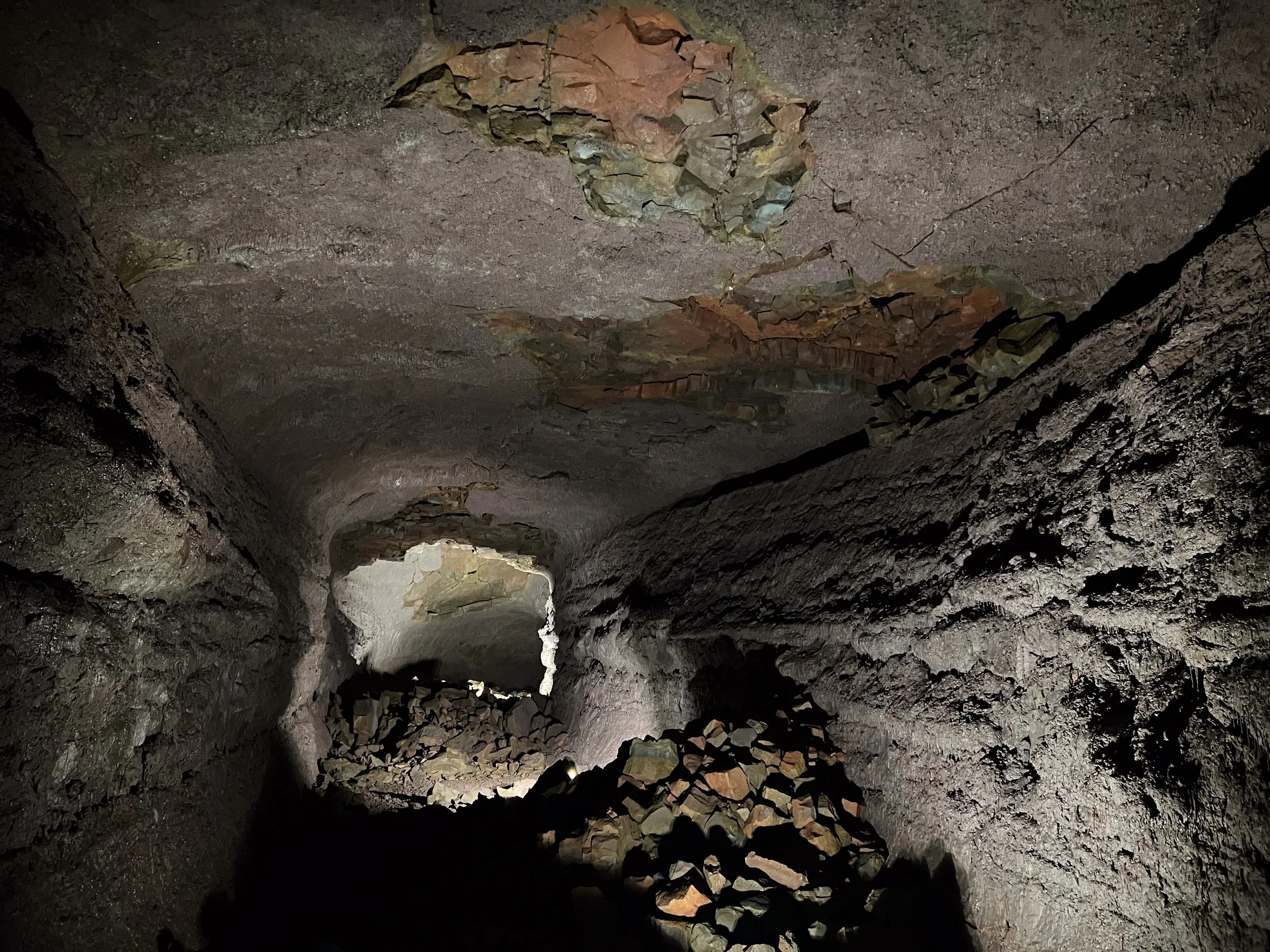
Vidgelmir Lava Tube
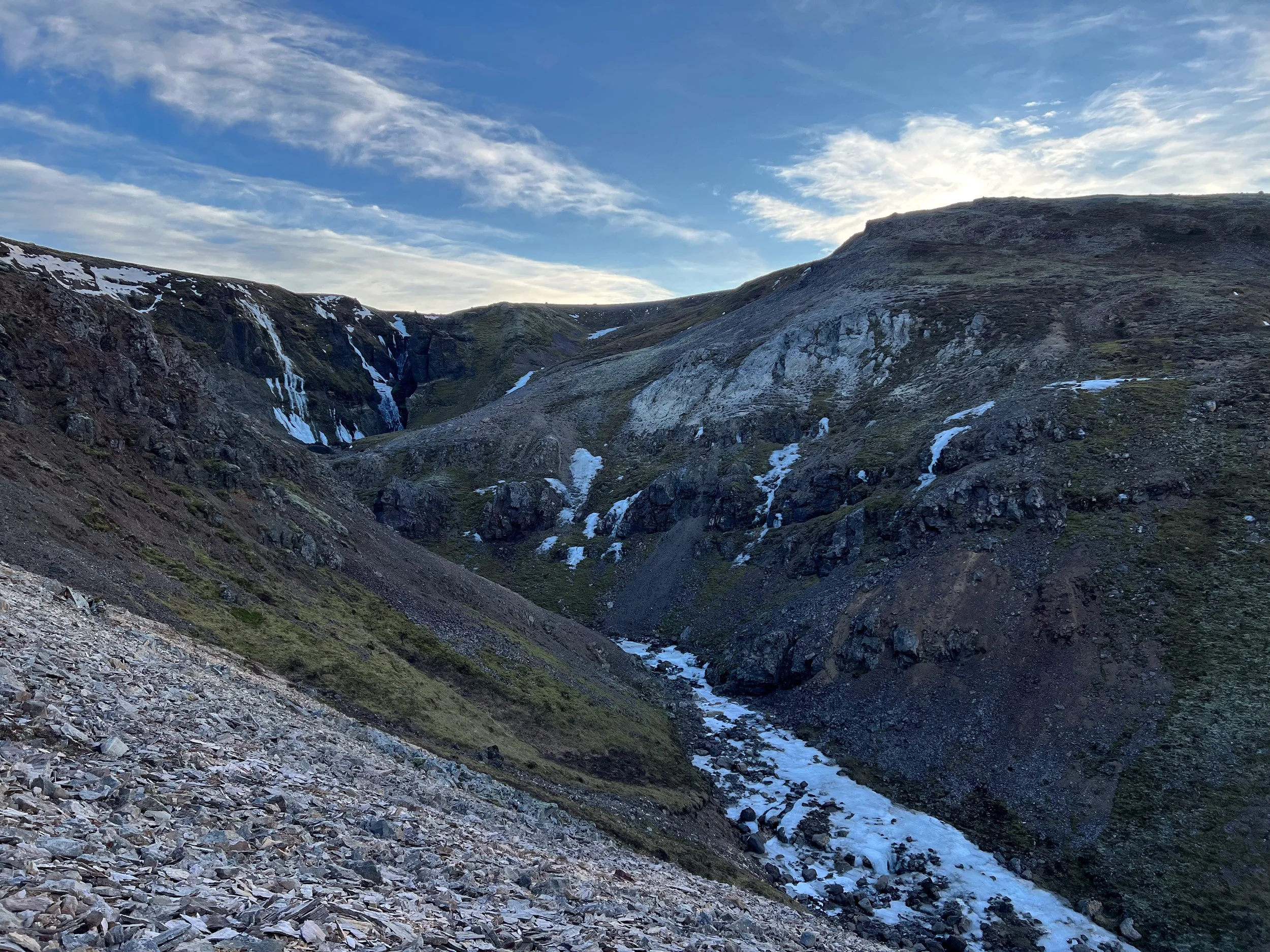
Baejargil Canyon Hike
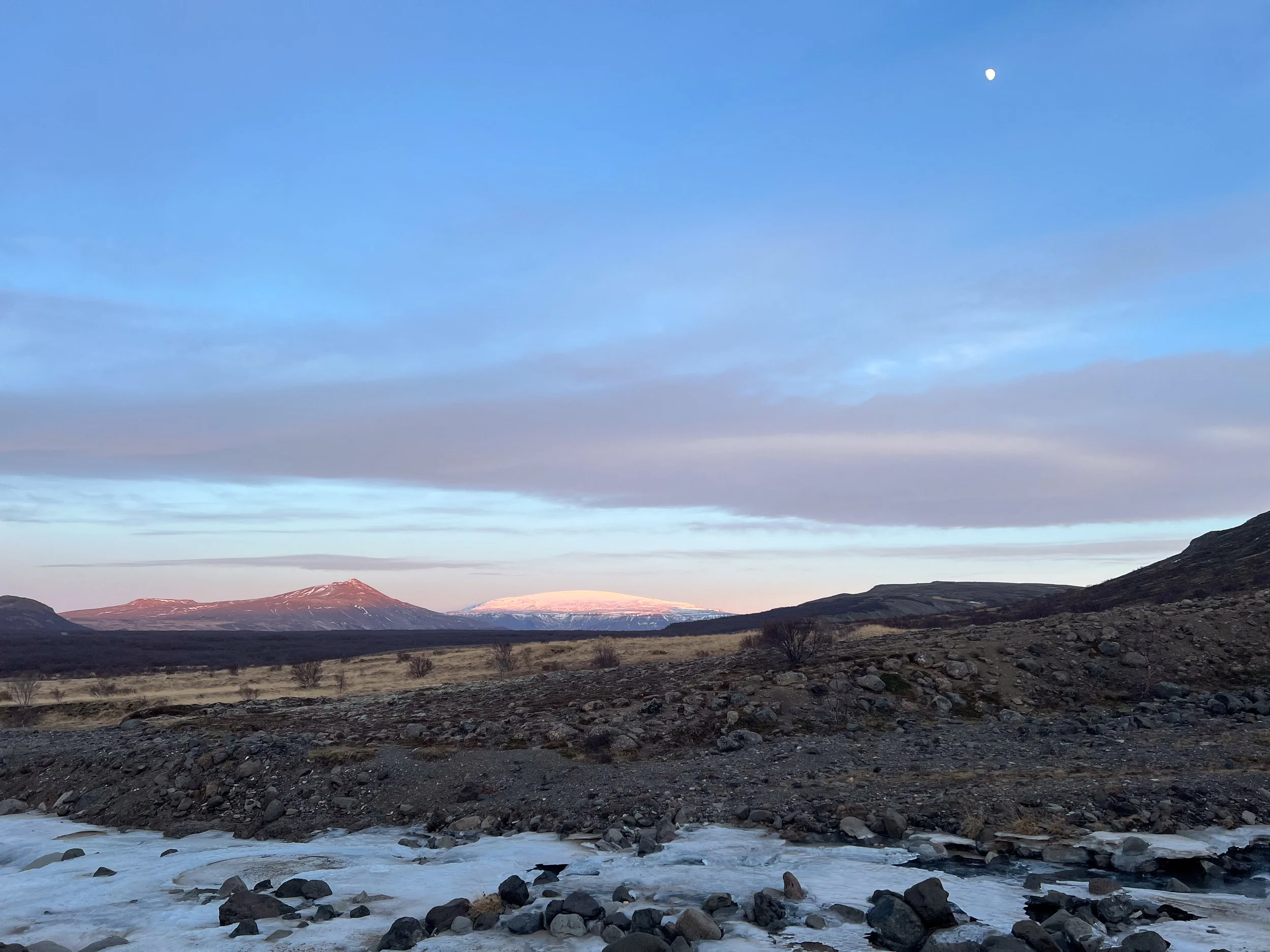
Moon and Sunset Over Eiriksjökull
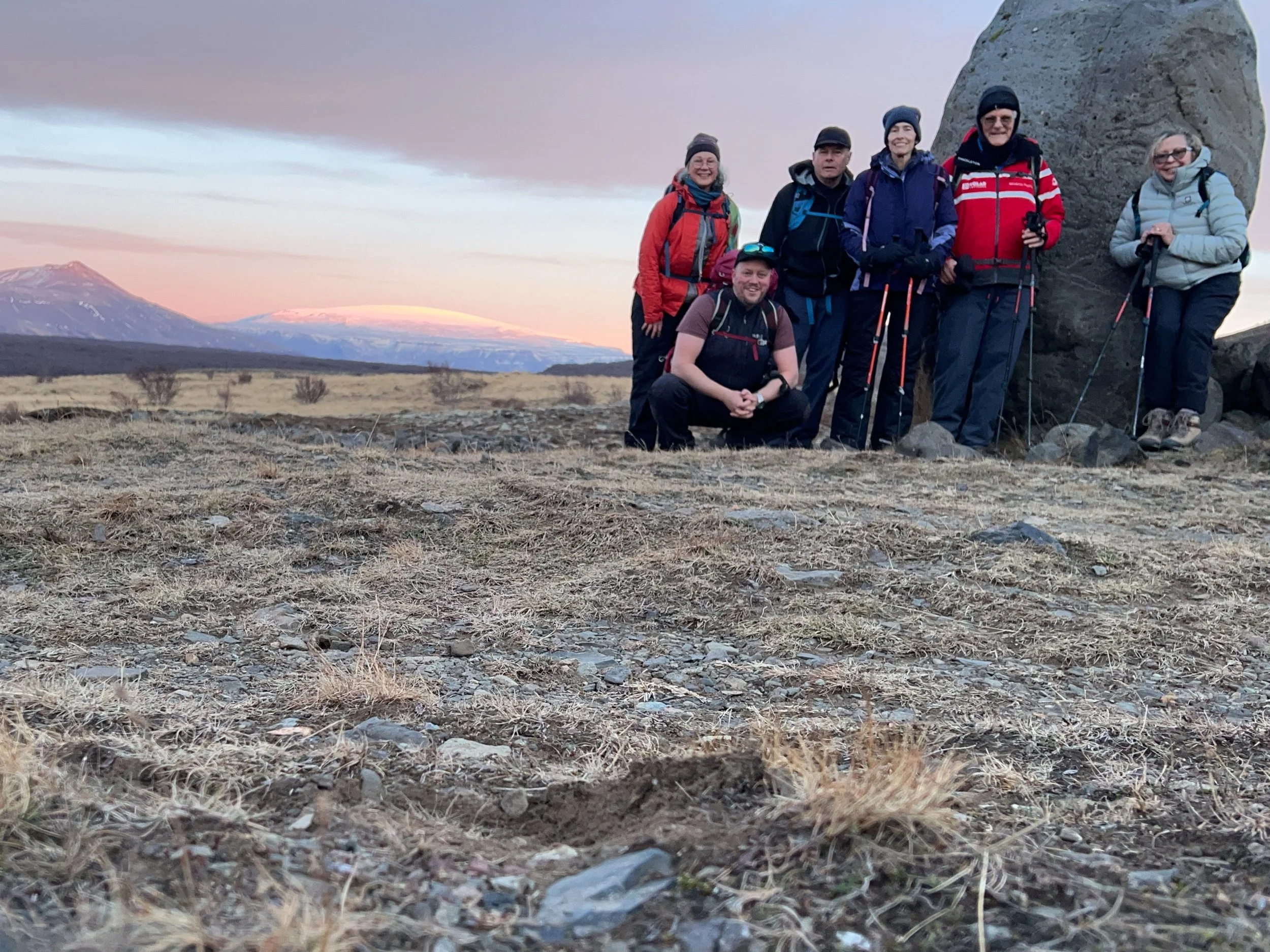
Our group after the Baejargil hike. Can you guess which one of us is Icelandic? Eiriksjökull is in the distance, rosy-hued by the sunset.
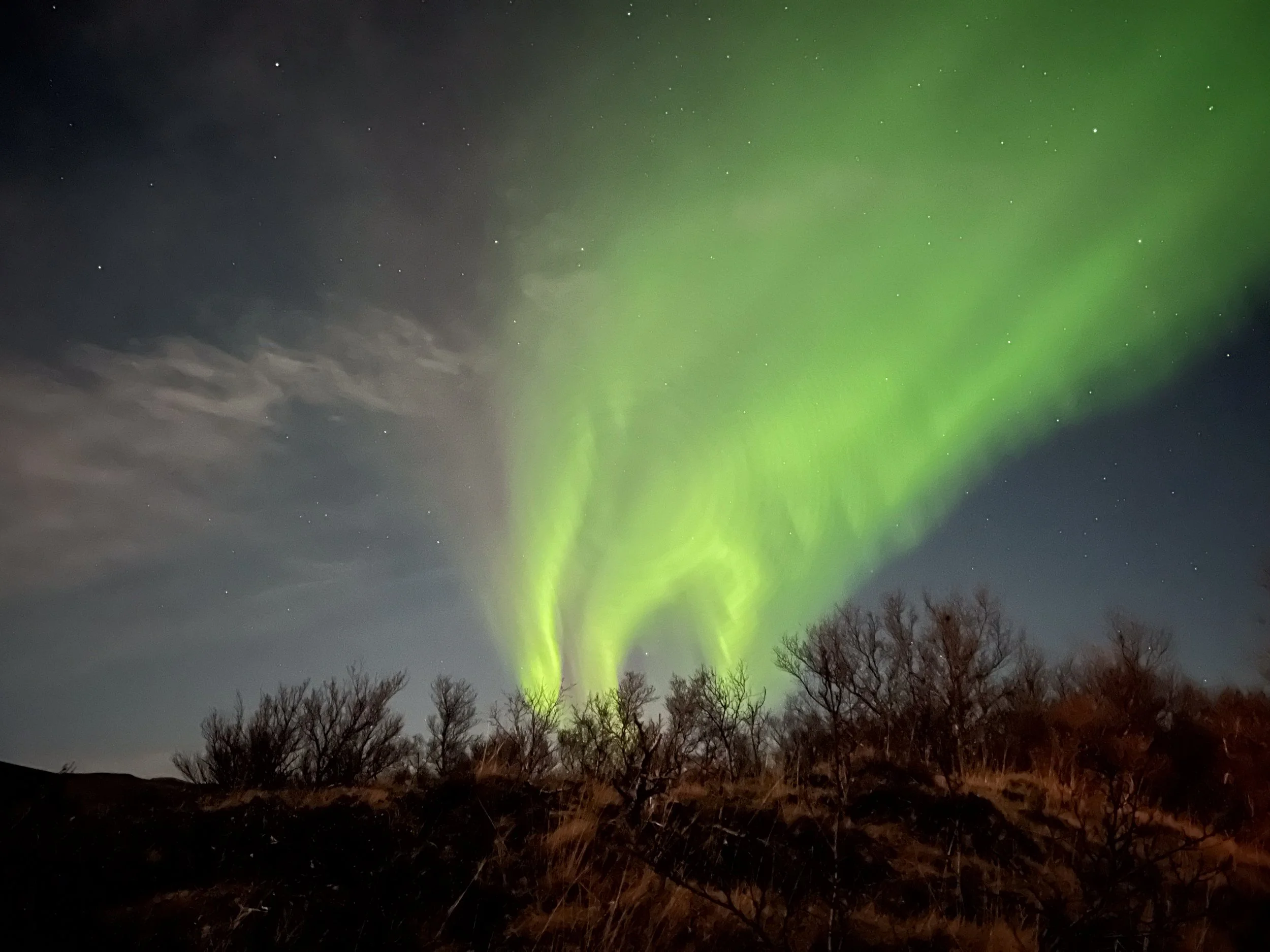
Northern LIghts
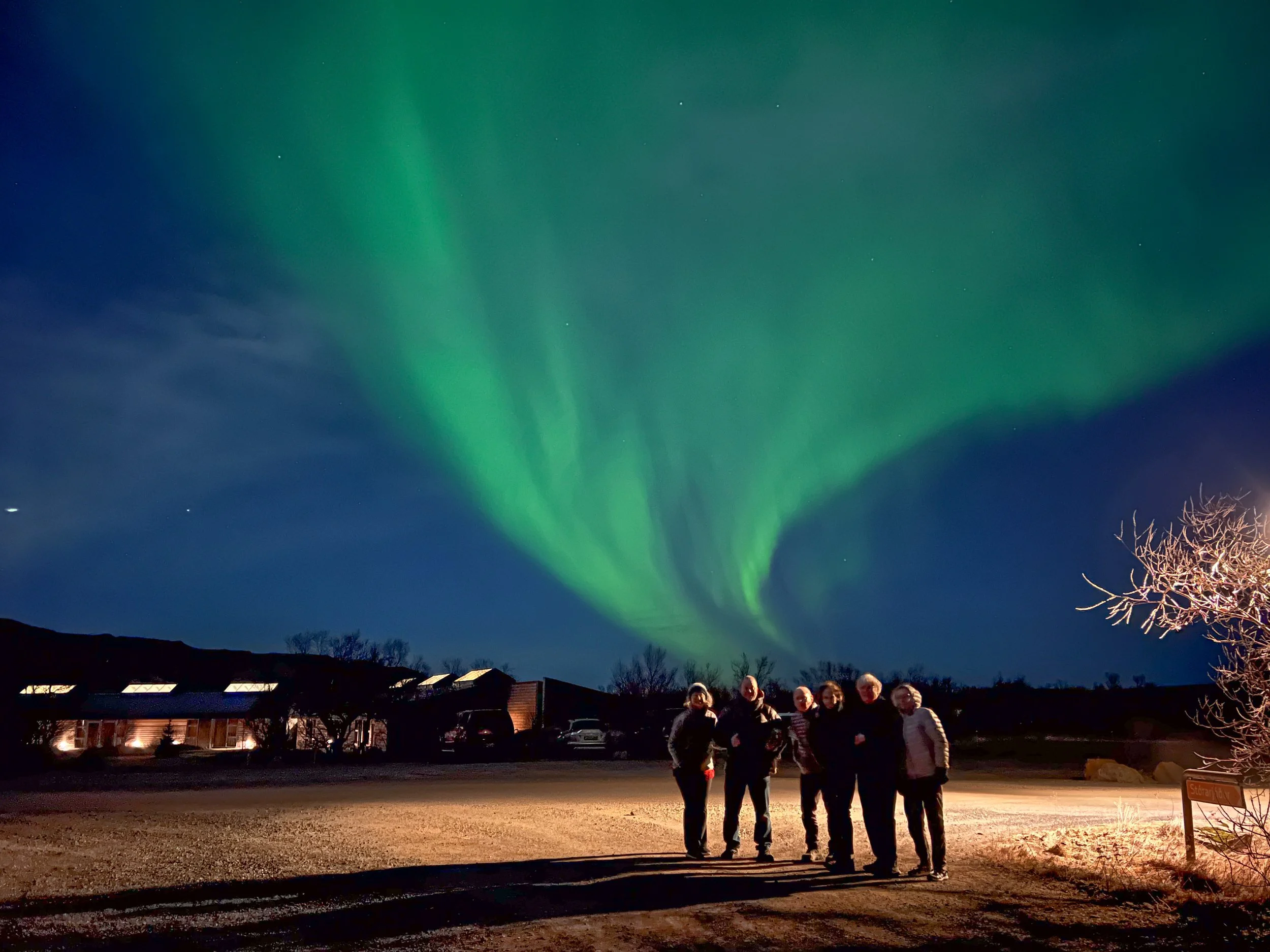
Our Group
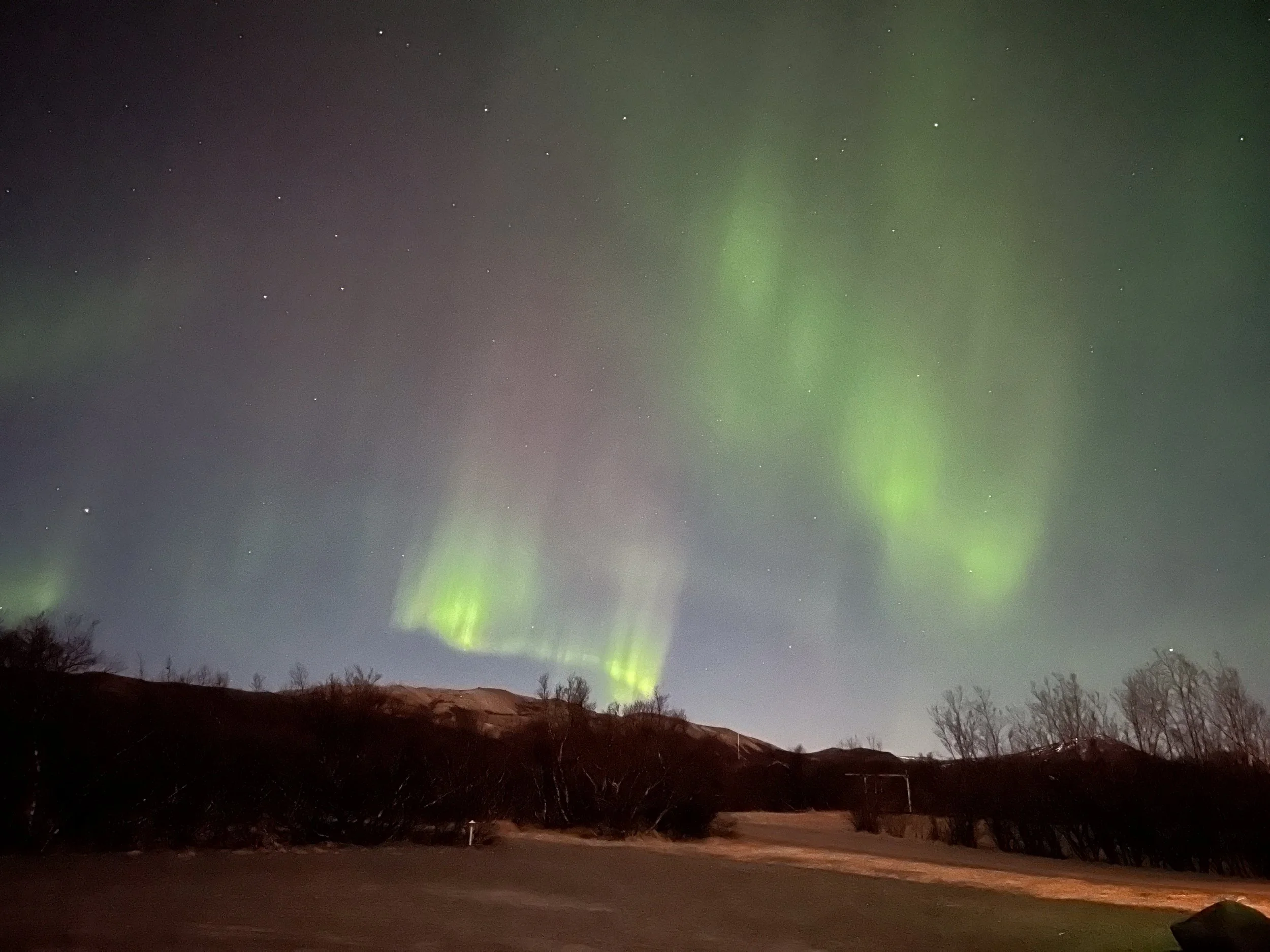
Northern LIghts
January 29th, Day 5:
Lava Falls, Thermal Pools & Cold Plunges, More Lava Fields
We left Hotel Húsafell this morning to make our way to our next destination, Hotel Búdir, at the western tip of the Snaefellsnes Peninsula. It was our coldest morning so far, 19°F (-7°C), but it was a lovely sunny day so it soon warmed up. Our first stop was the Lava Falls (Hraunfossar), which are the most beautiful falls I have ever seen. Not the tallest or widest, but the water tumbling from black lava into brilliant turquoise water was just gorgeous.
After the falls we stopped in Reykholt to visit Snorri’s Pool before arriving at Krauma Thermal Spa. The pool is named after Snorri Sturluson, who was a famous Icelandic poet, historian and politician who lived during the 13th century. Wikipedia says “He was elected twice as lawspeaker of the Icelandic parliament, the Althing. He is commonly thought to have authored or compiled portions of the Prose Edda, which is a major source for what is today known about Norse mythology and alliterative verse, and Heimskringla, a history of the Norse kings that begins with legendary material in Ynglinga saga and moves through to early medieval Scandinavian history. For stylistic and methodological reasons, Snorri is often taken to be the author of Egil's Saga. He was assassinated in 1241 by men claiming to be agents of the King of Norway.”
At Krauma we soaked in the geothermal pools—bliss! There was also a cold plunge—exhilarating!
After lunch at Krauma we were on the road again—next stop was the town of Borganes, which happens to be where Ragnar grew up.
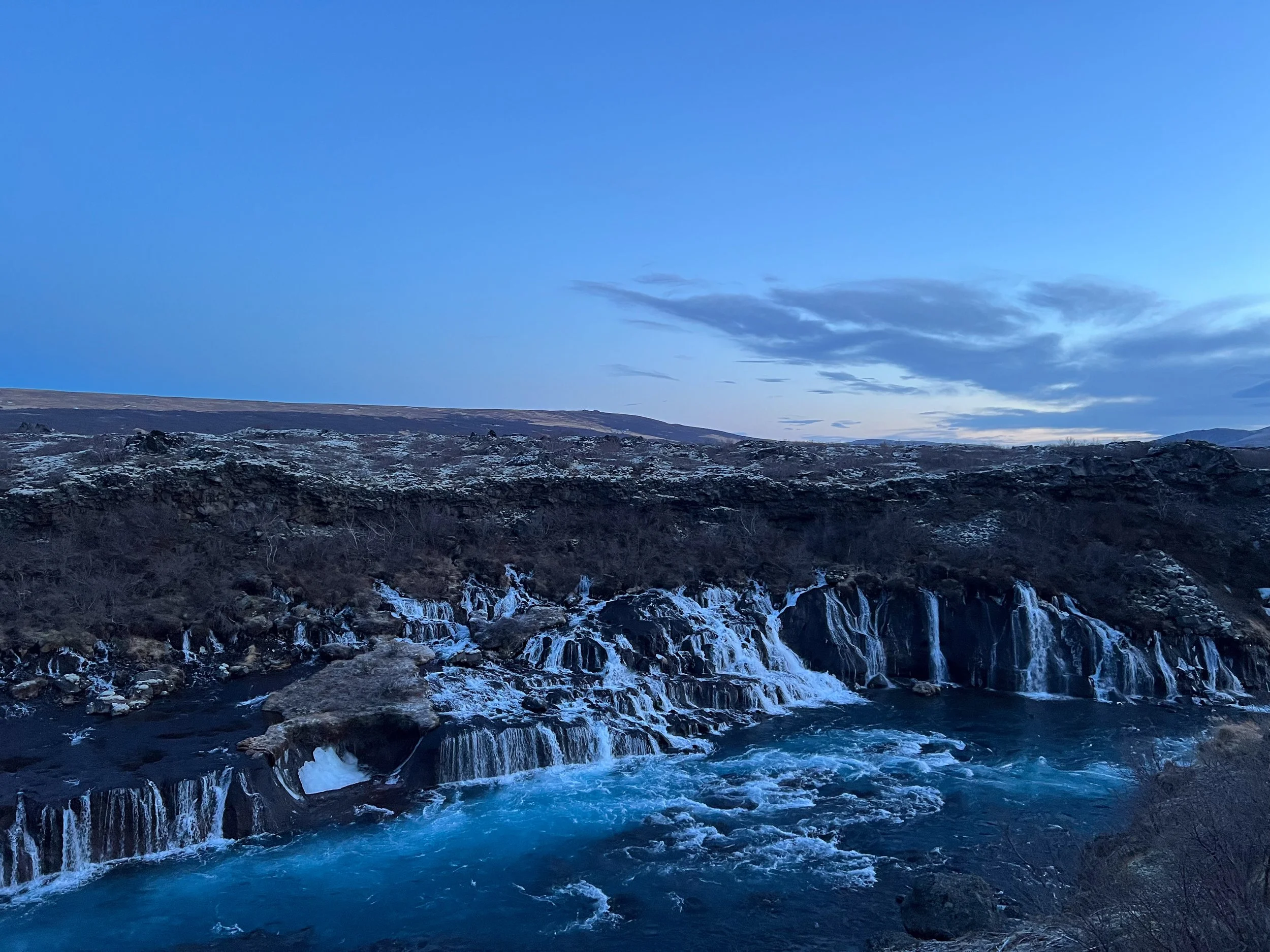
Lava Falls
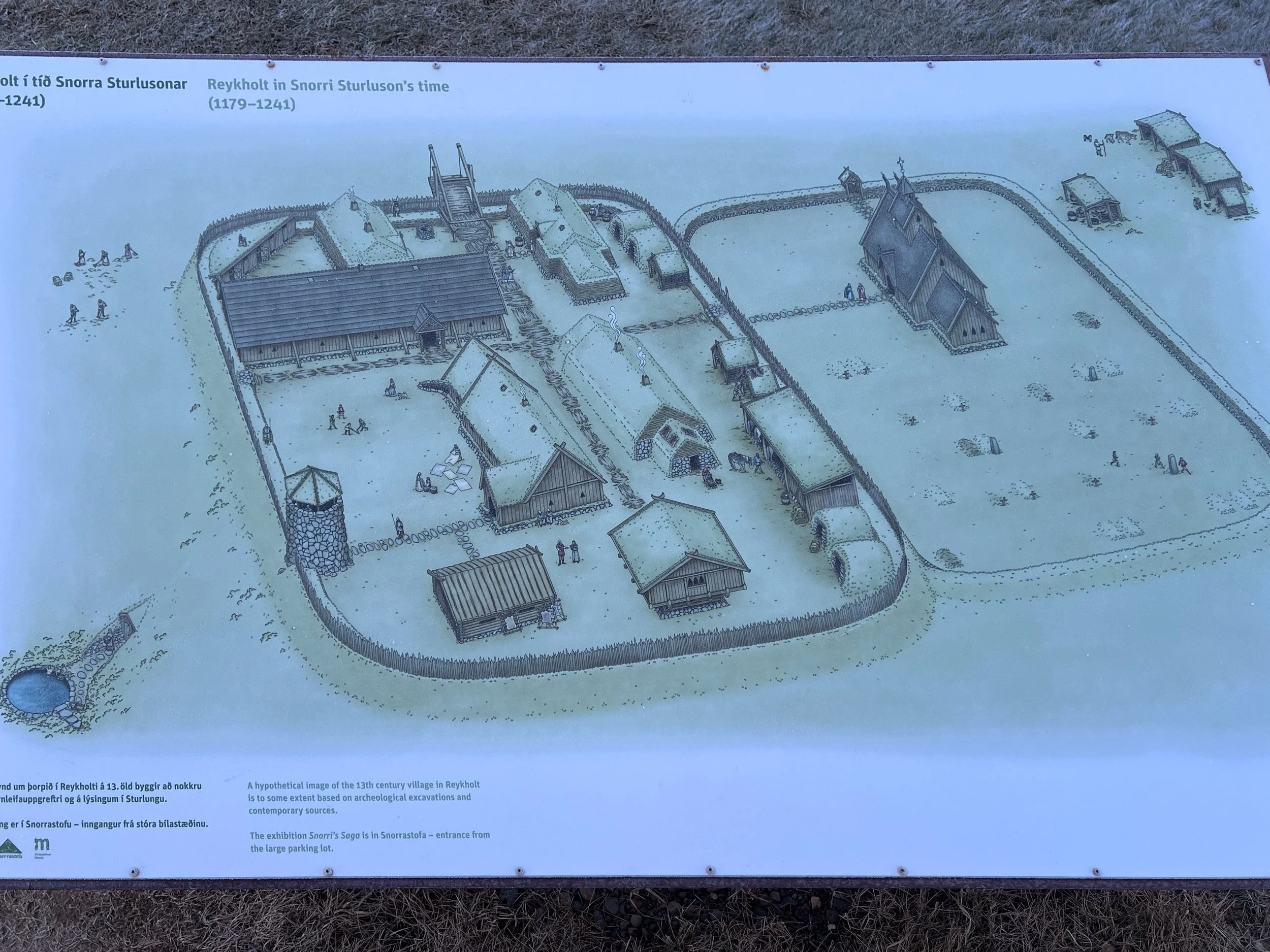
What the 13th century village in Reykholt might have looked like. Snorri's Pool, which still exists, is in the lower left.
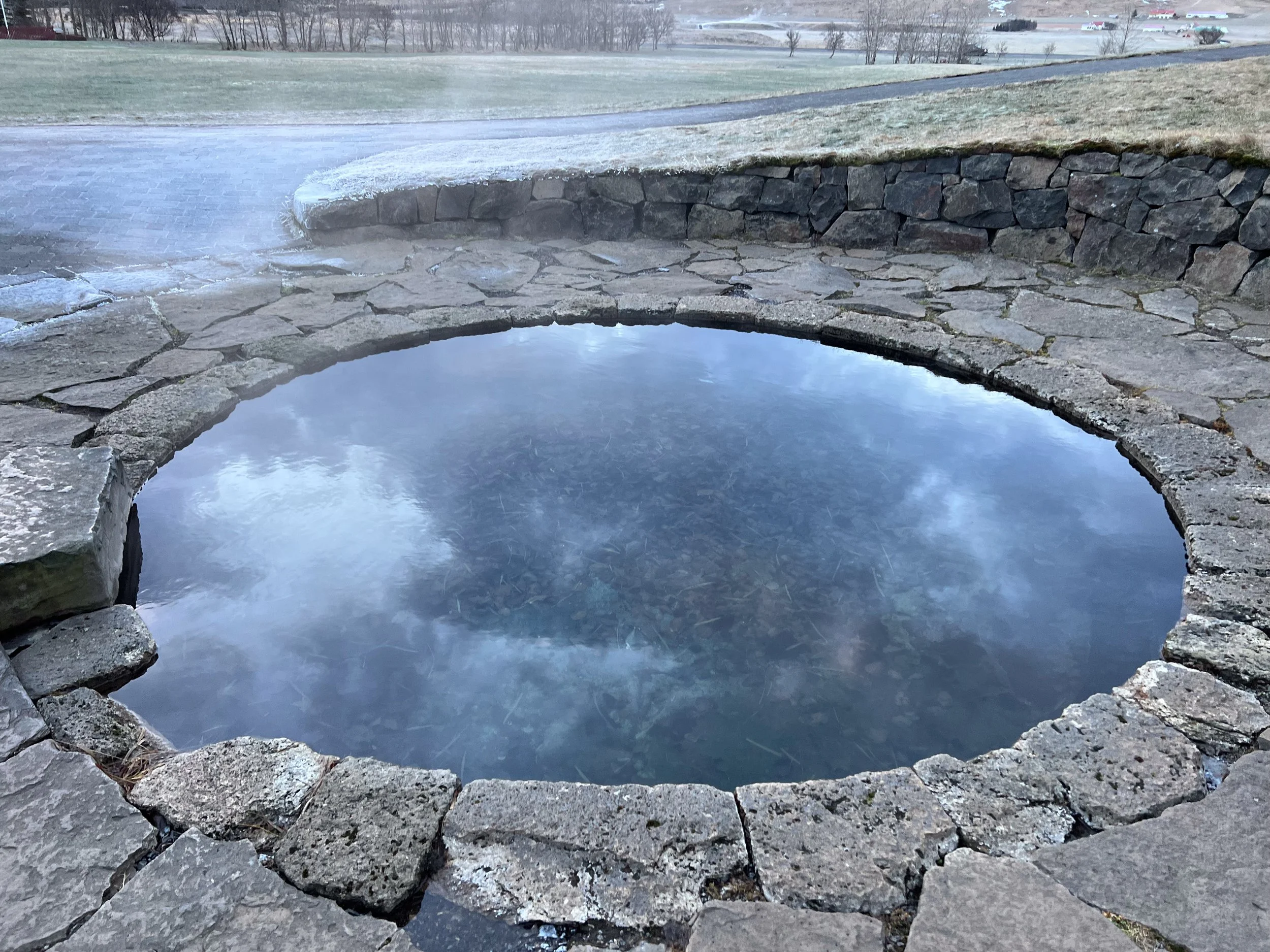
Snorri's Pool
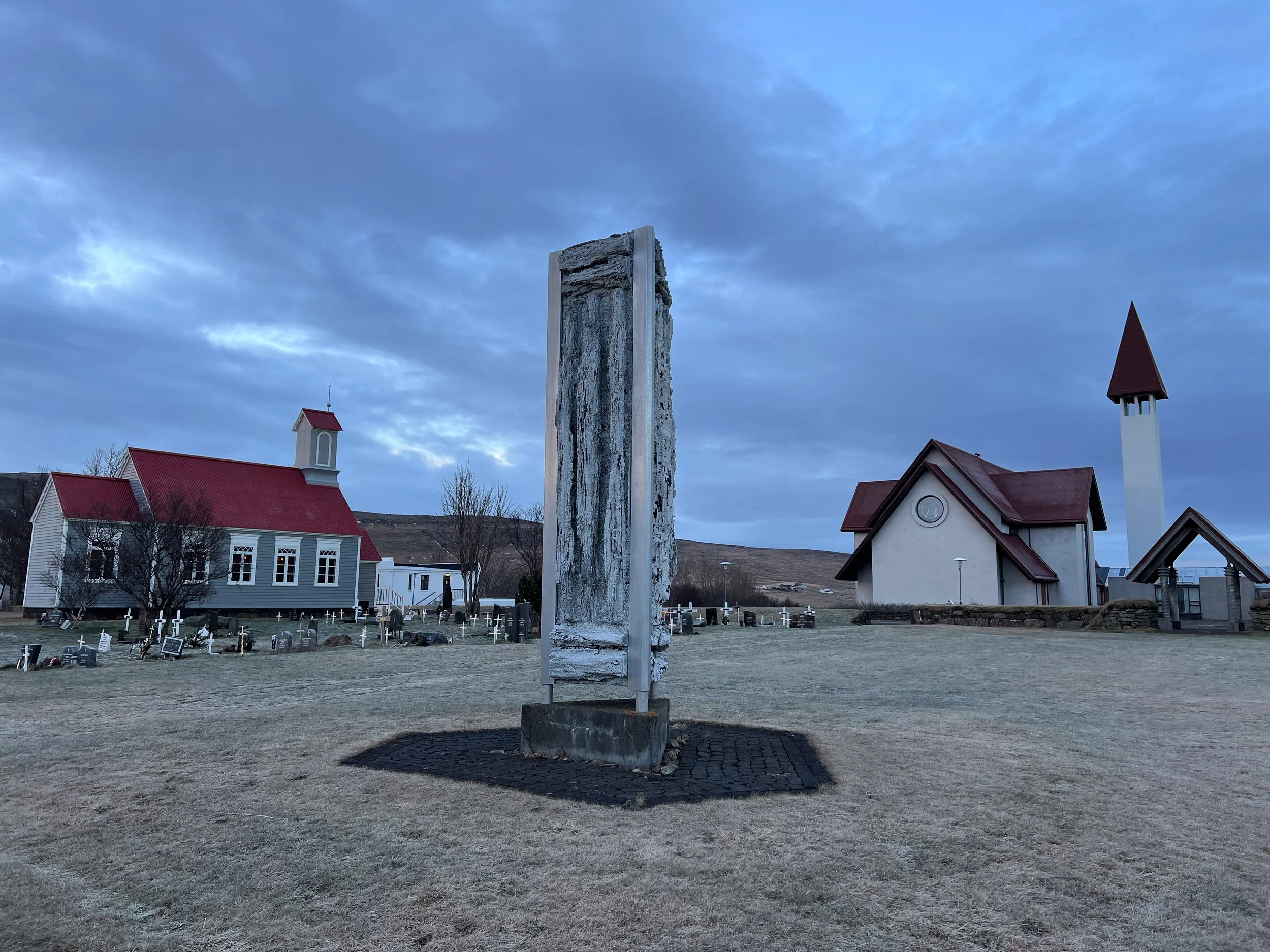
Sculpture using a piece of timber from the old medieval village.
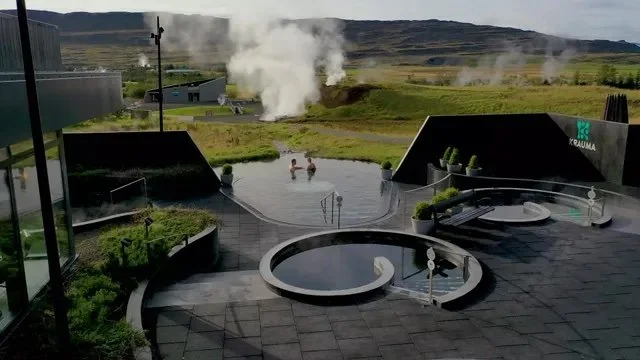
Krauma Geothermal Baths. This photo is courtesy of their website - I did not take my phone into the pools!
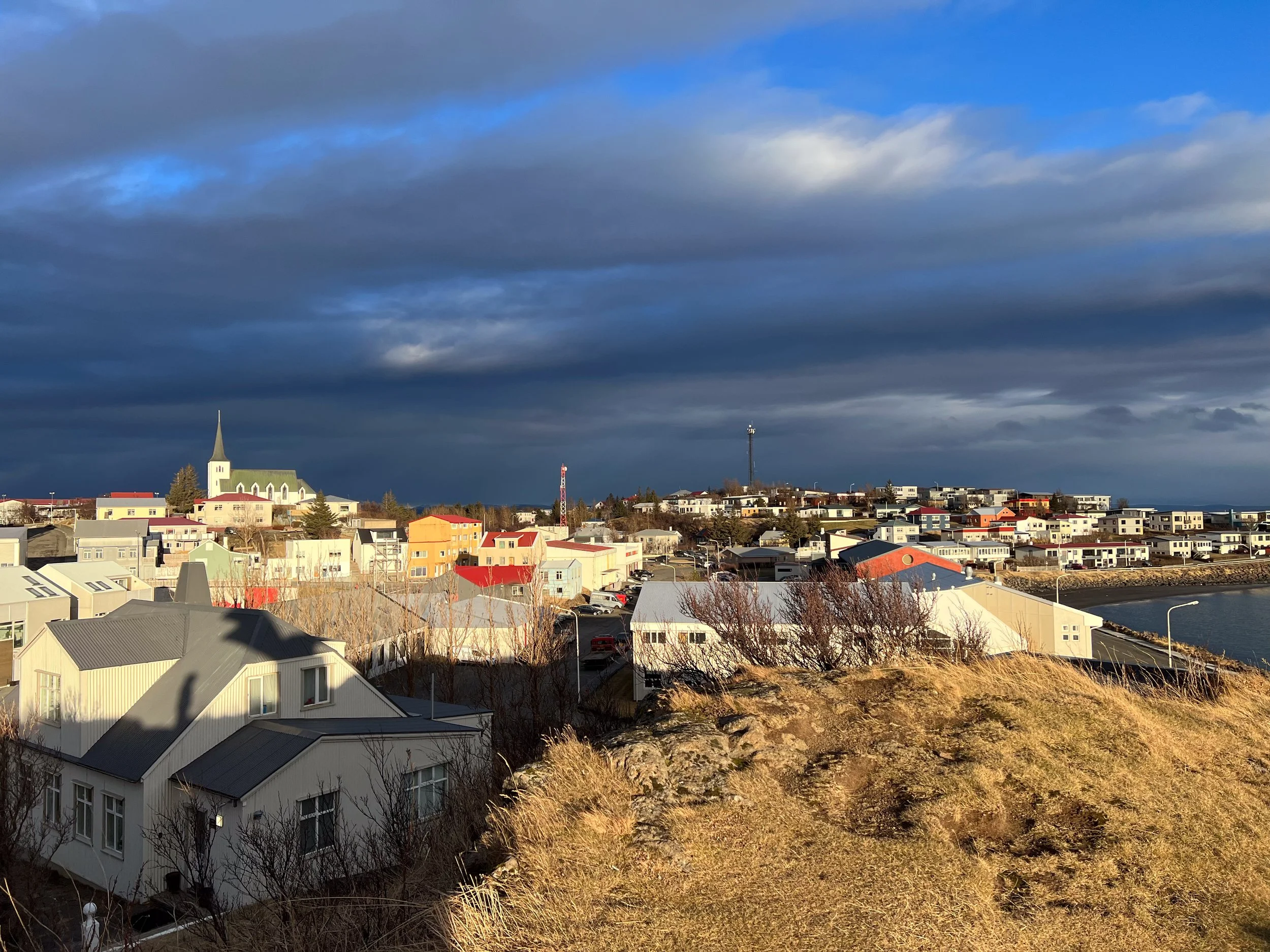
Borganes
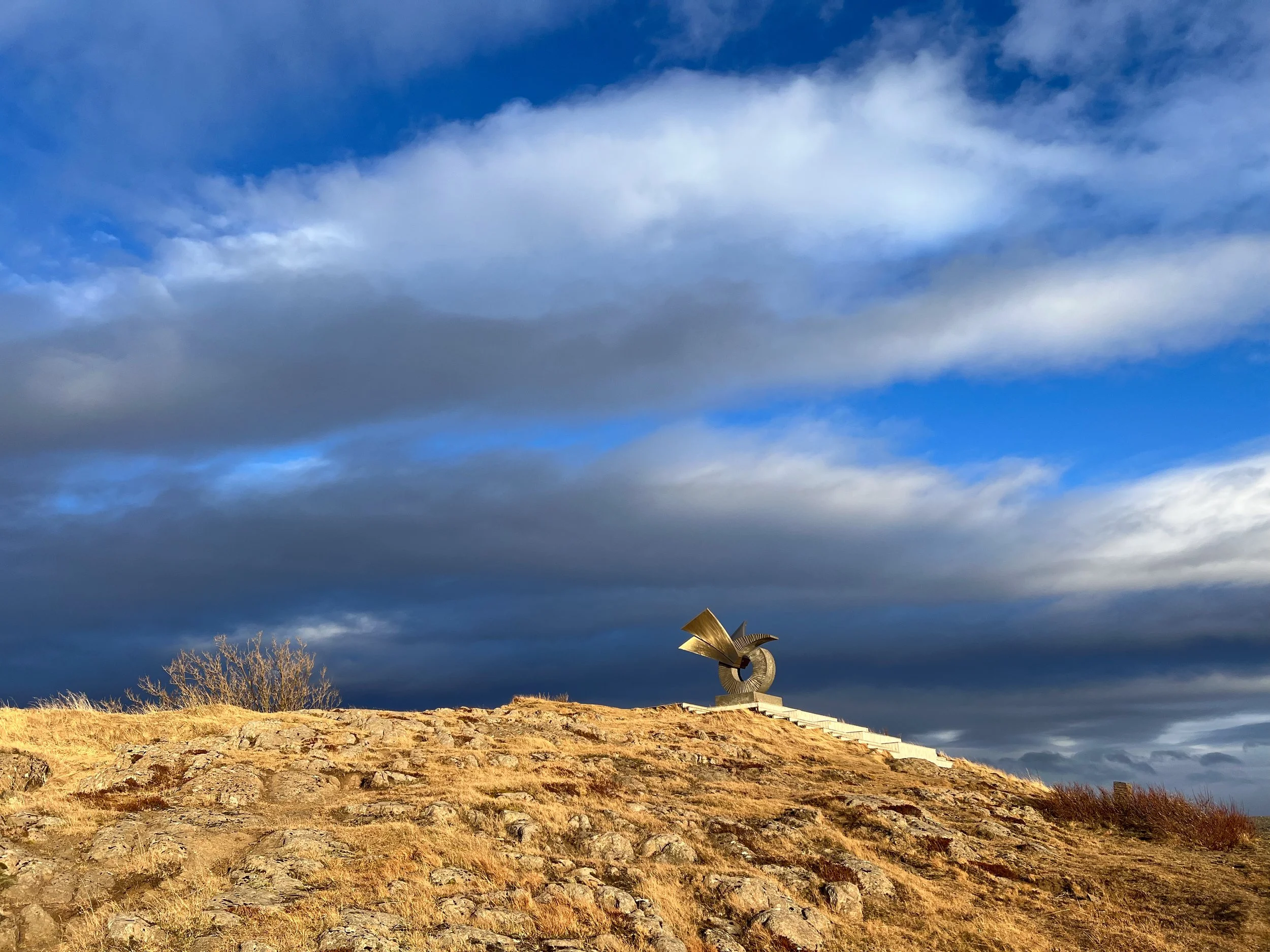
Borganes—monument to a character from the Egil's Saga.
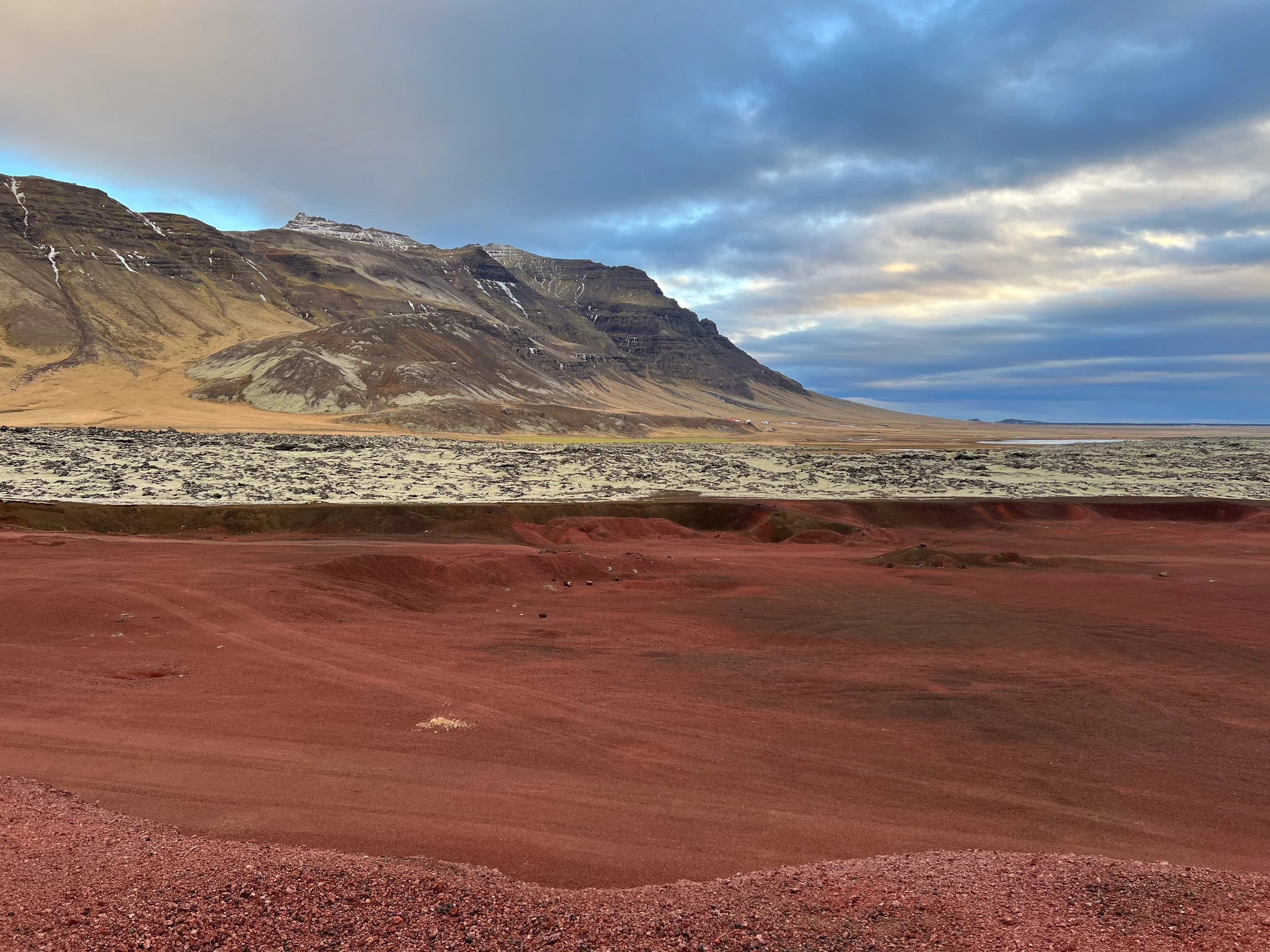
The iron-rich red lava in the foreground is surrounded by the more common grayish-black lava, covered by moss. It seems that moss thrives on lava rock because it is porous and moisture-retaining while also allowing air flow.
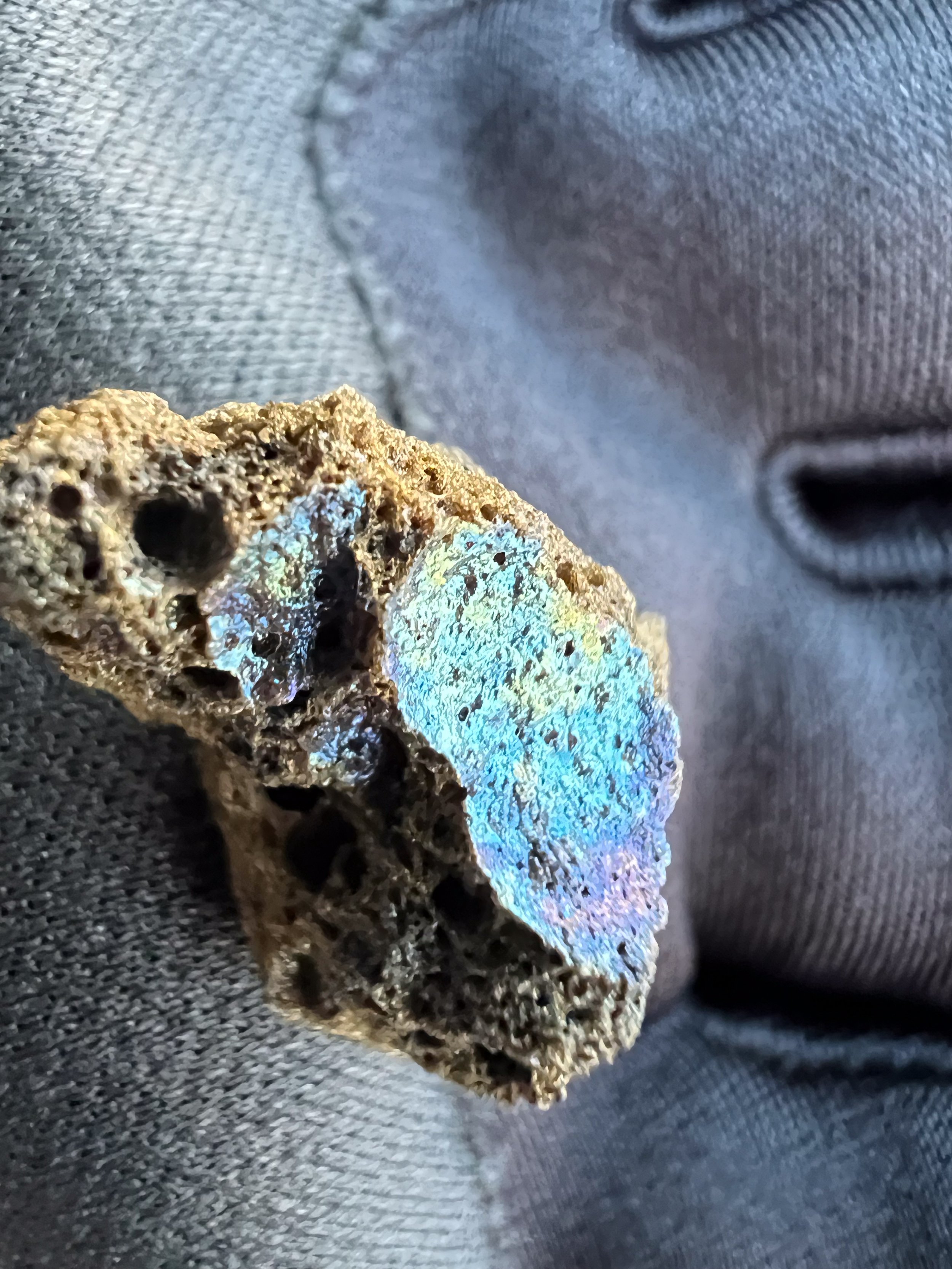
This piece of lava has a thin layer of iridescent basaltic glass.
January 30th, Day 6:
Snaefellsnes Coastal Walk, Saxhóll Crater
We had another beautiful day for walking along the coast of the Snaefellsnes Peninsula. After the first coastal trail we visited Djupalonssandur (Black Lava Pearl) Beach, which has four “lifting” stones to prove one’s strength:
339 lbs = fully strong
220 lbs = half strong
120 lbs = half carrier
50 lbs = weakling
From there we walked to another cove, Dritvik, which was for centuries an important fishing port. As many as 600 men lived there during the busy season (which is hard to imagine because it is not a big place).
We then visited Saxhóll Crater and climbed the sweeping iron stairs (a design which won the Rosa Barba International Landscape Prize in 2018) that lead to the top before returning to the coast to see sunset.
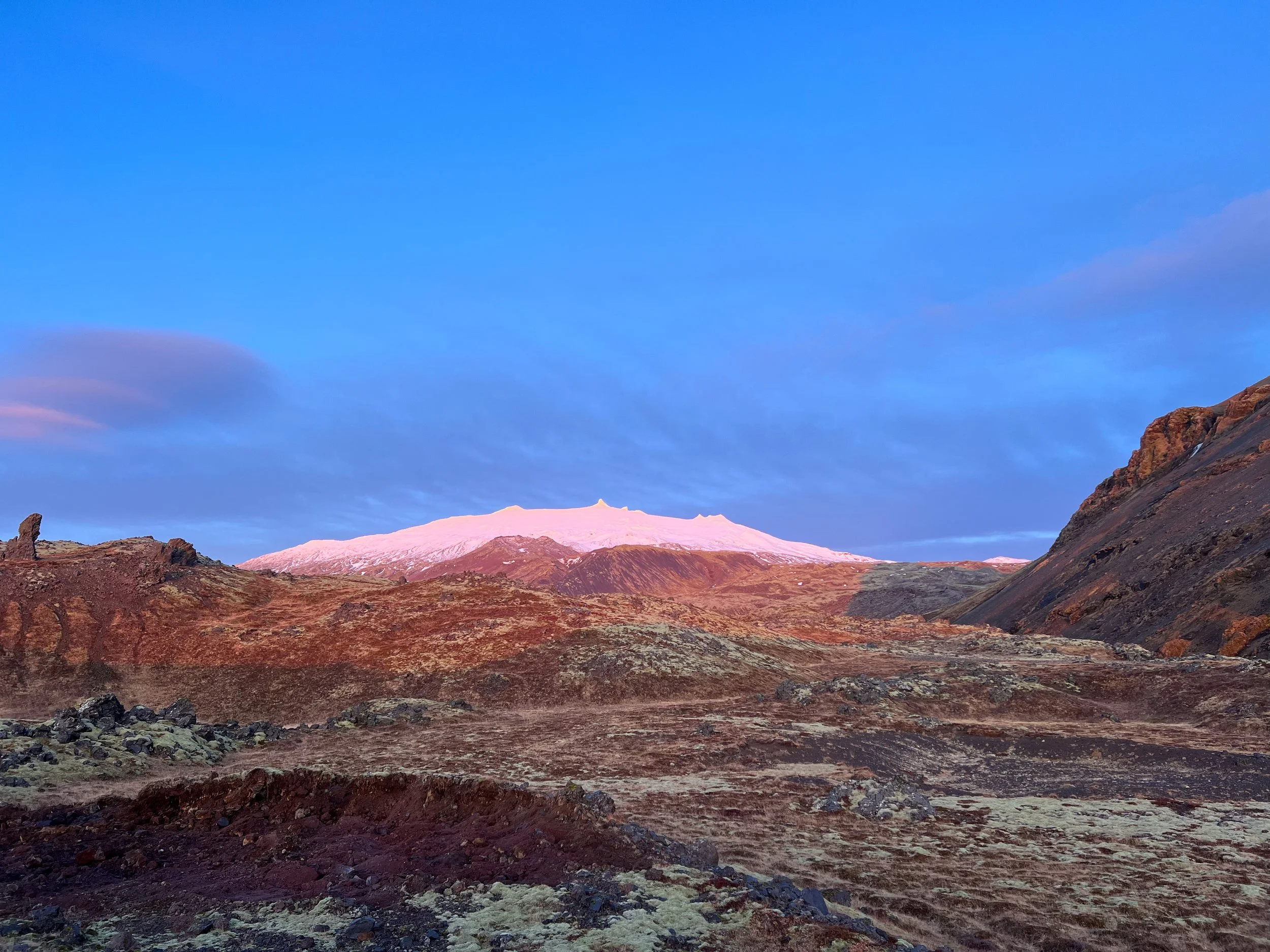
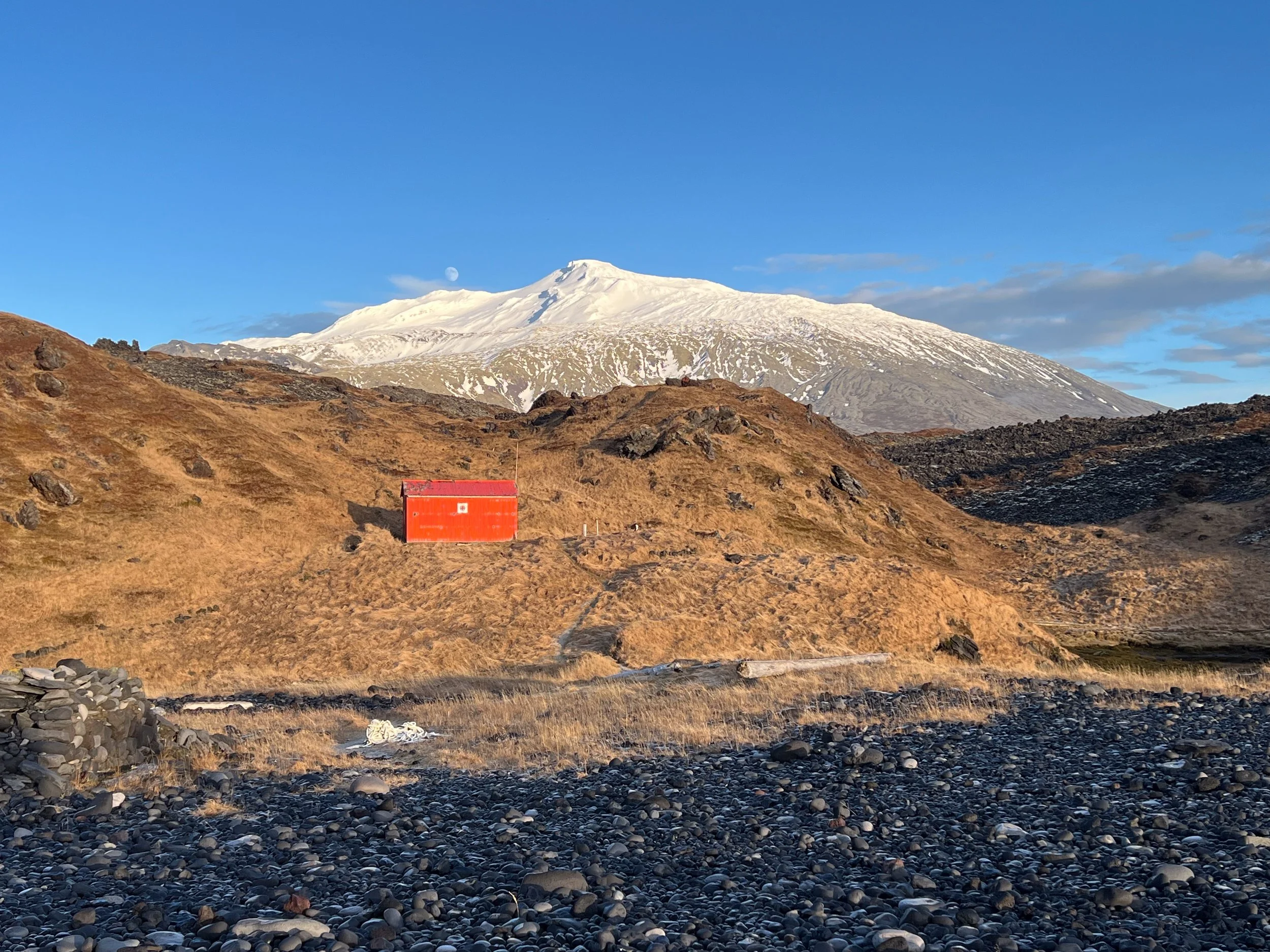
Morning Sun on Snaefellsjökull
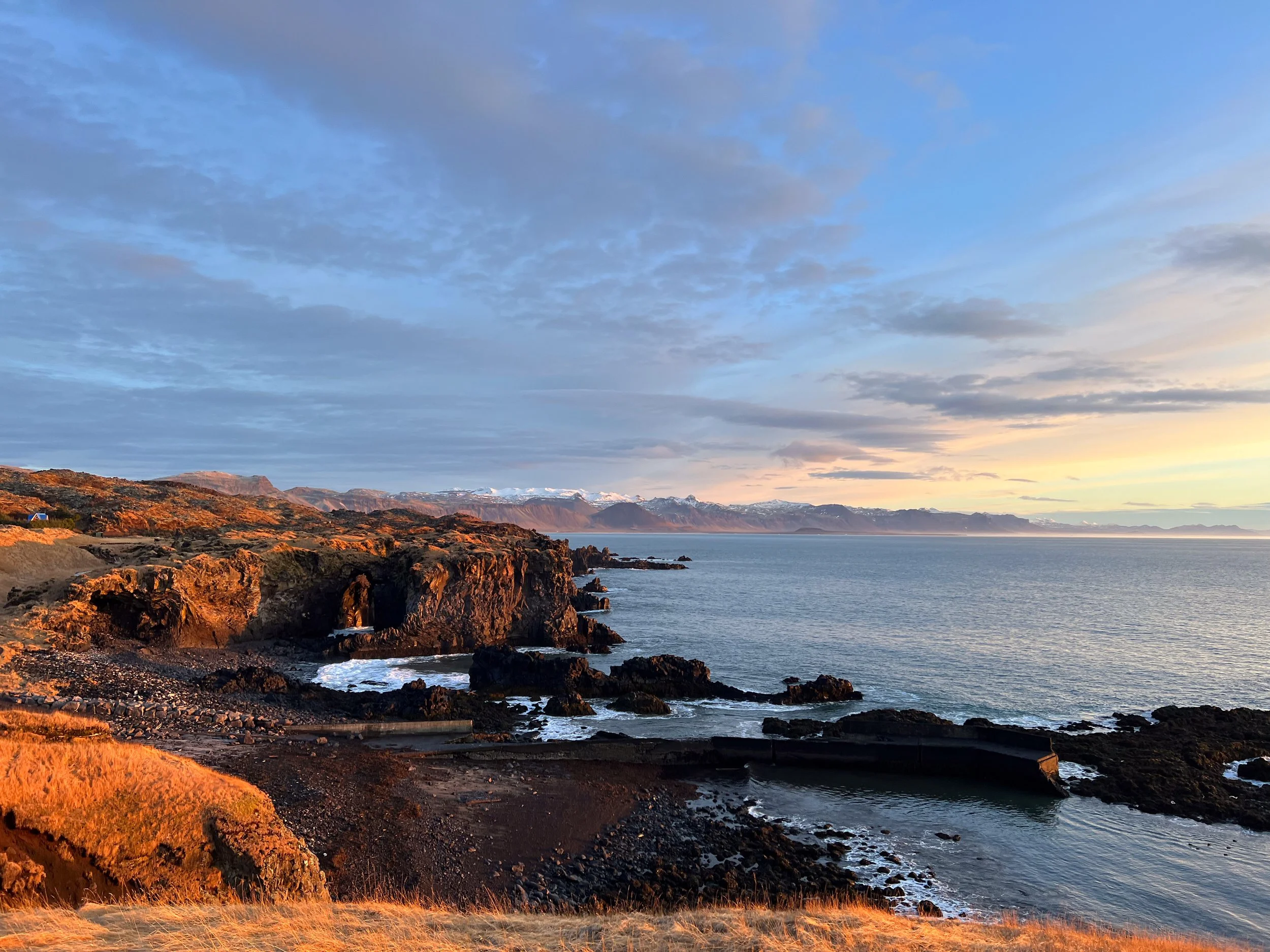
Coastal Walk, Snaefellsnes Peninsula
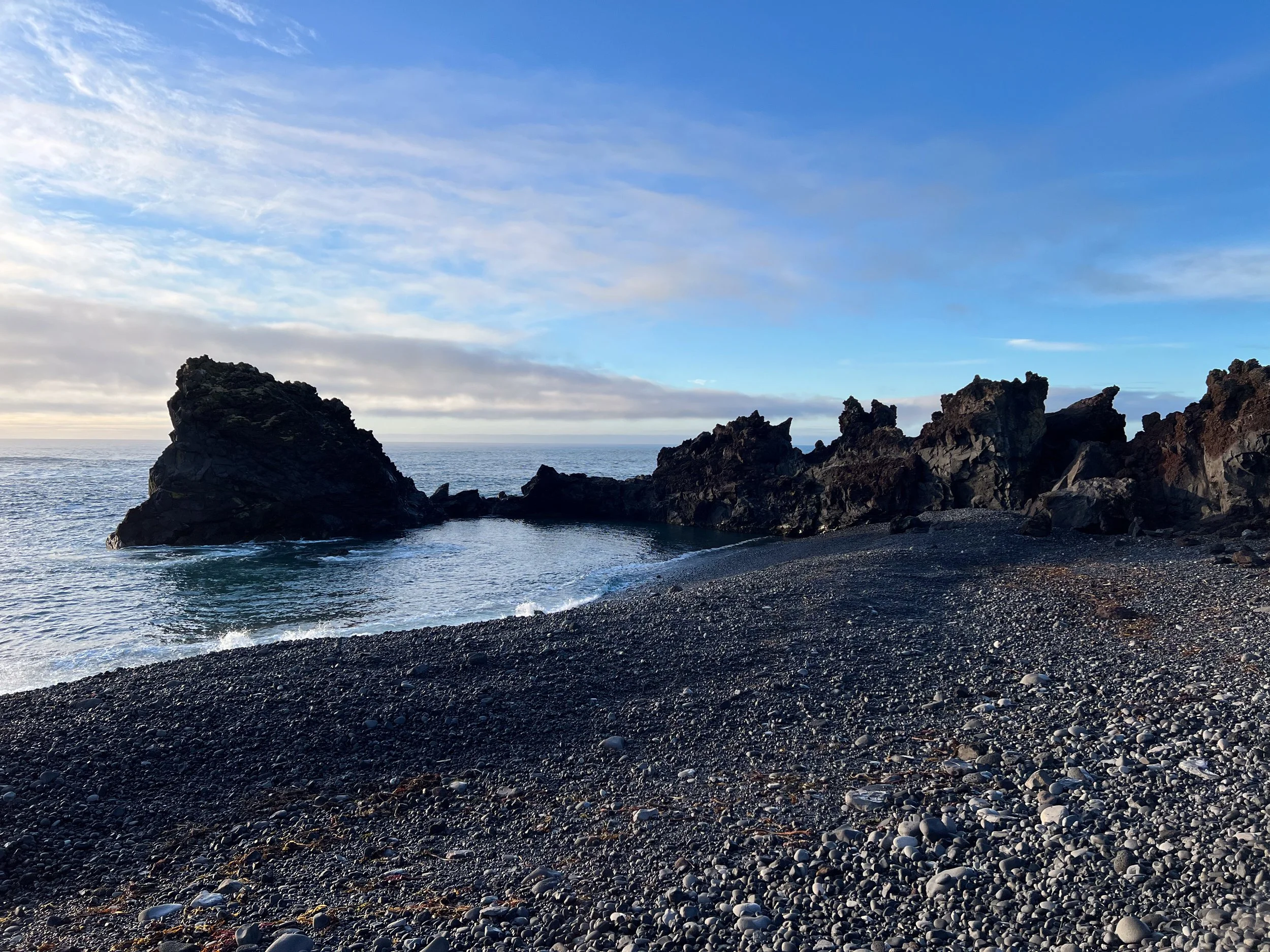
Dritvík, for centuries a vital fishing port.
The red building is an emergency shelter at Dritvik—in the unlikely event you survive a shipwreck and Icelandic waters to make it to shore.
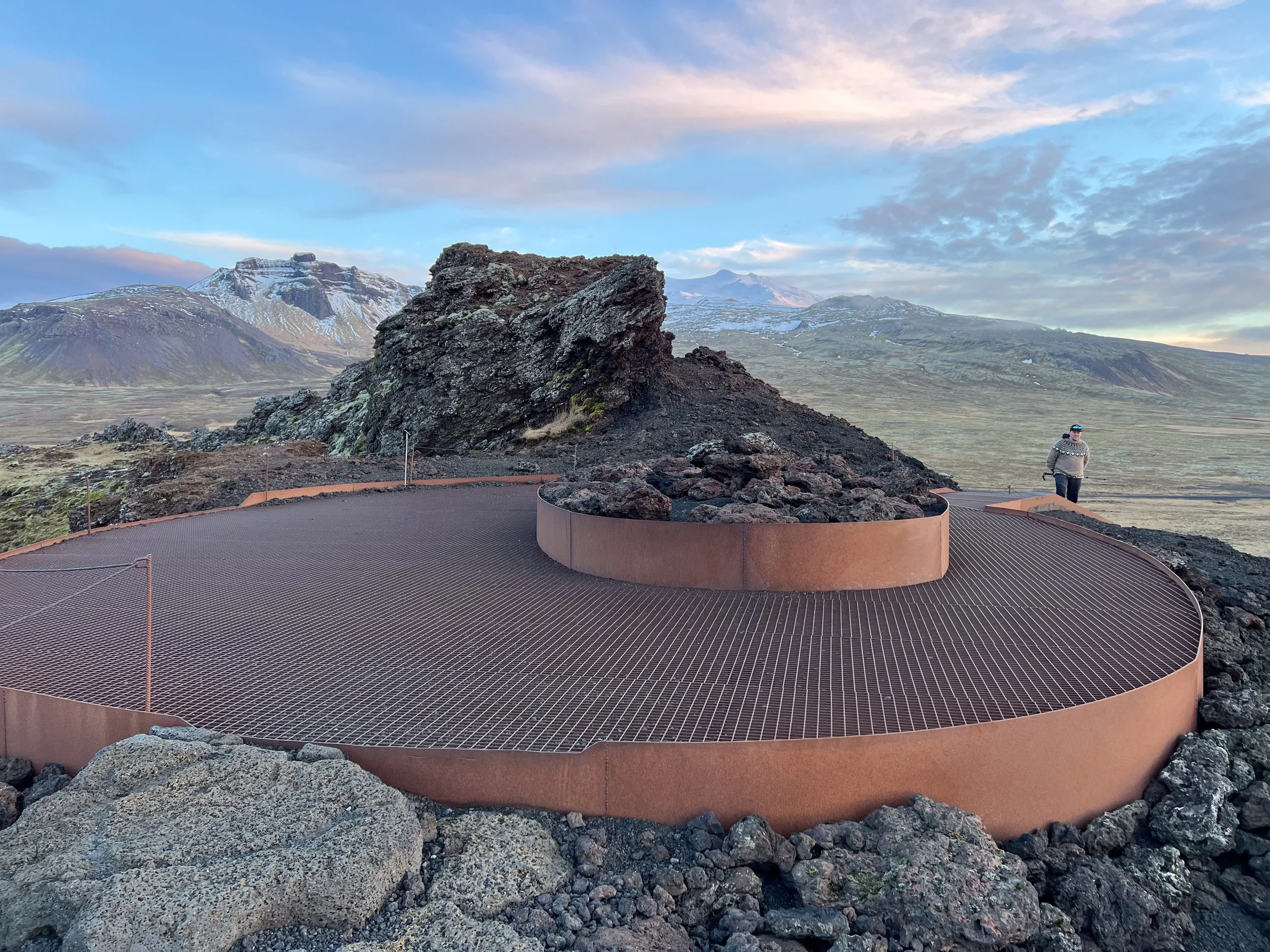
Top of Saxhóll Crater
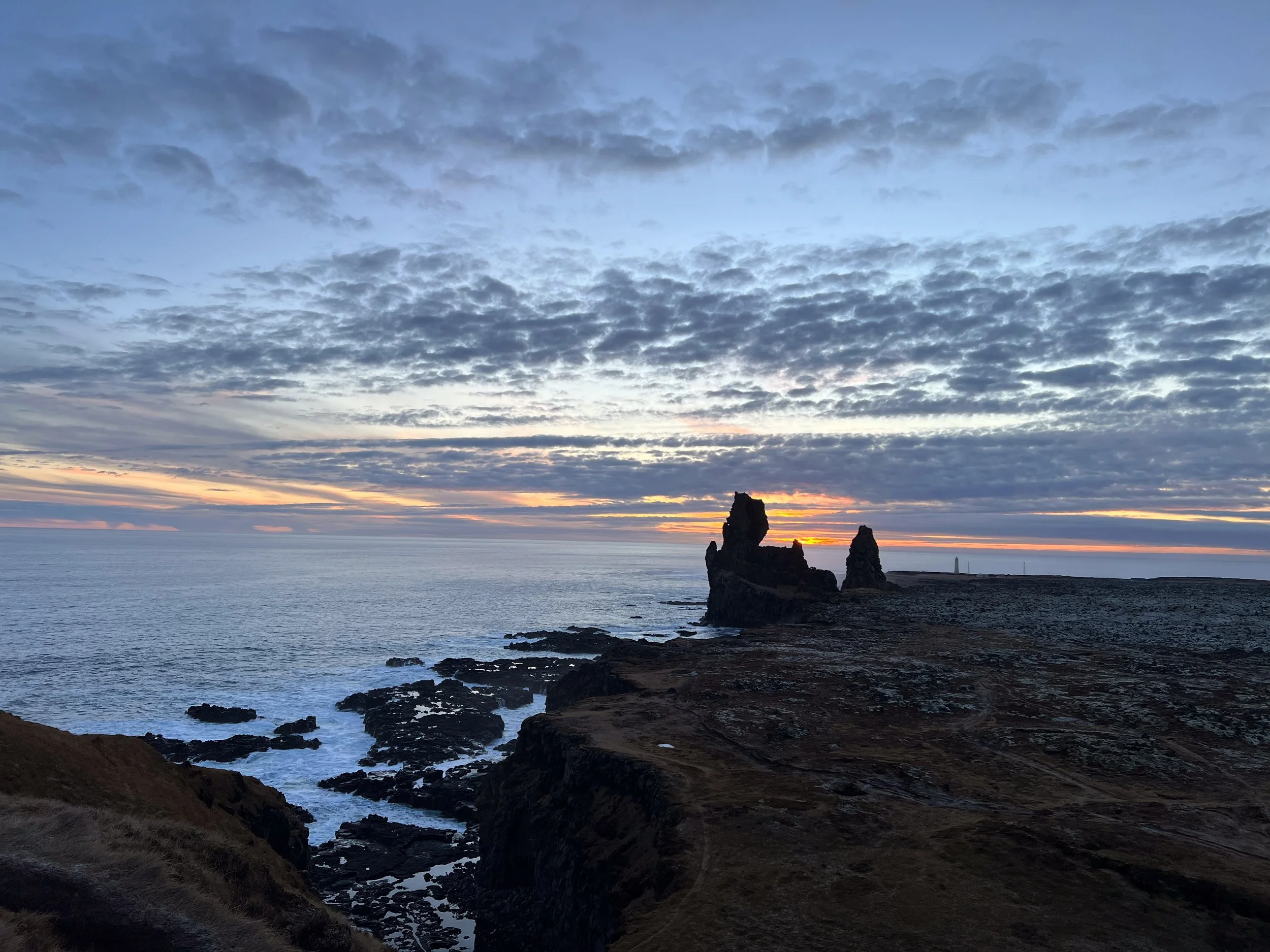
The Lóndrangar basalt pinnacles, in Snaefellsnes National Park. Can you imagine them as a Viking ship sailing into the sunset?
January 31st, Day 7:
Eldborg Crater, Back to Reykjavik
We left Hotel Búdir this morning to return to Reykjavik for our last night (sob). But first we stopped to hike up Eldborg Crater. The trail was quite flat until we got to the crater itself, first running along a river, then turning through a birch forest towards the volcanic cone.
Icelandic birch trees are the only native trees in Iceland. They are, by necessity I imagine, short and scrubby (often under 6’). Ragnar told us that locals joke “if you are lost in a forest in Iceland, just stand up.”
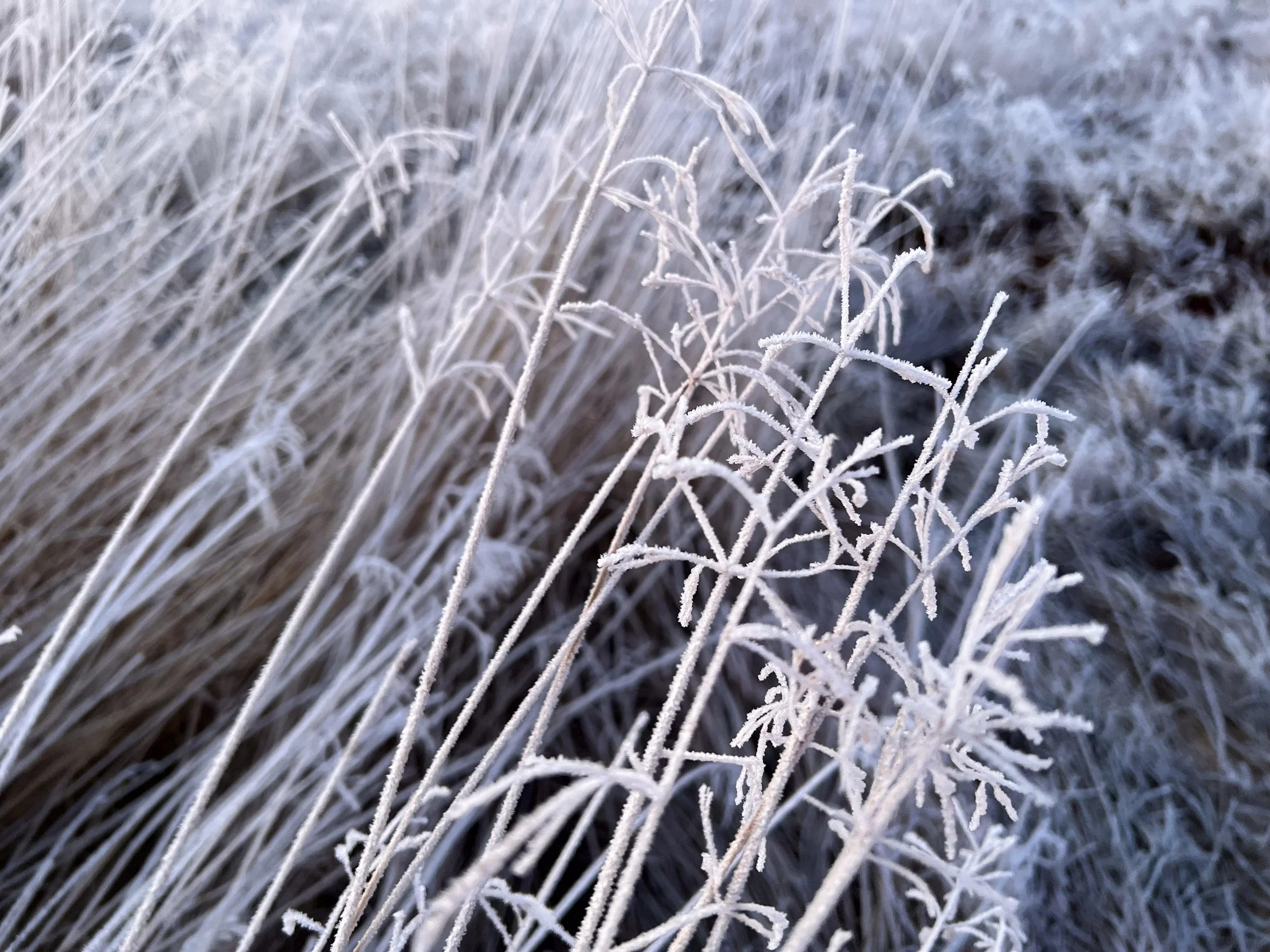
It was a frosty morning!
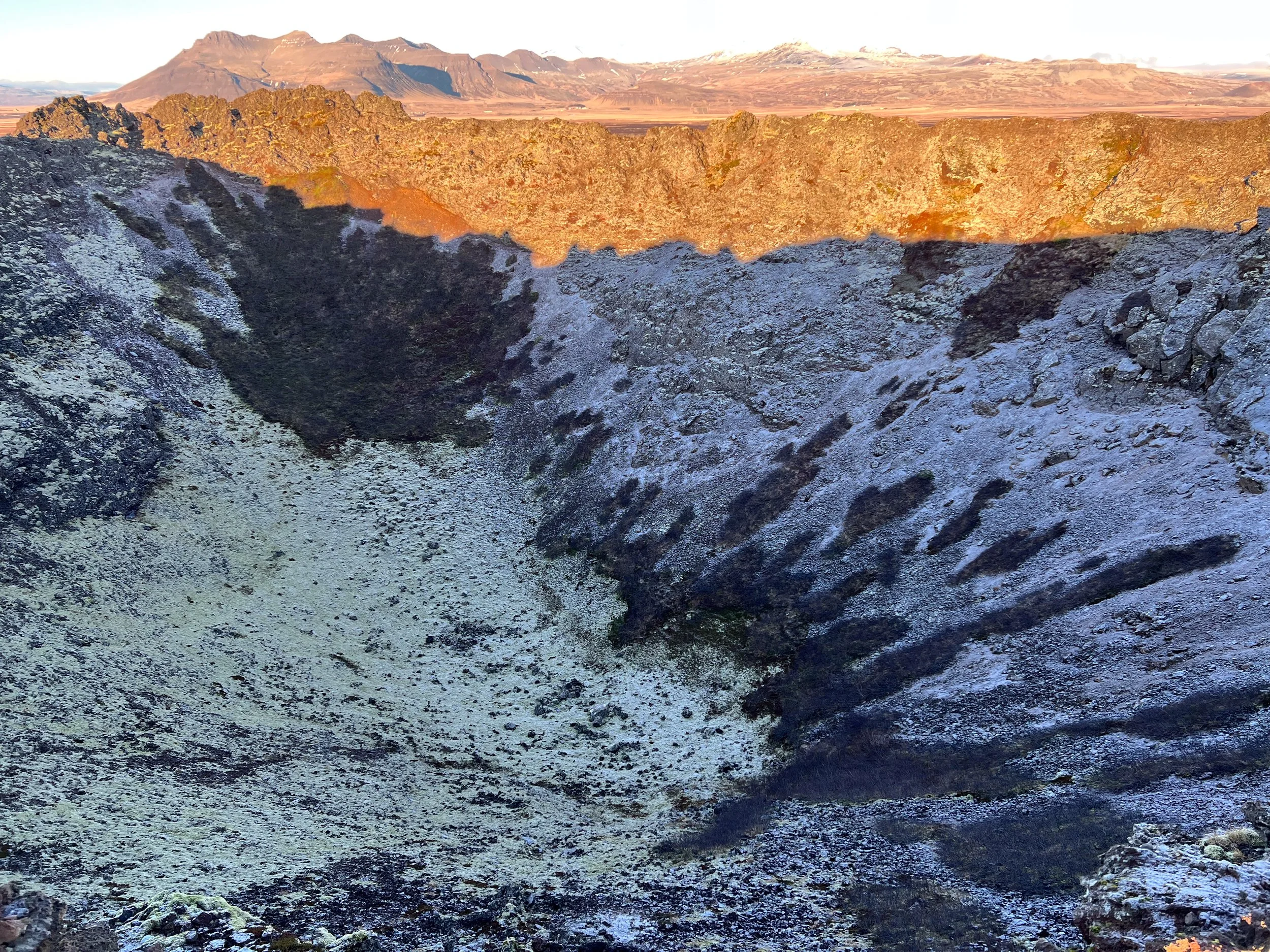
Looking Down into Eldborg Crater
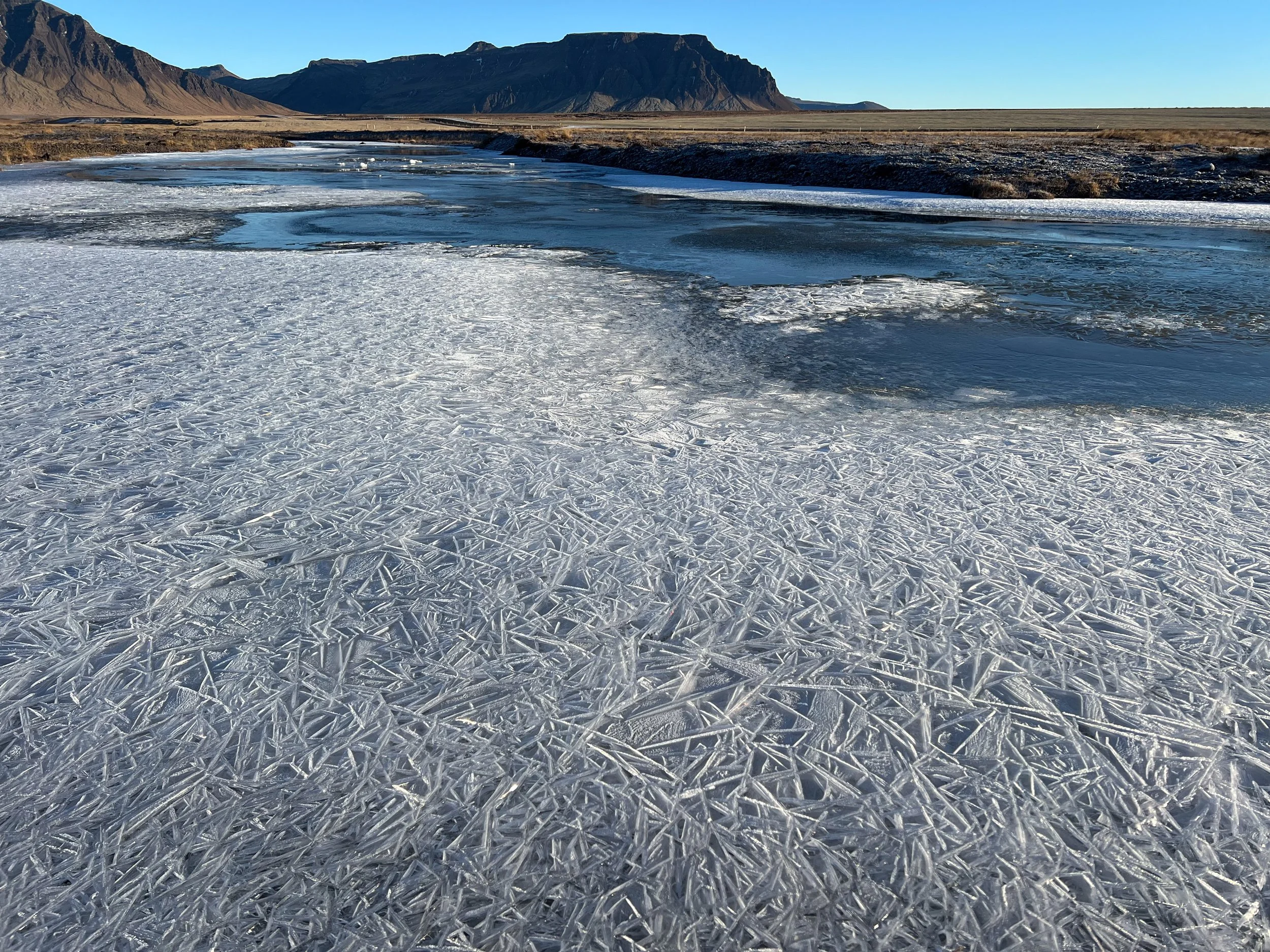
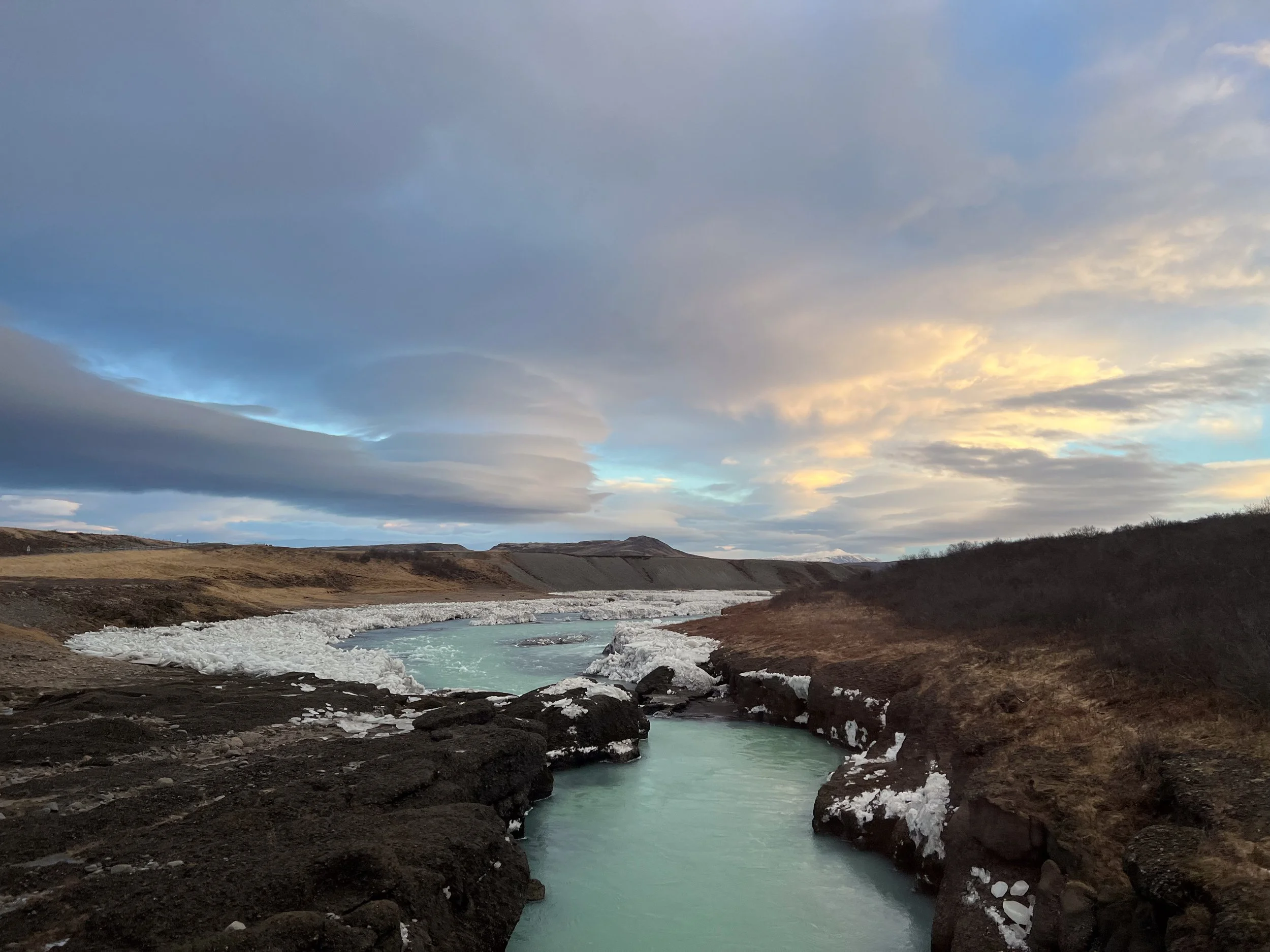
Fantastic ice formations in the river.
February 1st, Day 8:
Sky Lagoon
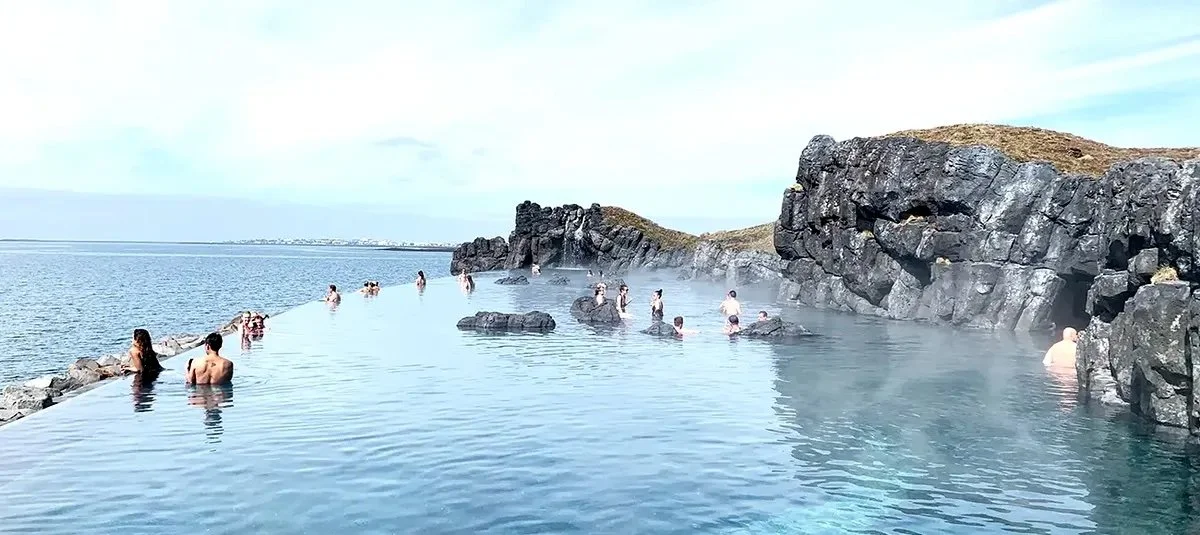
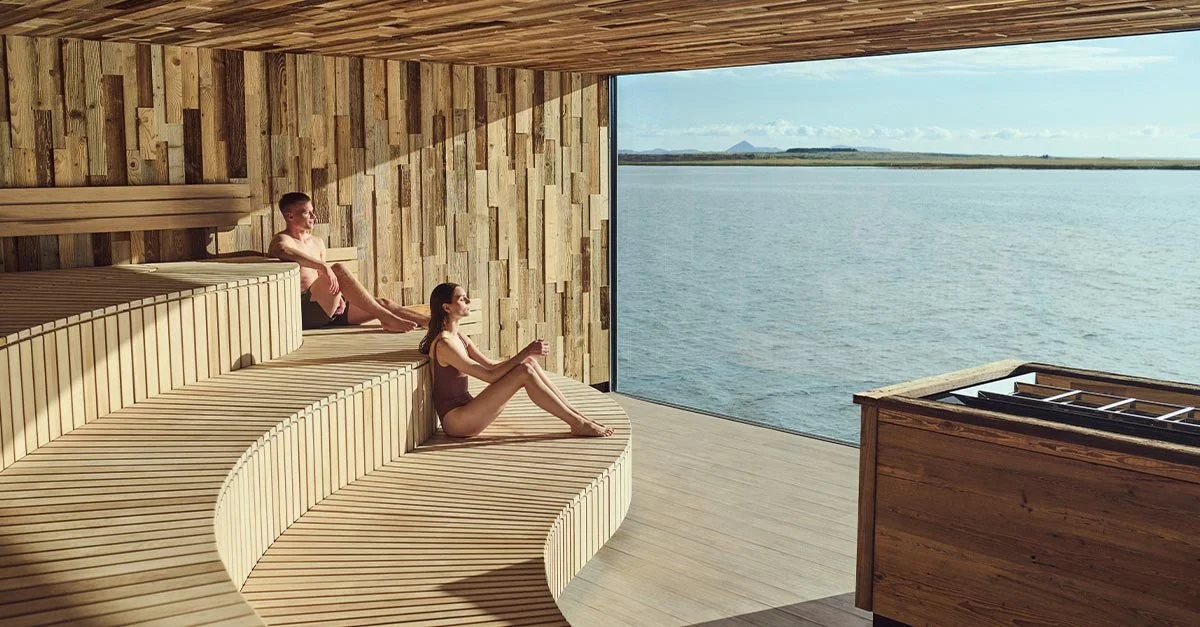
I can’t imagine a more perfect ending to our trip than the morning we spent at Sky Lagoon. Because I did not take my phone with me, I copied a couple of images from their website.
After indulging in the 7-Step Ritual, we had lunch, then it was time for Ragnar to drop us at the airport.