Mexico City
When: October 2026
One of my Bucket List items is to live in another country long enough to become fluent in its language. I’ve always thought it would be France, and I do speak some French thanks to long-ago studies in high school and various trips there, but I am in a galaxy far, far away from fluency.
While living in France and achieving fluency is still a dream, I recently took a Spanish class at my town’s community center. I was pleasantly surprised by how much I remembered from my solitary year of high school Spanish, and it motivated me to make a serious effort to learn the language. A friend had recently visited Mexico City and posted some tempting photos, so I thought it would be fun to combine traveling and studying. A brief internet search led me to a “luxury Spanish immersion” program by Fluenz, and I thought “that sounds like fun!”
I had 5 days in the language immersion program, and stayed an additional 5 days to practice my new skills and be a tourist.
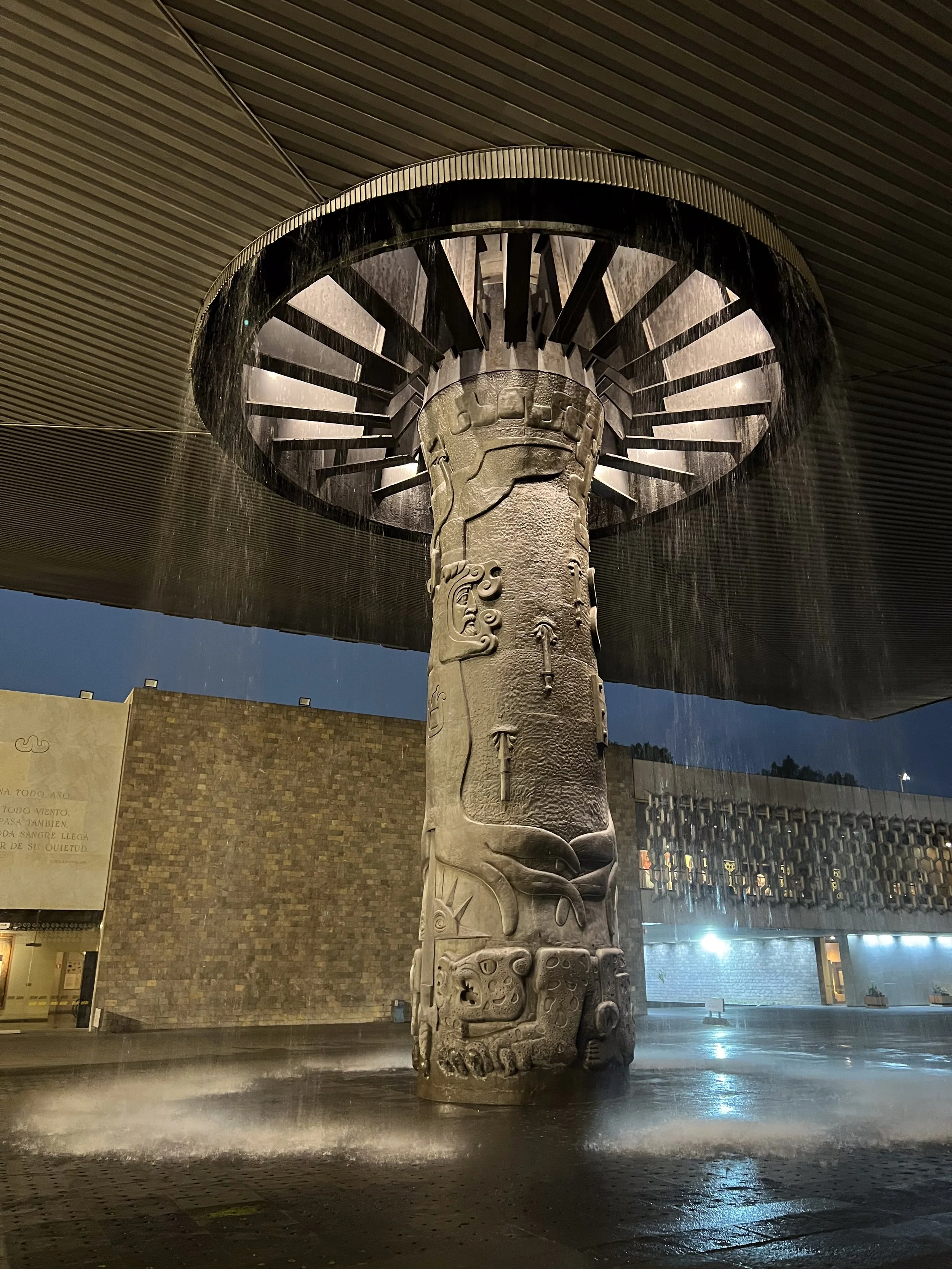
About the photo at left (or above, if viewing this on a mobile phone): at the National Museum of Anthropology, a visitor’s first impression is created by "El Paraguas (The Umbrella)," a fascinating fountain supporting a massive (48,000 sq ft) concrete umbrella shading the central courtyard. The umbrella is also supported by cables connecting it to the surrounding buildings.
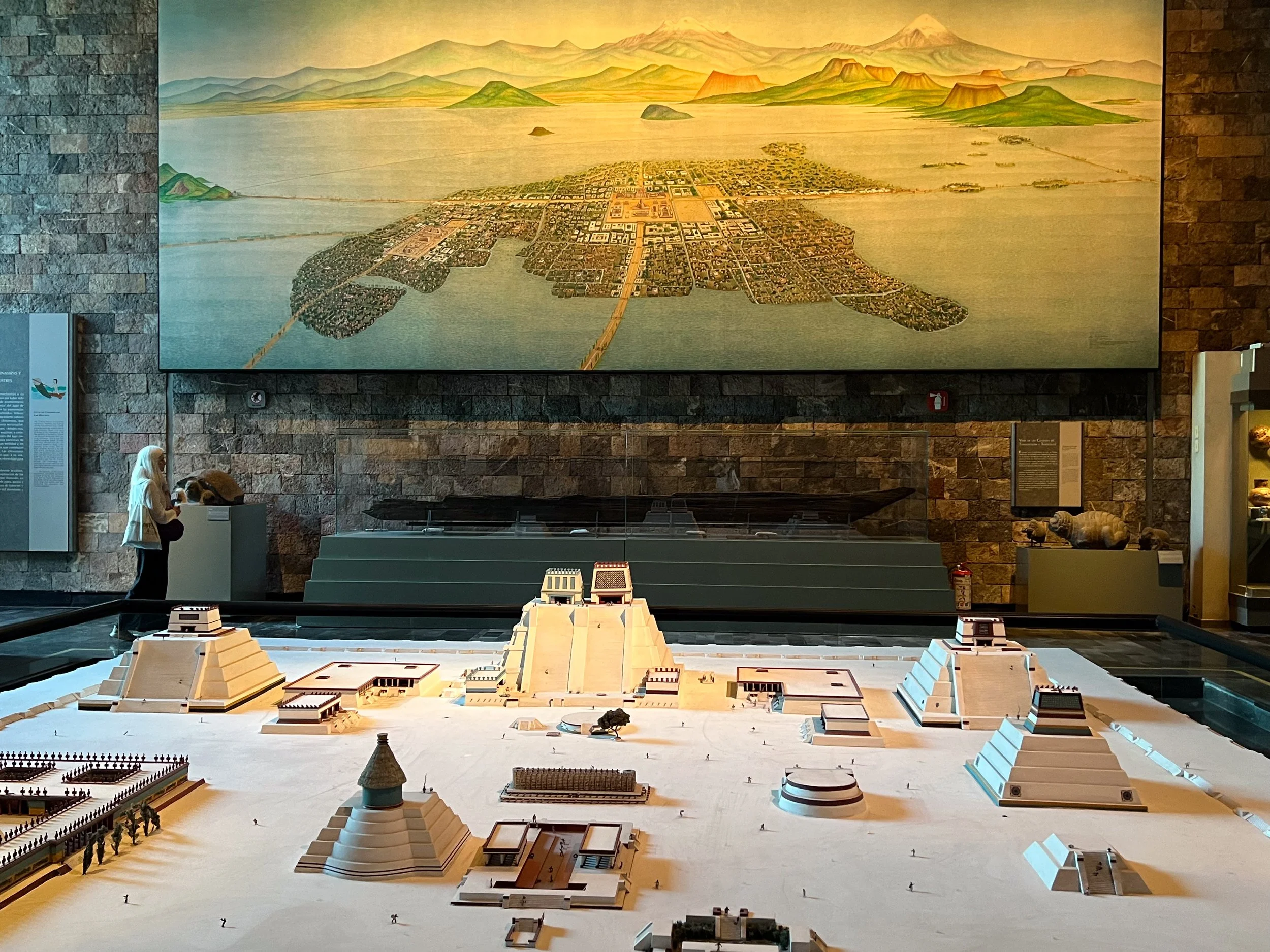
This photo was taken at the National Museum of Anthropology, and the foreground is a model of the Mexica (Aztec) plaza seen in the center of the painting in the background. The main temple is Templo Mayor, the ruins of which still exist in the midst of the Historic Center. Mexico City fun facts include:
Founded in 1325 by the Mexica (Aztec), it was known then as Tenochtitlan (sometimes referred to as Mexica-Tenochtitlan).
After it was destroyed and rebuilt by Spanish conquistadodrs in 1521, it served as the capital of New Spain for 300 years.
It was originally an island in Lake Texcoco. A canal system built by the Mexica still exists in the World Heritage site Xochimilco.
The city-proper has a population of 9.2 million, which swells to 21.8 million if the surrounding metropolitan areas are included.
It has over 150 museums and 3 World Heritage sites.
It sits at an elevation of over 7,000 feet.
Jump To:
Random Travel Tips
These are just a few of my travel tips. I have no affiliation with any of the services or resources for which I provide links—it is simply to share what I learned when I was planning my trip.
Apps
GPSmyCity
GPSmyCity is one of my favorite travel apps. It provides self-guided walking tours and travel articles which can be downloaded in advance, so that you do not need WiFi or cellular service when you are actually using it. Note that it uses your phone’s GPS for navigation purposes, and I do find that it uses a lot of battery power, so if I am using it a lot during the day, I carry a portable recharger.
Bloomberg Connects Arts & Culture
This is a free app created by Bloomberg Philanthropies which allows the user to “explore expert-curated content and guides to over 1750 museums, galleries, sculpture parks, gardens, and cultural spaces from the palm of your hand. From behind-the-scenes guides, to artist and expert-curated video and audio content, Bloomberg Connects makes it easy to discover arts and culture, anytime, anywhere.” Thanks to Kali, one of my fellow Fluenz students, for sending us the link to this app when we were at the National Museum of Anthropology.
Communicating
Outside of places which really serve tourists (hotels, some restaurants), you might not find a lot of English spoken.
Staying Connected
I used a Nomad eSim for this part of my trip, but there were a couple of times when I was out and about and had problems with the service. Whether this was related to the Nomad service or cell service in general, I couldn’t say.
Money
Credit cards are widely accepted, but you will want to have some Mexican pesos on hand.
Getting Around
Mexico City is a massive, sprawling, densely populated place (over 9 million residents) and the traffic (el tráfico) is possibly the worst I’ve experienced. The previous record was held by London, where it once took me 2 hours to drive 8 miles. One of my Uber journeys in Mexico City took an hour to go 3.5 miles. There is a metro system, but I did not try it. I had suffered a knee injury before leaving on this trip, and I was having to use a knee scooter whenever I left the hotel.
Fluenz Spanish Language Immersion
The Fluenz program I enrolled in spanned 5 days and comprised 9 classes, each of which was 2 hours. From Monday to Thursday we had a class in the morning and a class in the afternoon. On Friday morning, the “class” was an excursion into the neighborhood to practice our Spanish in the real world (ordering coffee and a pastry, or buying books or chocolates, for example).
At least one class each day was one-on-one, and the other class was a very small (maybe only 2 or 3 people) group of students at a similar level. In my cohort there were 13 students and 8 coaches, so it was a highly personalized experience.
But it was not all work and no play! One evening we had a very interesting talk by Adrián Pascoe (a Mexican playwright, cultural critic, and political consultant) about the history of Mexico since the time of the Spanish invasion. Another night we were taken to the National Museum of Anthropology for a guided after-hours visit. We also explored Casa Gilardi, a private home design by Luis Barragán.
It was a fabulous experience. My fellow students were an interesting and fun group: Janet, Gerry F., Durga, Gerry G., Don, Anne, Sofia, Andrea, Chris, Ellen, Kali, and Ryan. And the whole Fluenz team was truly wonderful. Many thanks to the coaches, Carlo, Fabiola, Hector, Jessica, Abril, Paulina, Diego, and Maria—and to those working behind the scenes, Andreina, Isabel, and Patricia (and no doubt others that I don’t know about). Here we all are at our Thursday afternoon celebration!
Museo Soumaya
Museo Soumaya’s striking architecture houses part of billionaire Carlos Slim’s private collection. The museum was designed by designed by Slim’s son-in-law, Fernando Romero, who worked with Ove Arup and Frank Gehry on the engineering. The collection is eclectic, ranging from pre-hispanic artifacts to paintings by Old Masters to Rodin sculptures (both original and cast reproductions) to objects of everyday life (a collection of old telephones, for example). Entrance to the museum is free.
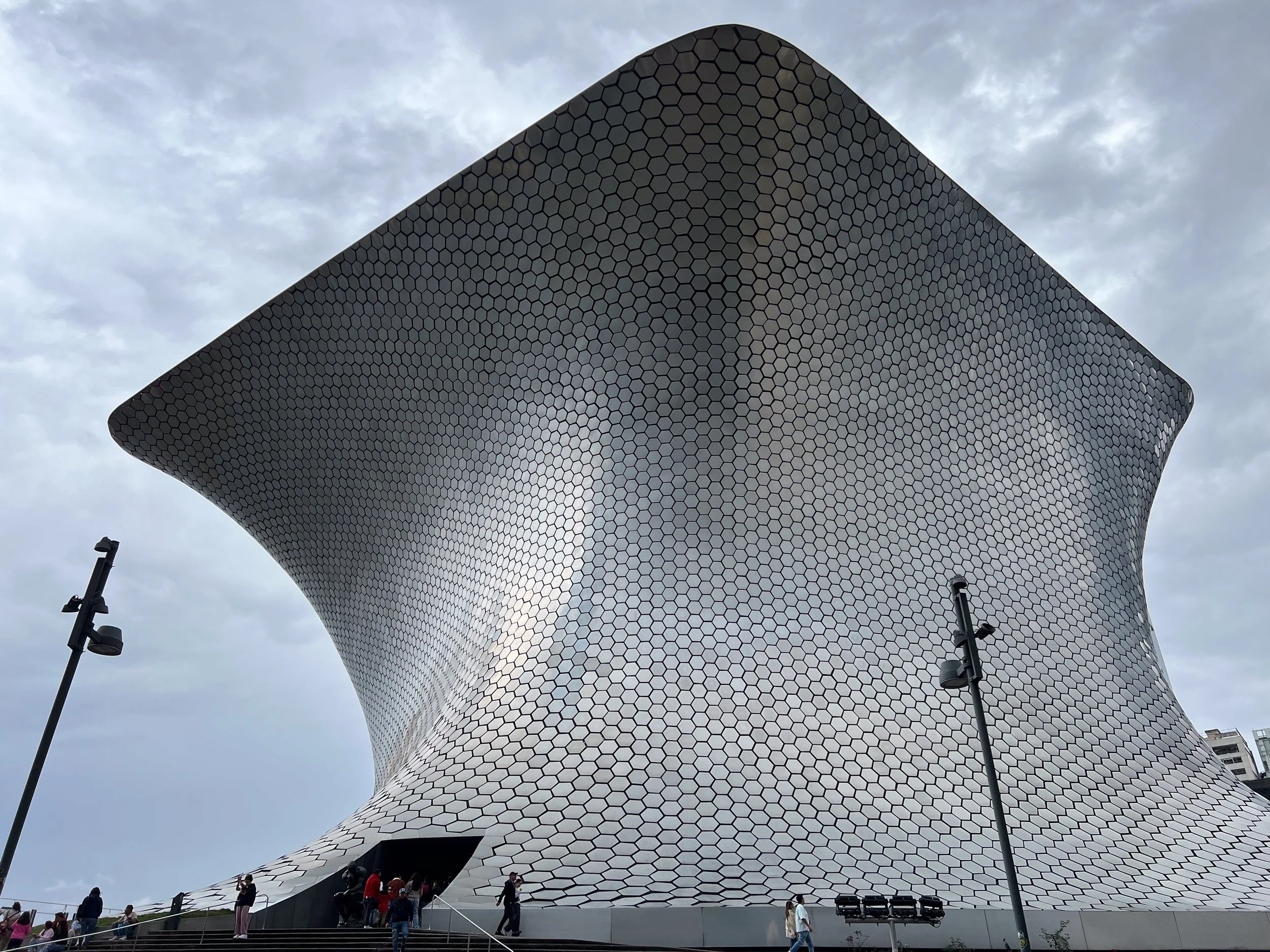
Exterior of Museo Soumaya
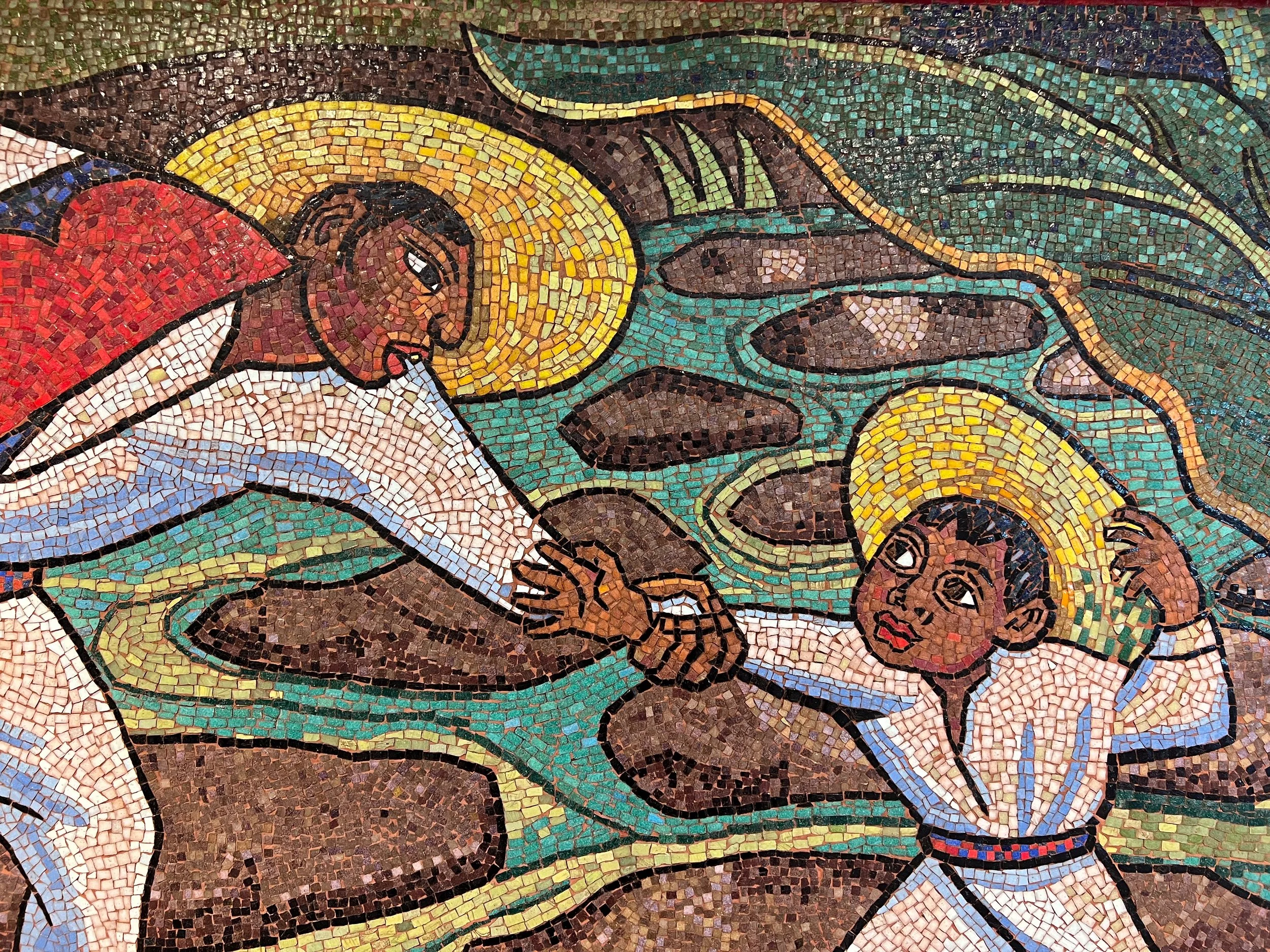
Mosaic of a Diego Rivera Mural
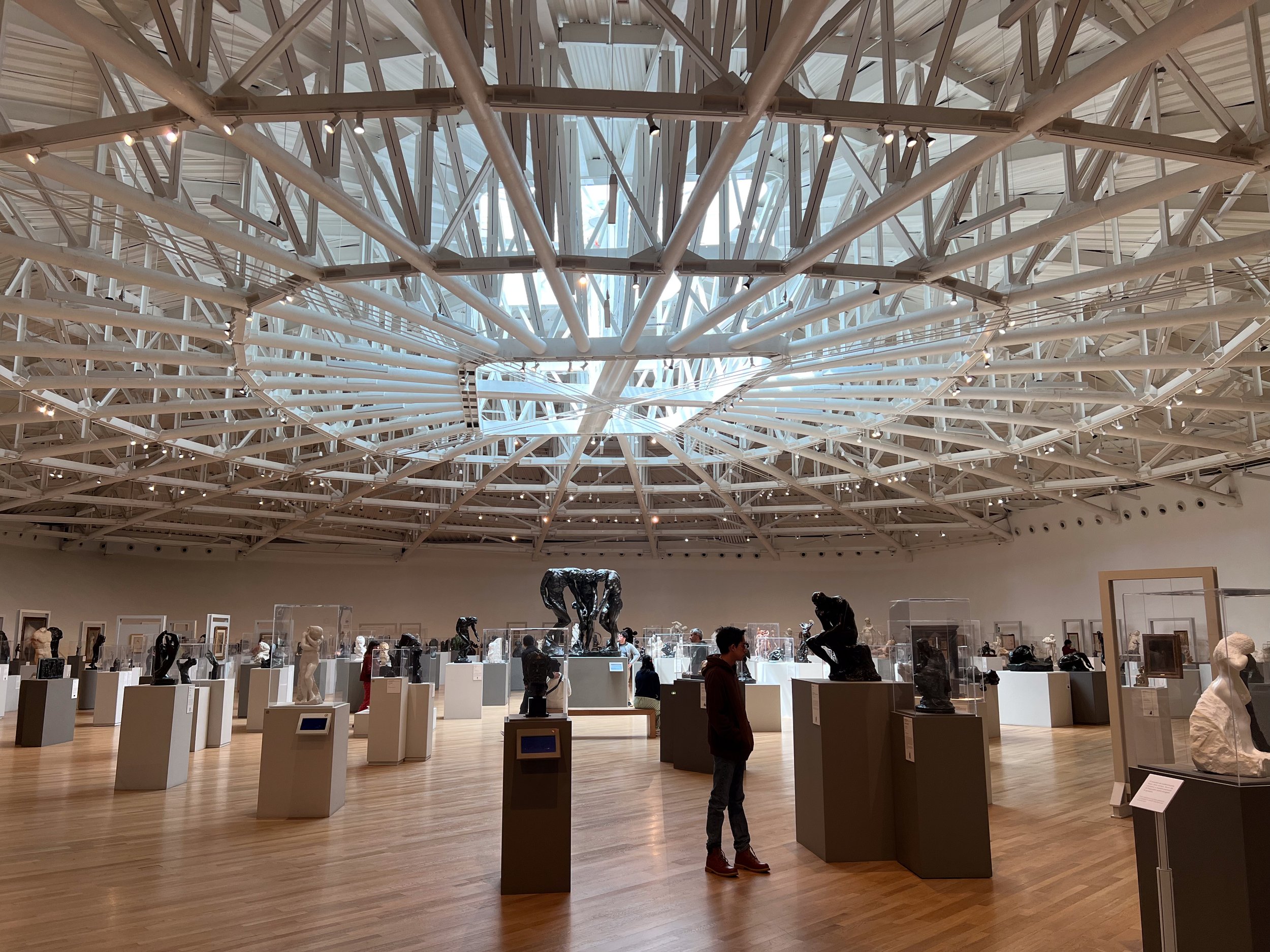
The ceiling on the upper floor is an engineering marvel - there are no supporting columns.
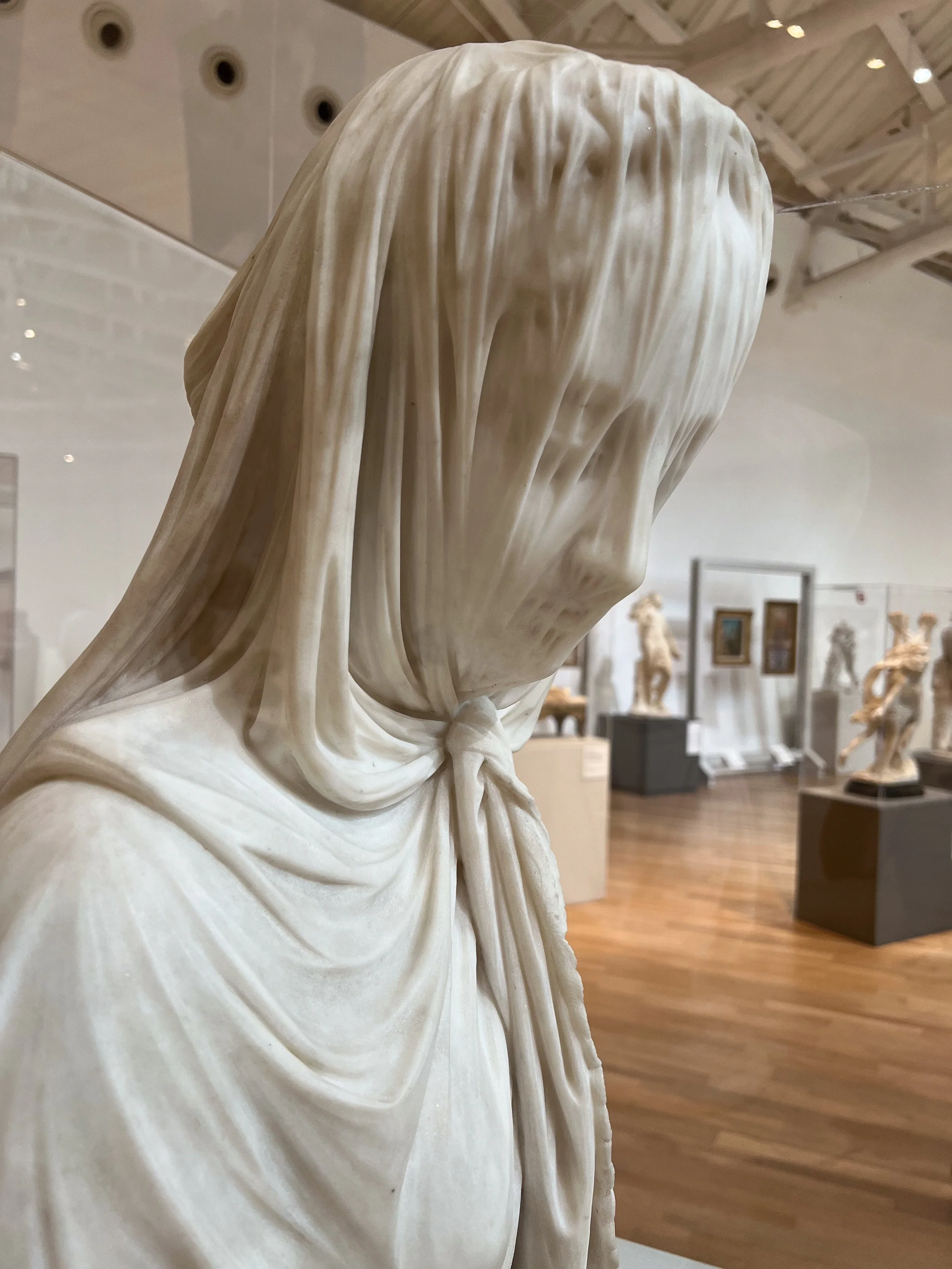
"Dama Con Velo" by Giovanni Battista Lombardi. I was mesmerized by the artist's ability to use marble to convey the transparency and delicacy of a veil.
Casa Gilardi
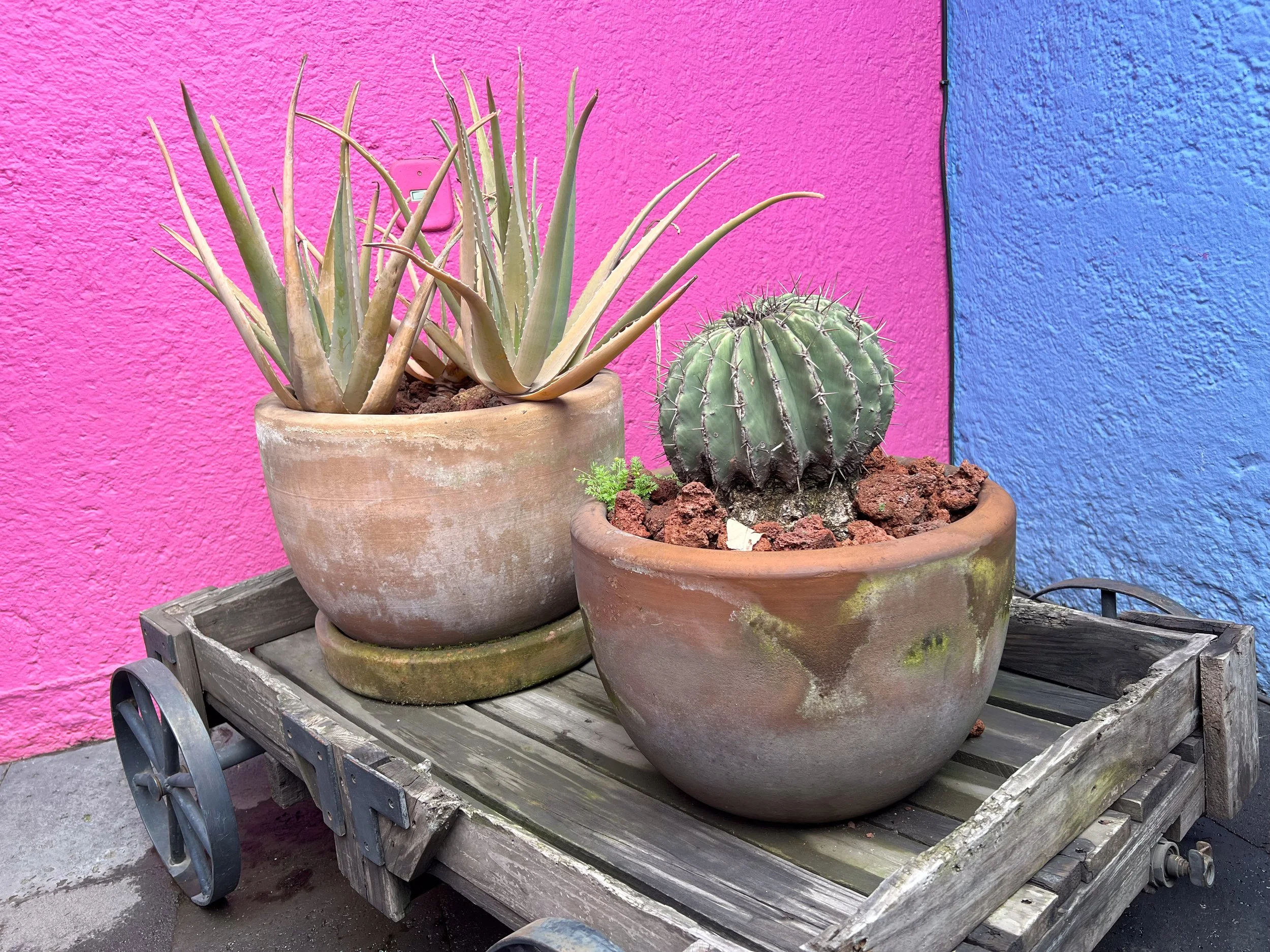
Casa Gilardi is a private residence designed by Luis Barrágan, a Pritzker Prize winner who is considered to be Mexico’s most famous architect. Built in the 1970’s, it was the last private residence he designed, and after years of having architects (including Japan’s Tadao Ando) knock on their door asking if they could see the house, the owners (who still live in the home) opened it part-time to private tours.
If you find yourself flying on AeroMexico (as I did on this trip), pay attention to the safety video - much of it was filmed at Casa Gilardi (thanks, Paulina, for sharing this fun fact with me).
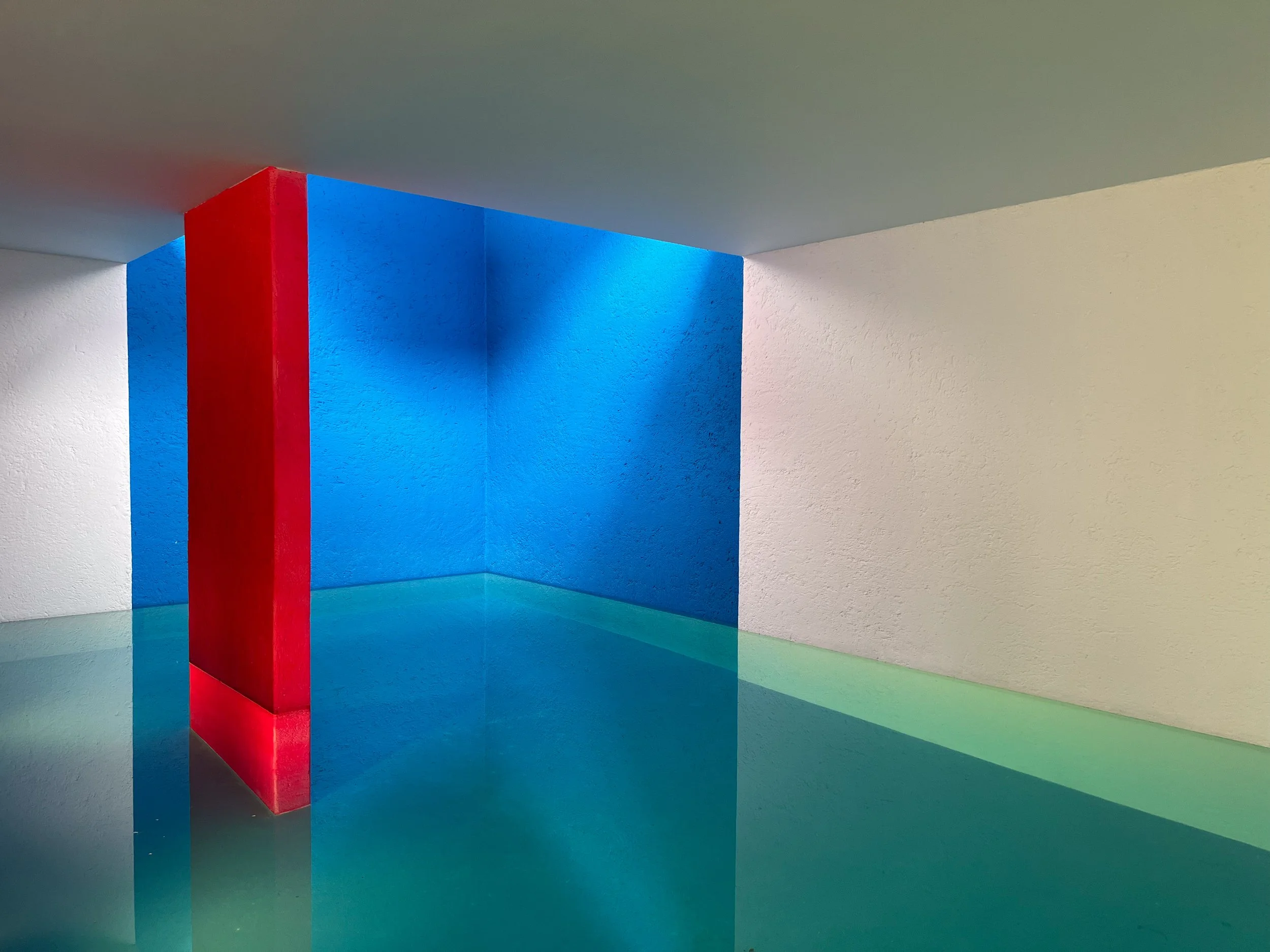
The pool
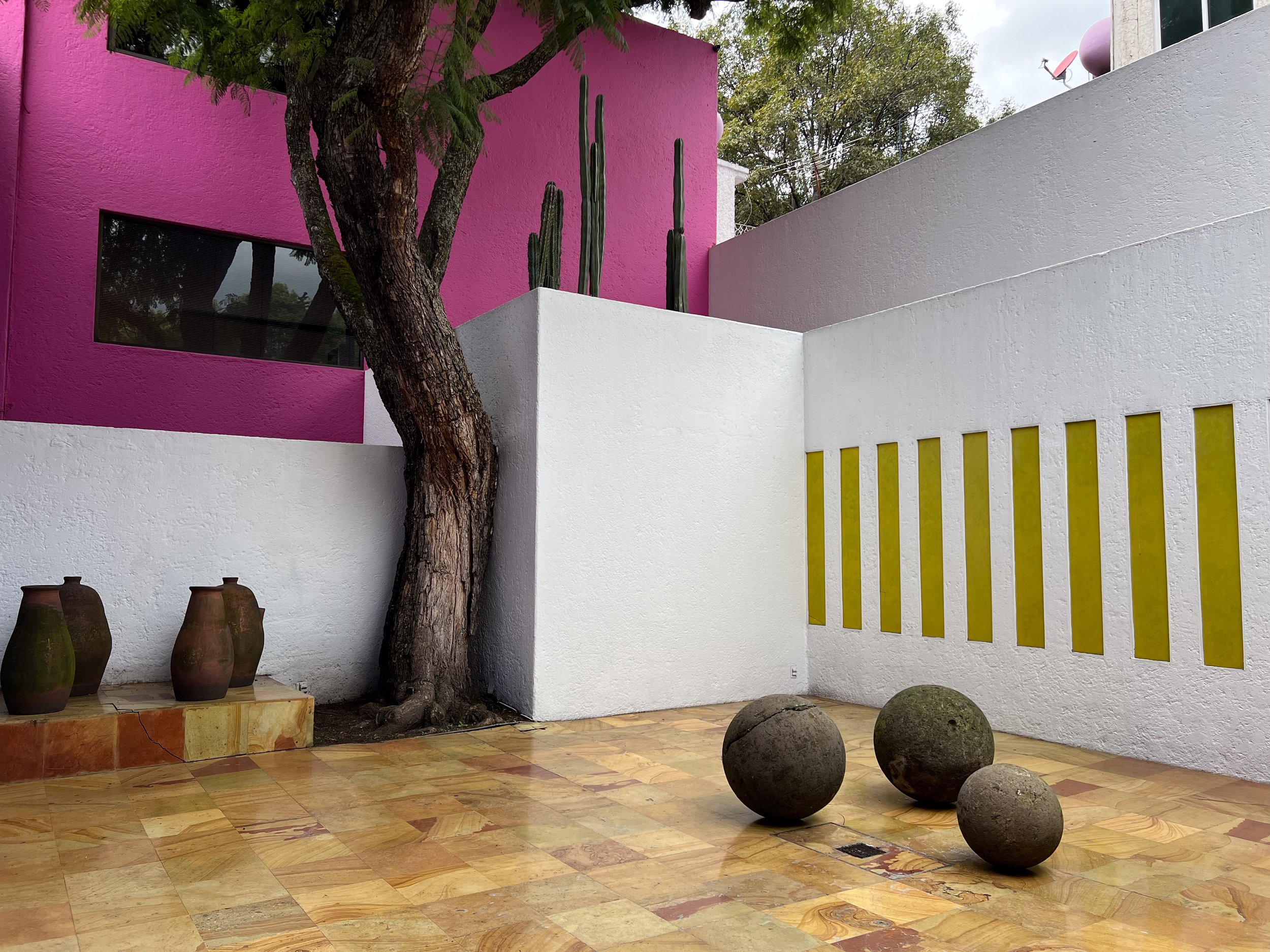
The Courtyard
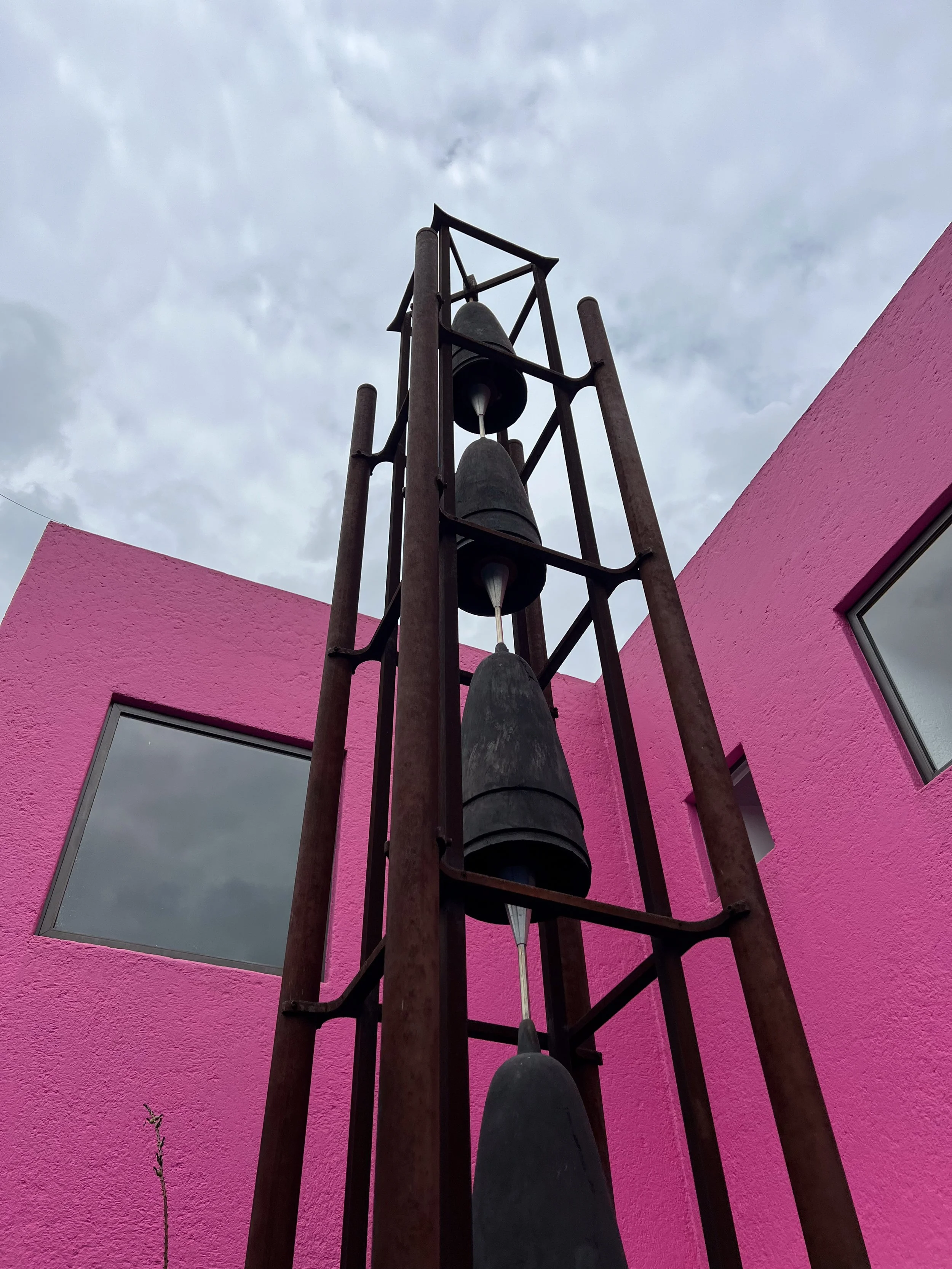
Upper Patio
Upper Patio
Museo Nacional de Antropología
From the National Museum of Anthropology’s website:
Since its conception, this icon of 20th century urban architecture was designed to be, more than a repository, a space for reflection on the rich indigenous heritage of our multicultural nation. Its 11 archaeological and 5 ethnographic rooms, added to the 45 thousand square meters of construction, make it the largest museum in Mexico and one of the most prominent in the world.
This important site houses the archaeological and anthropological testimonies forged by multiple cultural groups over hundreds of years of history; At the same time, it pays tribute to the indigenous peoples of today's Mexico through a rich collection that rescues the uses, representations, expressions, knowledge and traditions that are the intangible heritage of the nation and a legacy that belongs to all humanity.
With my Fluenz group I had a brief introduction to the Mexica (Aztec) and Maya collections on our after-hours visit. The following week I returned on my own and spent another 4 hours there, which still is not enough time to see everything.
Historical Timeline Reference
The information below is from an AI generated summary. I really found it hard to wrap my head around how and when the various Mesoamerican cultures rose and fell during their long history.
Preclassic (2,500 BC to 100 AD)
The Bloomberg guide describes this period as “a fundamental stage in which agriculture, sedentary life and ceramic production emerged, laying the foundations of Mesoamerican civilizations.”
Olmec Civilization (c. 1500–400 BC): Established the first major cities like San Lorenzo and La Venta, developing monumental sculpture and ceremonial centers.
Zapotec and Maya Emergence: The Zapotec founded Monte Albán (c. 500 BCE), while early Maya settlements like Tikal and El Mirador began to flourish.
Teotihuacan: This dominant city in central Mexico rose during the Late Preclassic, introducing key religious and cultural elements.
Classic Period (250–900 AD)
Maya Apogee: City-states such as Tikal, Palenque, and Copán reached their political and artistic peak. Mayans construct Chichén Itzá
Teotihuacan Dominance: From c. 300–600 CE, Teotihuacan was the largest metropolis in the ancient world before its destruction around 650 CE.
Terminal Classic (800–900 AD): Many Classic Maya cities collapsed or were abandoned, signaling the end of this era.
Postclassic Period (900–1521 AD)
Toltec Rise: The Toltec civilization flourished in central Mexico, with their capital at Tula, influencing later cultures. They capture Chichén Itzá in 987.
Aztec Empire (1345–1521 AD): The Aztecs (aka Mexica) founded Tenochtitlan in 1345, formed the Triple Alliance in 1428, and built a vast tributary empire.
Spanish Conquest: Hernán Cortés arrived in 1519, and the fall of Tenochtitlan in 1521 marked the end of independent indigenous rule in central Mesoamerica.
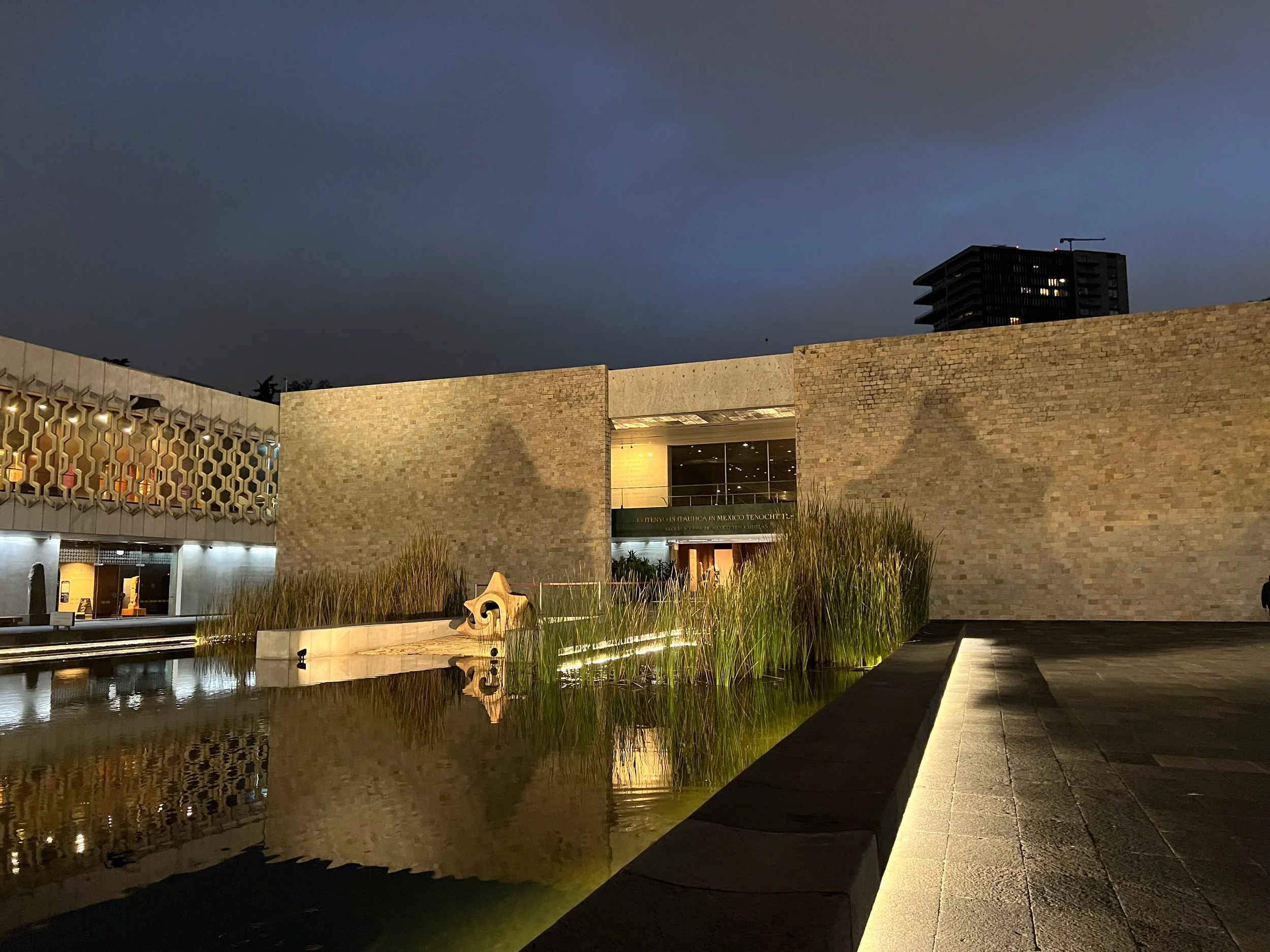
The central courtyard during the Fluenz group's after-hours visit.
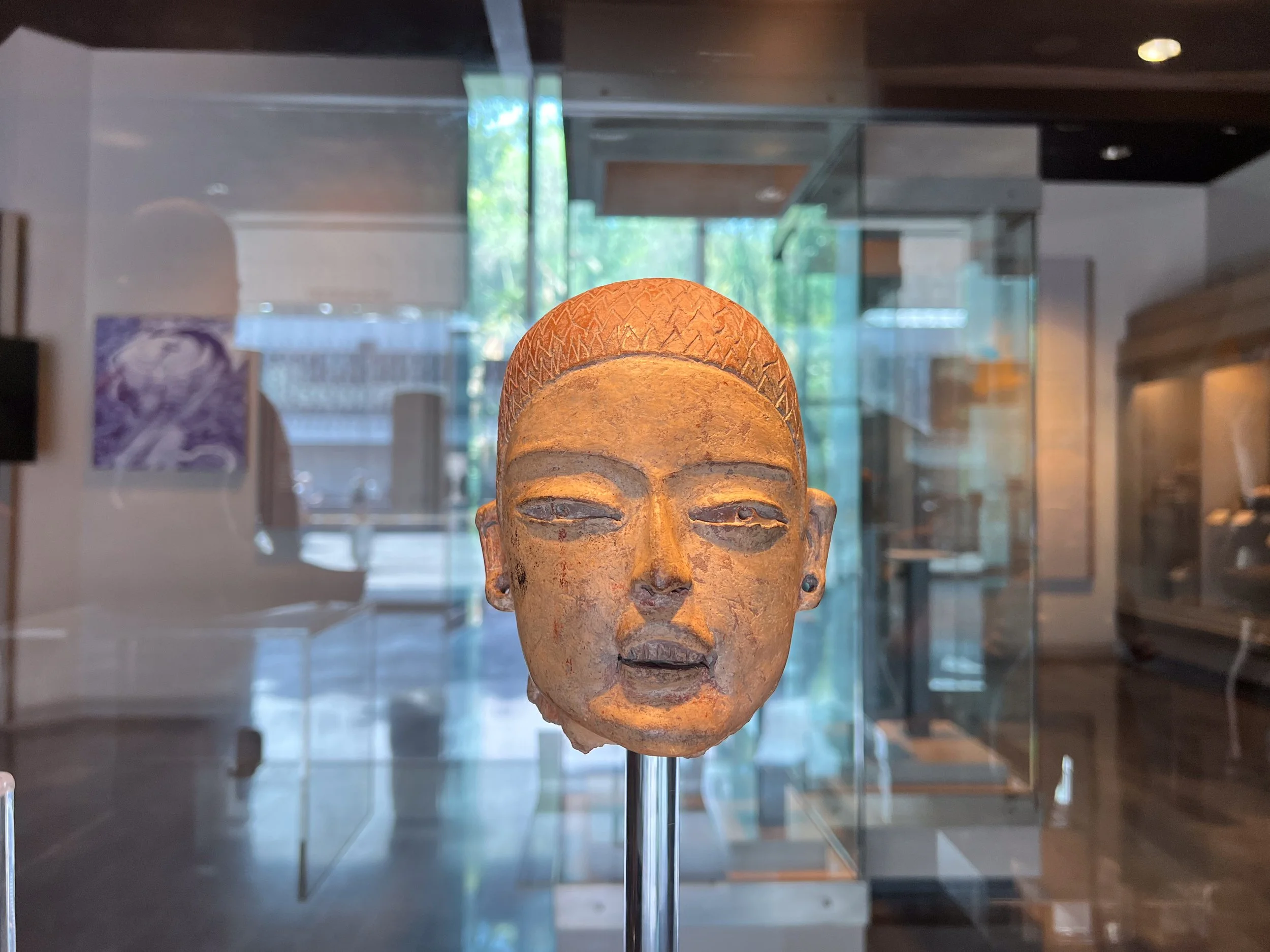
This mask from the Preclassic period shows strong Asian features.
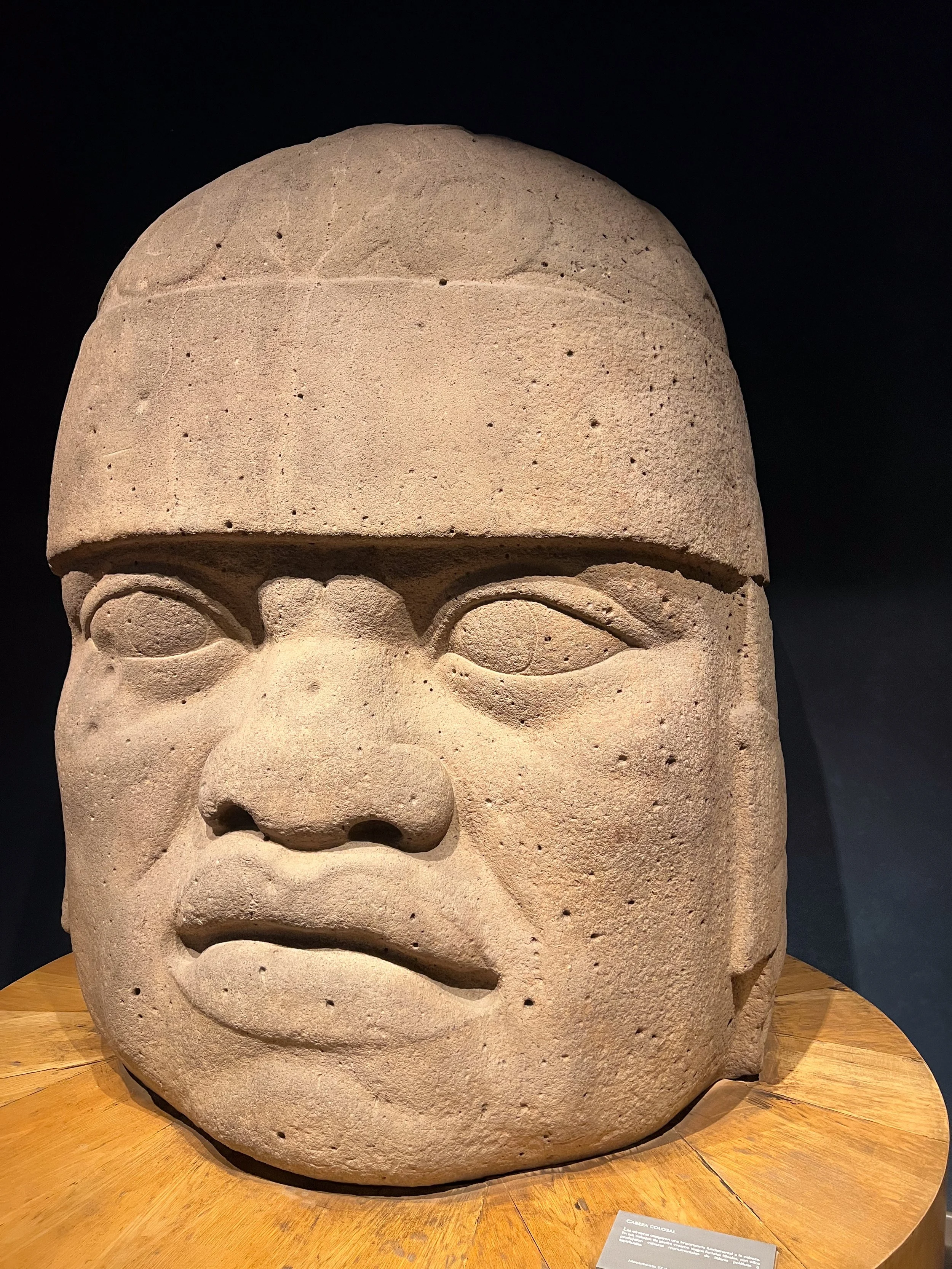
One of the Colossal Olmec heads (Gulf of Mexico region, Olmec culture, 1200-400 BC). "The colossal heads are one of the most iconic expressions of Olmec culture. These monumental stone sculputures have been interpreted in various ways: as representations of ancestors, shamans, warrior, or ballplayers. Hoever, the most widely accepted interpretatio identifies them as portraits of rulers, suggesting the existence of a political elite with great power and prestige. To date, 17 colossal heads have been discovered." —Bloomberg Connects Art & Culture
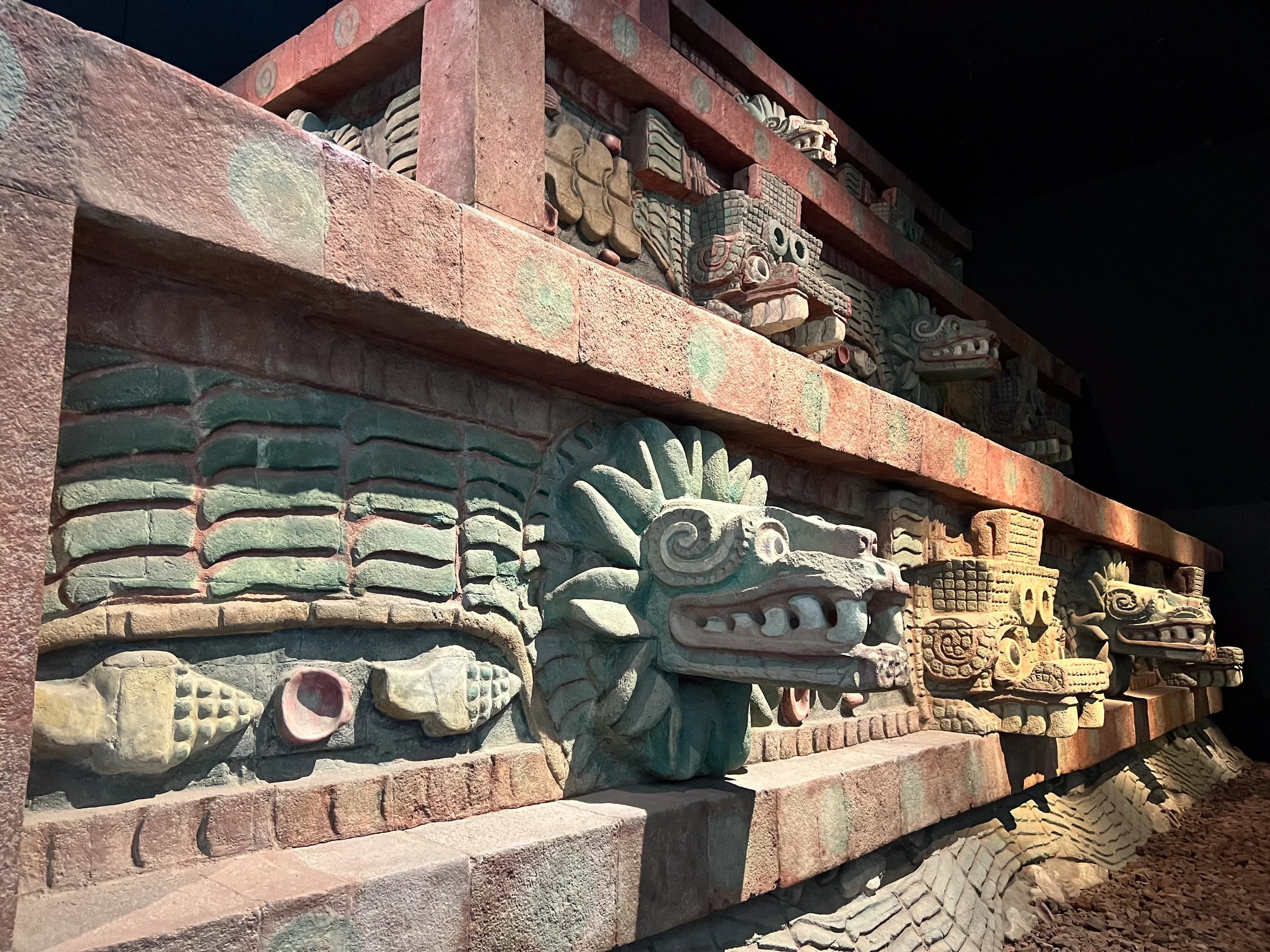
Reproduction of the Temple of the Feathered Serpent (Teotihuacan culture), built between 150 and 200 AD.
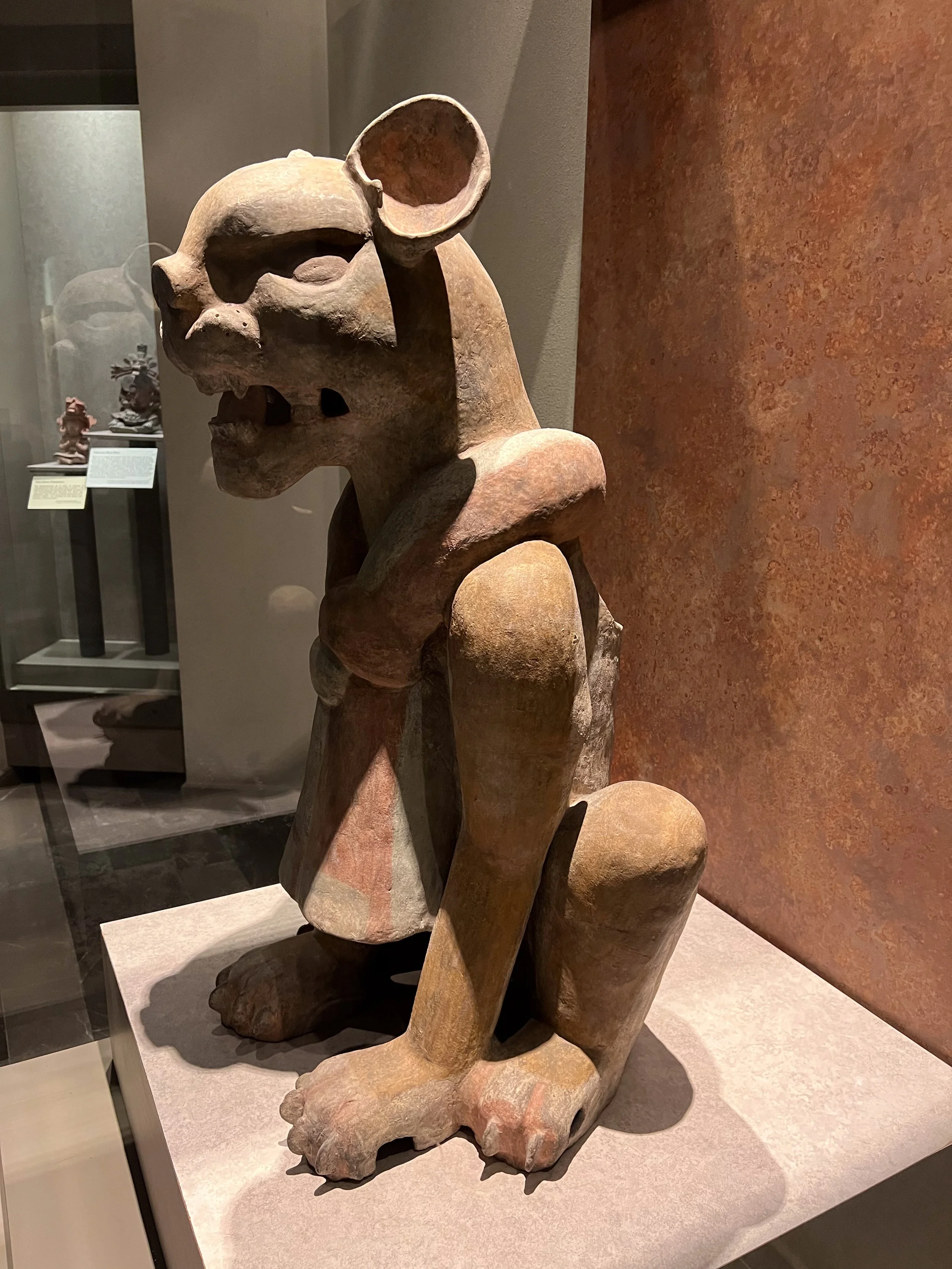
The Great Jaguar (Oaxaca region, Zapotec culture). From the Bloomberg Connects app: "The jaguar represents one of the most important sacred animals in Zapotec tradition. Associated with power, fertility, war, and the underworld, the jaguar also symbolized the authority of those who ruled."
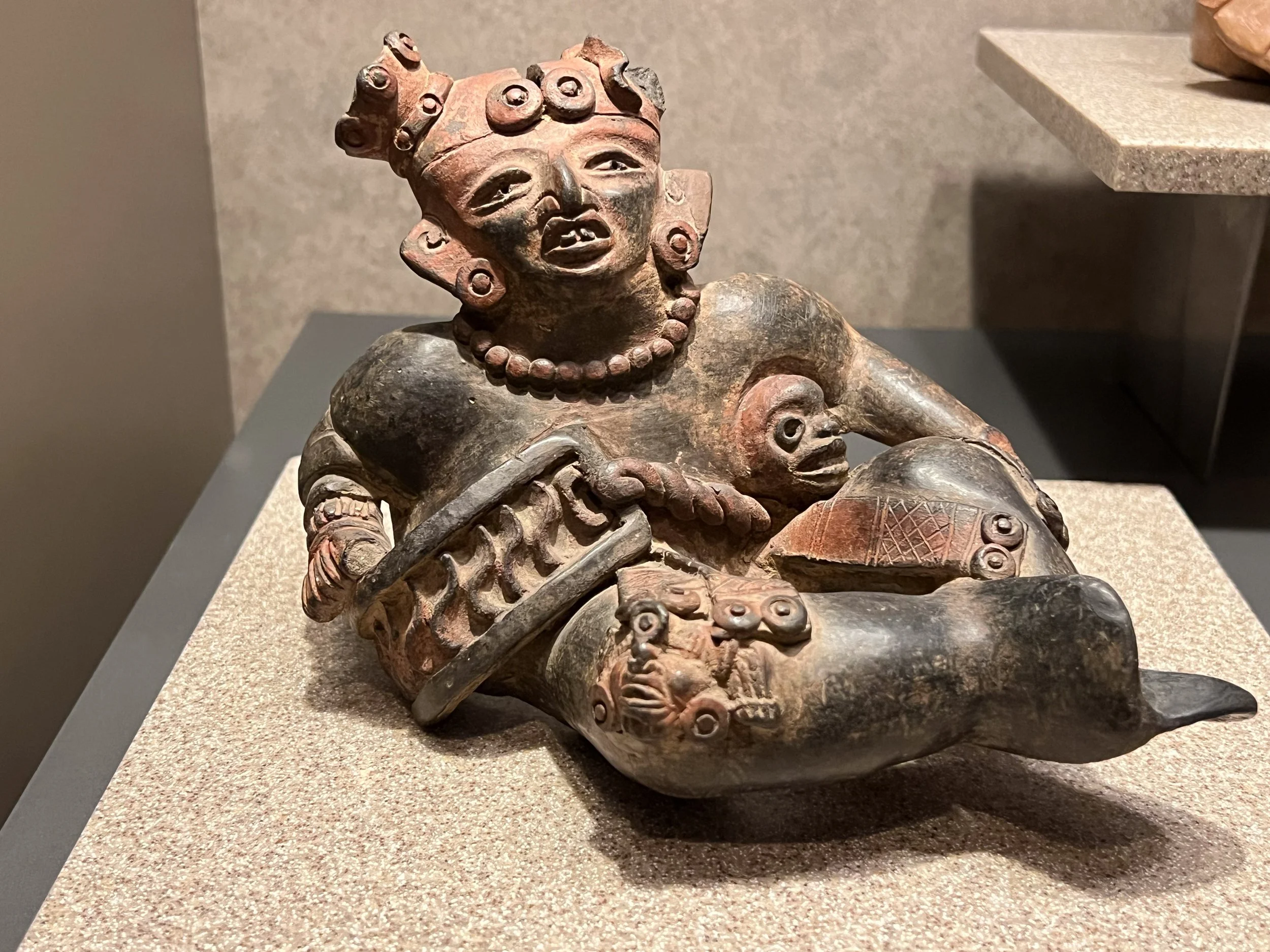
The Ball Player (Oaxaca region, Zapotec culture). From the Bloomberg Connects app: "This fragment of an effigy vessel depicts a player participating in the traditional hip ball game, a practice with more than 2,000 years of history in Oaxaca. The figure is depicted in the midst of action, wearing an elaborate outfit with a protective yoke and ornaments that signify his high rank."
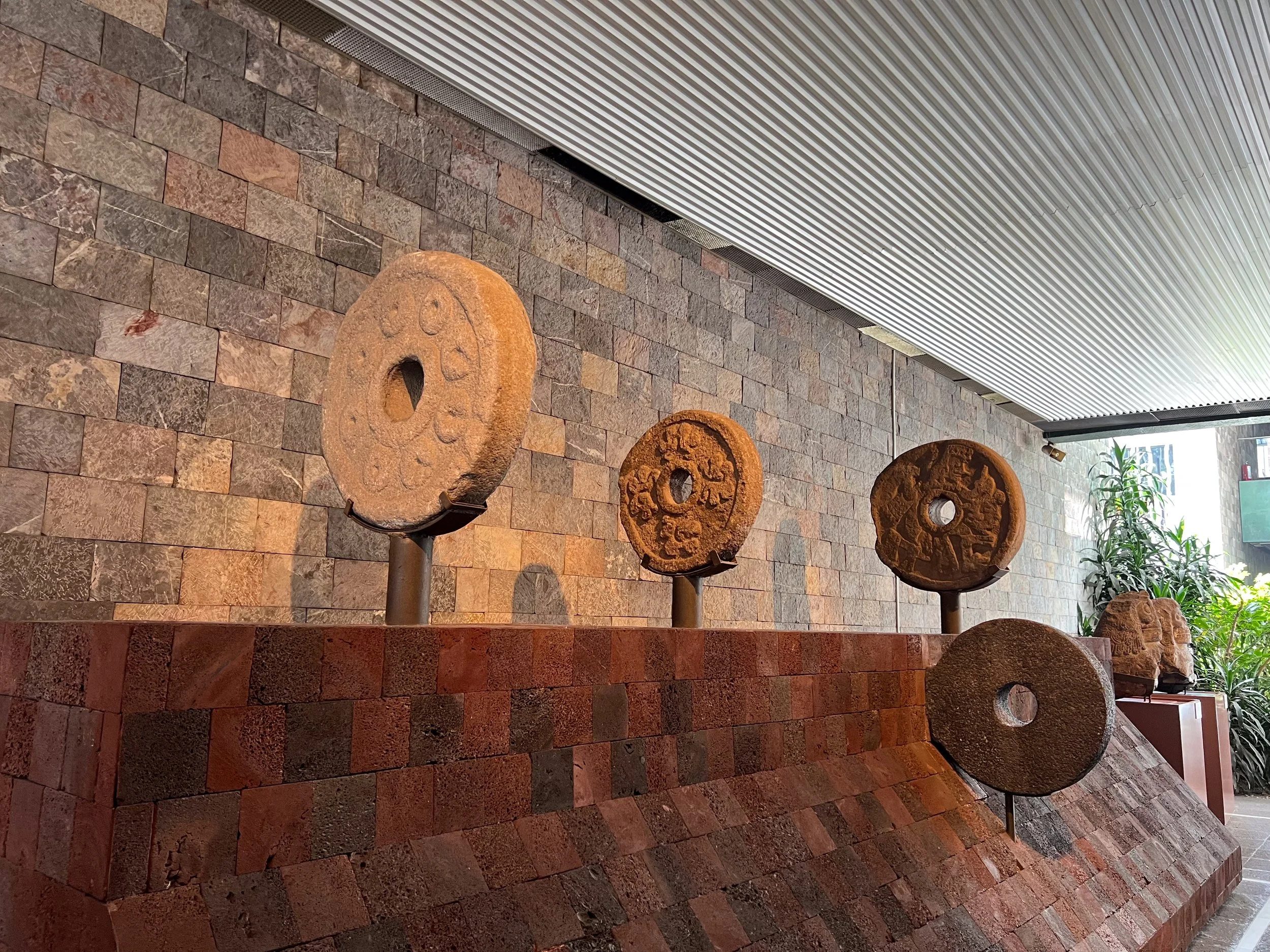
In the mesoamerican ball game, players would have to get a rubber ball through the center of discs such as these. Some variations required the players use only their hips or shoulders to strike the ball.
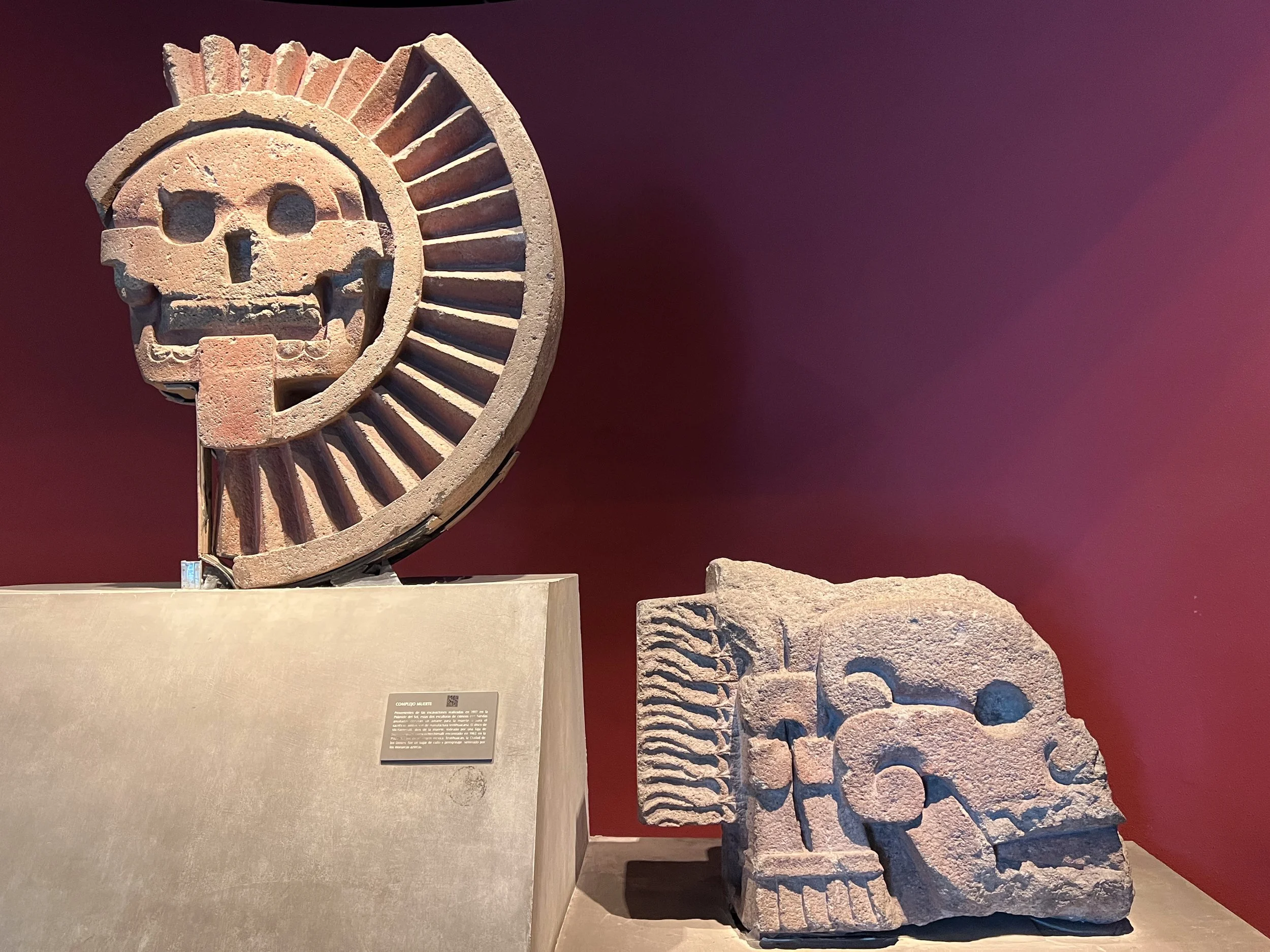
Death Disc (late Postclassic period, 1200-1521 AD). From the Bloomberg Connects app: "This large sculpture was discovered in 1963 south of the Pyramid of the Sun in Teotihuacan. It depicts a skull with its tongue sticking out, surrounded by a folded paper shield, a symbol associated with the Mexica. It is believed that it was not made by the Teotihuacans, but at a later time, when the city was already abandoned but was still an important sacred site visited by peoples such as the Mexica."
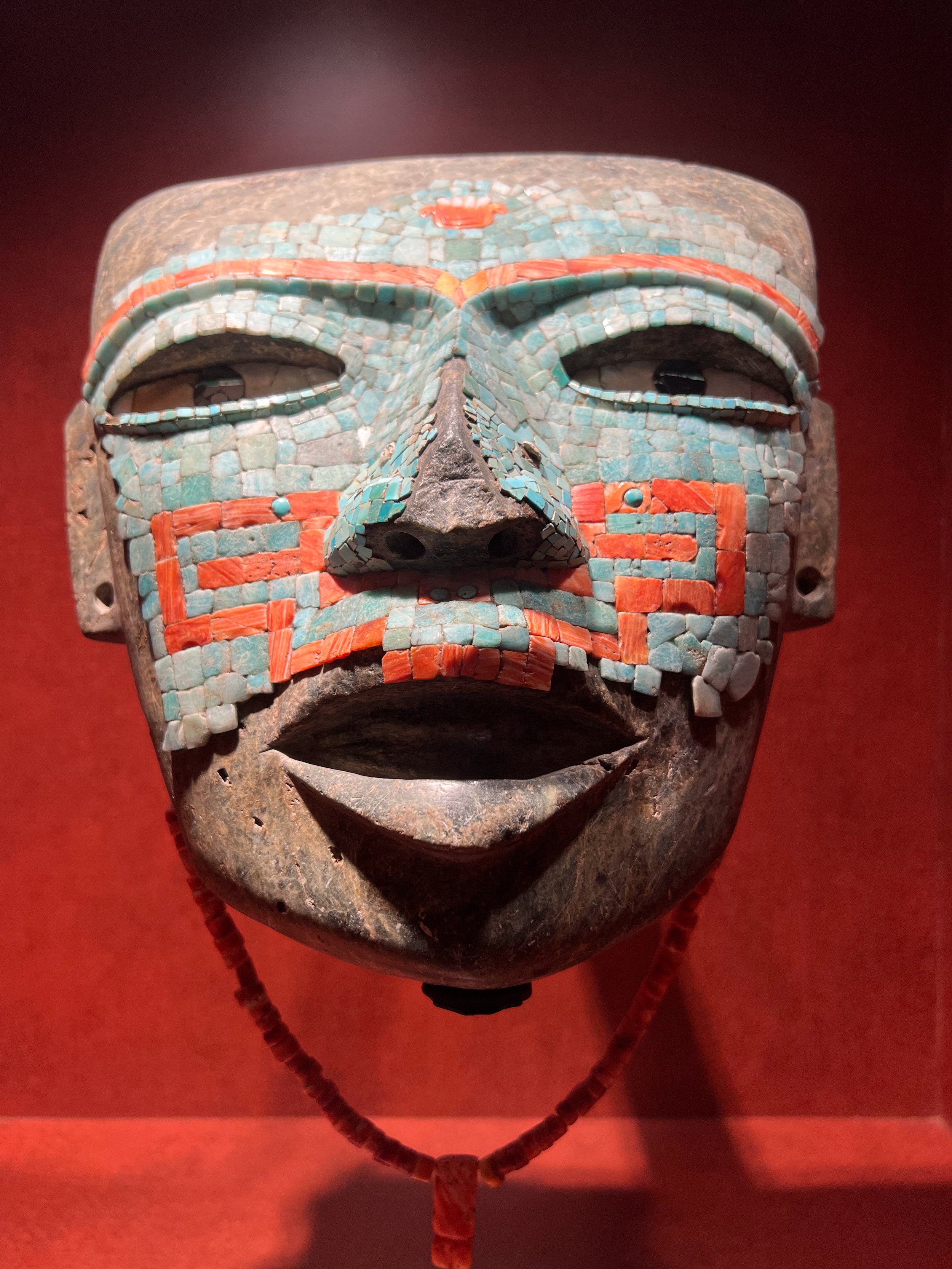
Malinaltepec Mask (Western Cultures, 1000-1200 AD). From the Bloomberg Connects app: "This green stone mask was made in the Teotihuacan era and, centuries later, reused as part of the funerary regalia of a person buried in Malinaltepec, Guerrero."
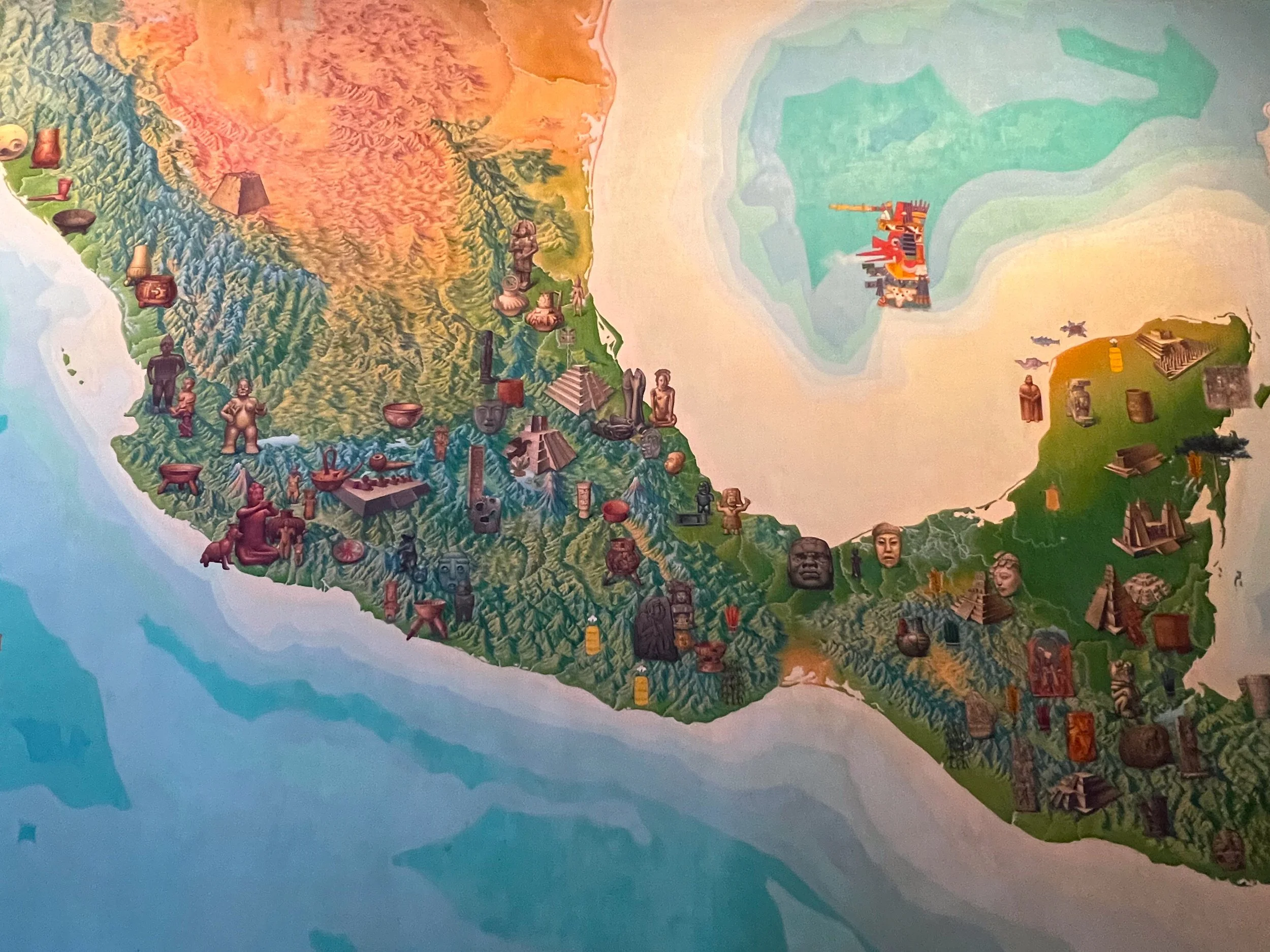
Map of Mesoamerica. This mural by Ernesto Vásquez Beltrán, depicts the numerous cultures that inhabited Mesoamerica for thousands of years.
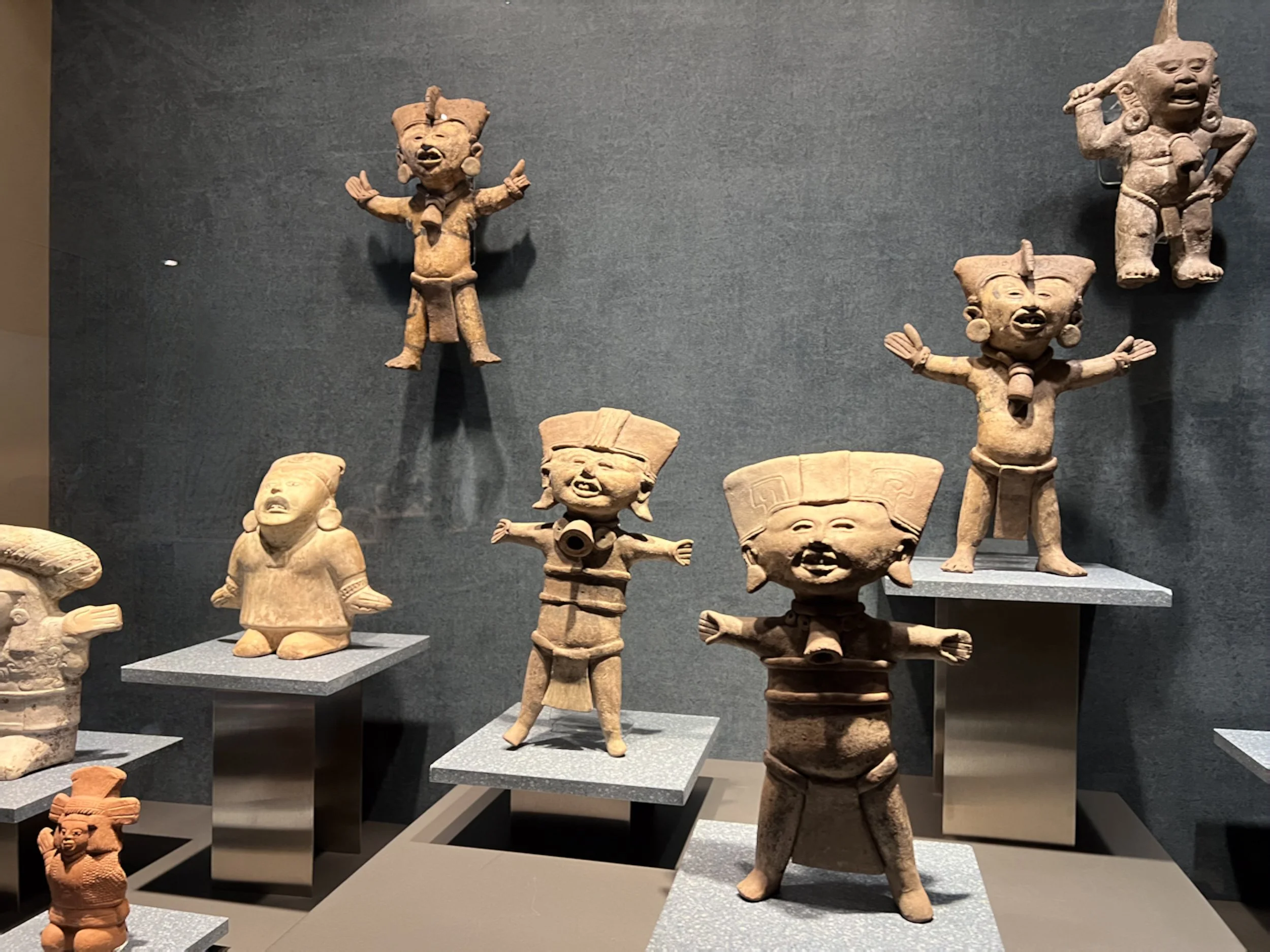
Smiling Figures (Gulf of Mexico region, culture of Central Veracruz, 150-900 AD). From Bloomberg Connects: "These unique figurines are notable for their smiling expressions, a feature that contrasts with the fact that they are frequently found in burial contexts. It has been proposed that their smiles served a symbolic purpose: to ease or make the passage to the underworld more bearable. These artifacts reflect the complex relationship between life, death, and ritual in Mesoamerican societies, as well as the importance of symbolic objects in funeral rites."
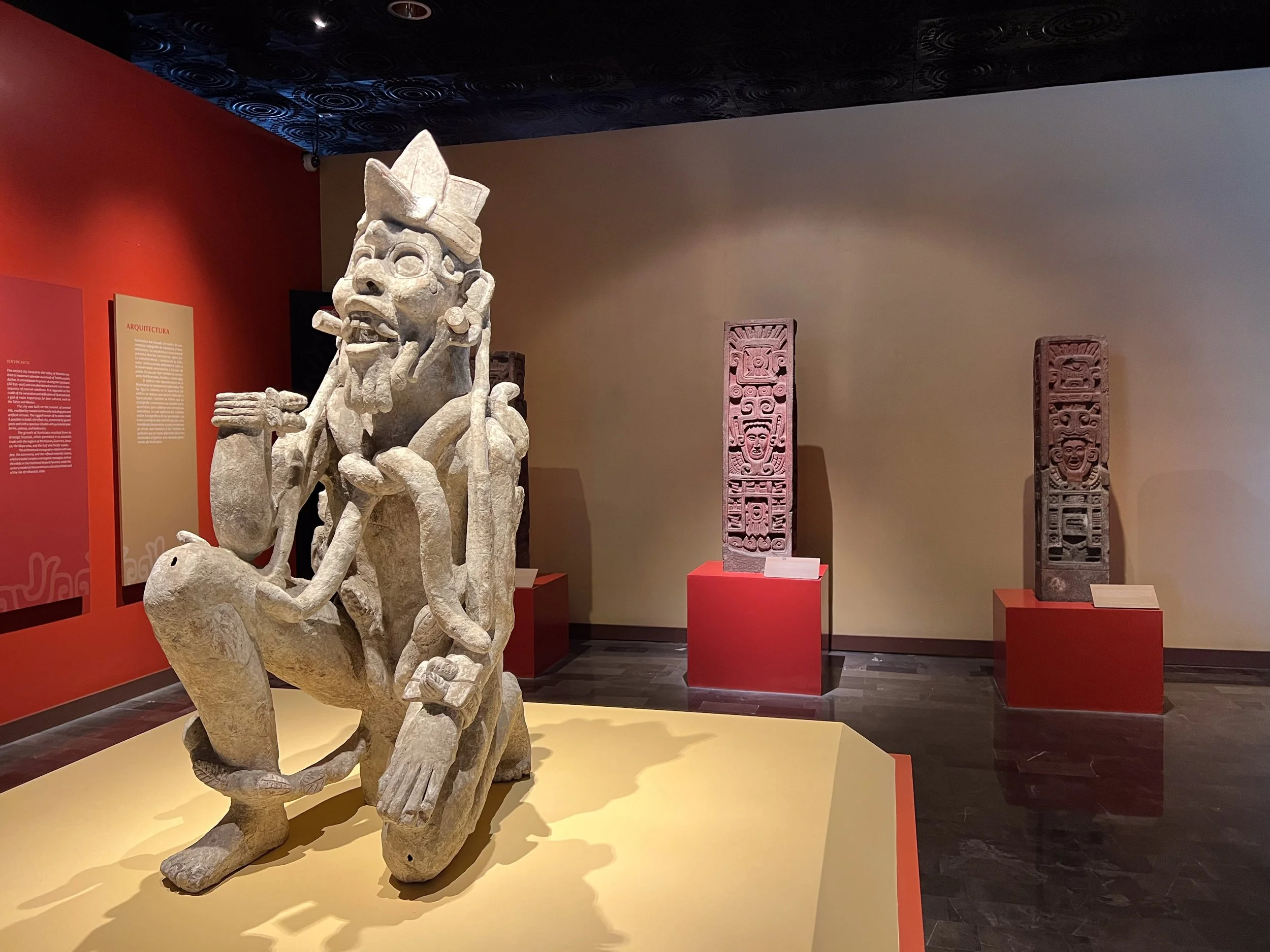
The God of Cacao. Now that's a deity I could believe in! Toltec, Xochichalca Culture (Late Classic period 650-900 AD).
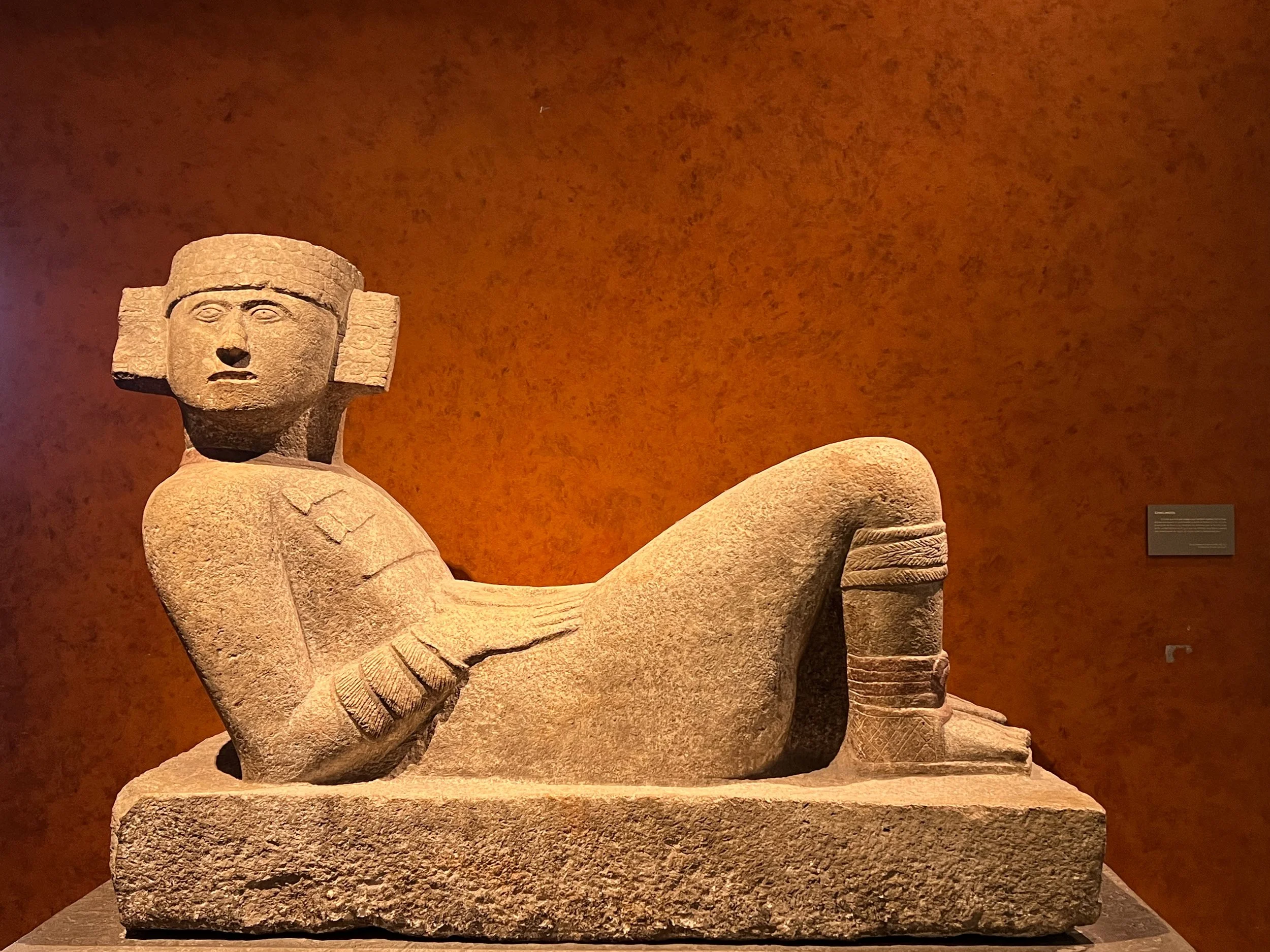
Maya Chacmool sculpture (Gulf of Mexico region, terminal classic to late post-classic period, 950-1200 AD). This Chacmool was excavated at Chichén Itzá.
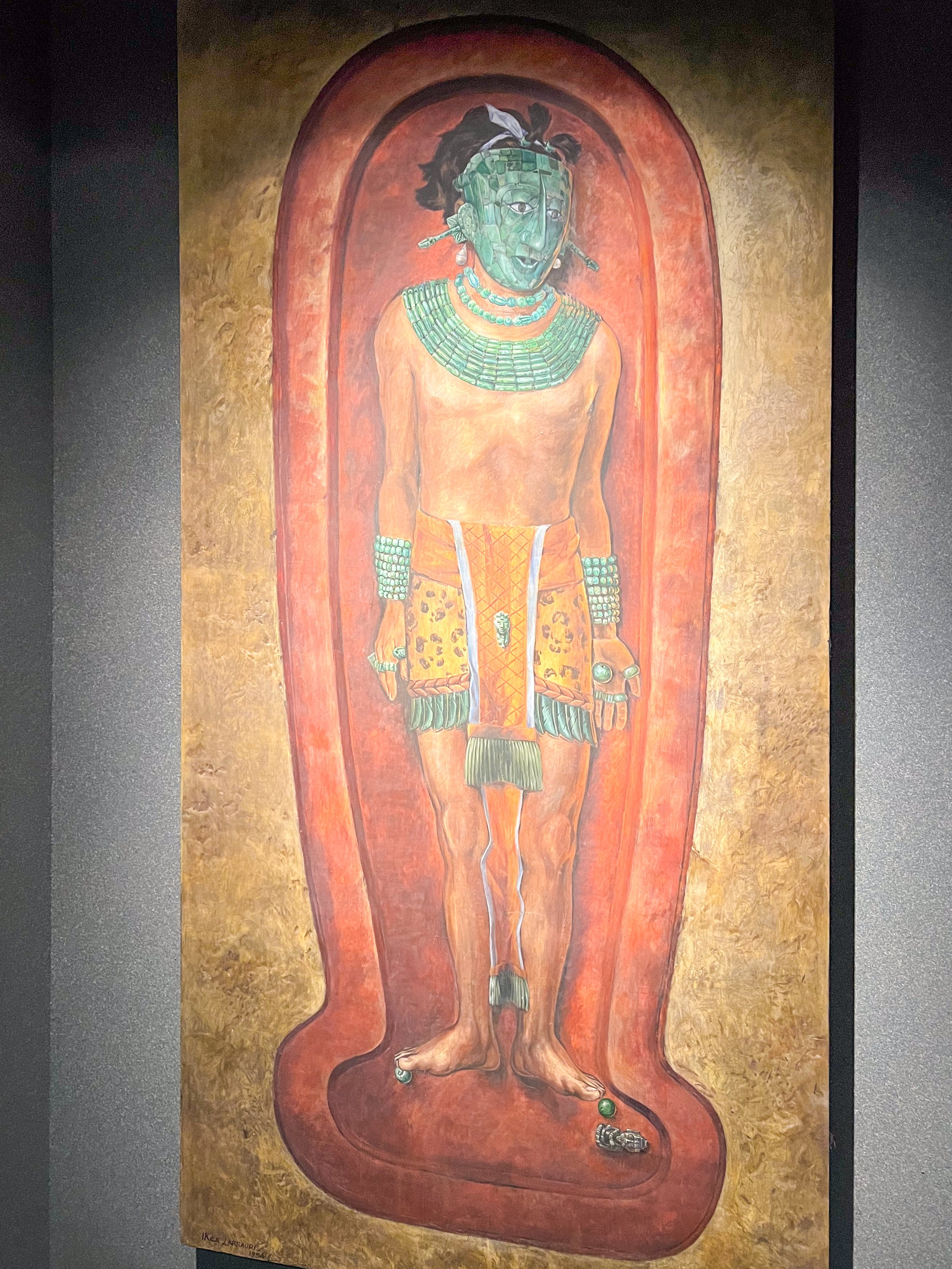
An artistic depiction of the burial sarcophagus of K'inihc Janahb' Pakal (Pakal the Great), a Maya ruler. The burial mask, which the museum has on display, is jade. (Late Classic period 650-900 AD).
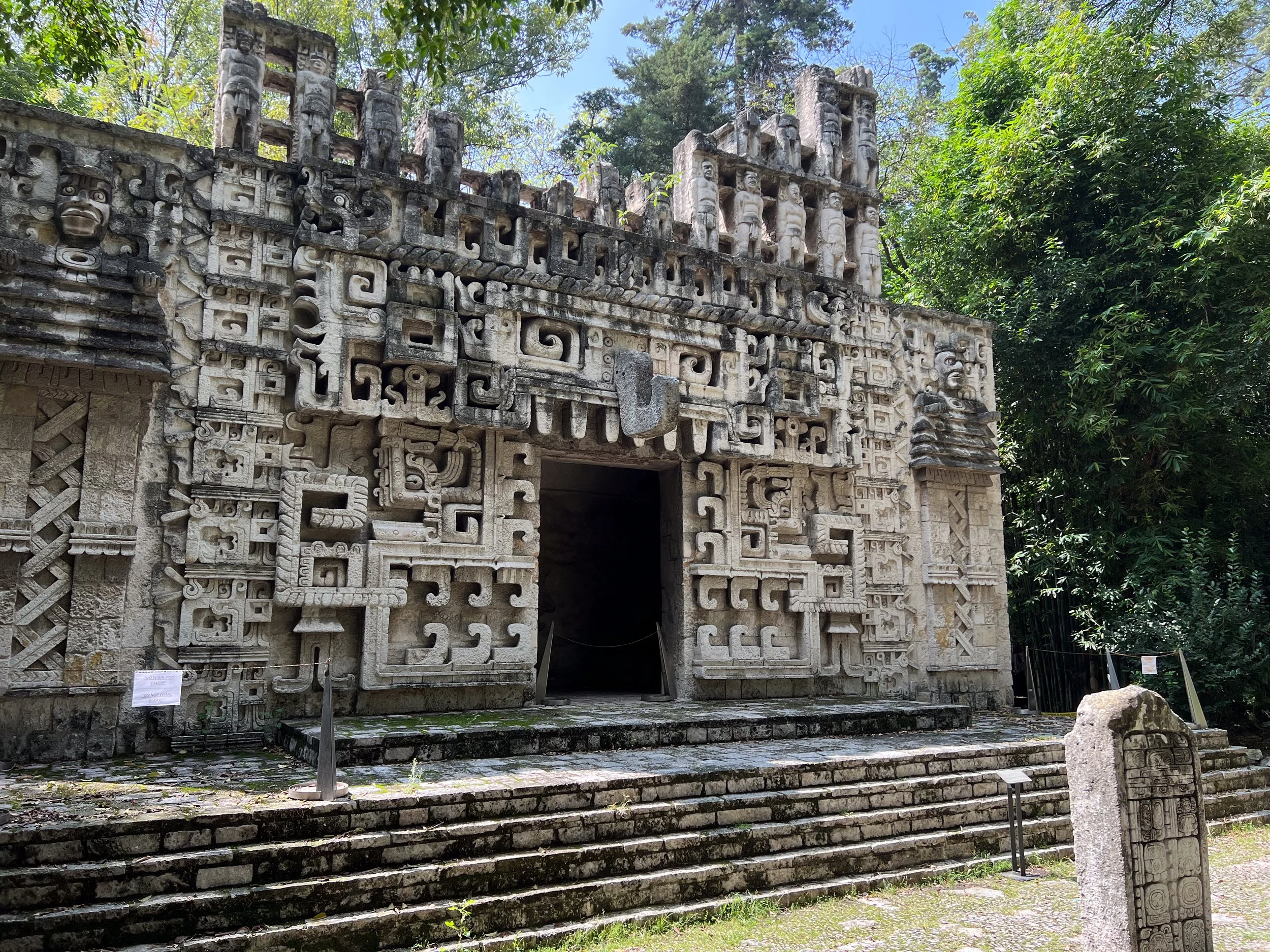
Reproduction of a temple from the Maya site of Hochob.
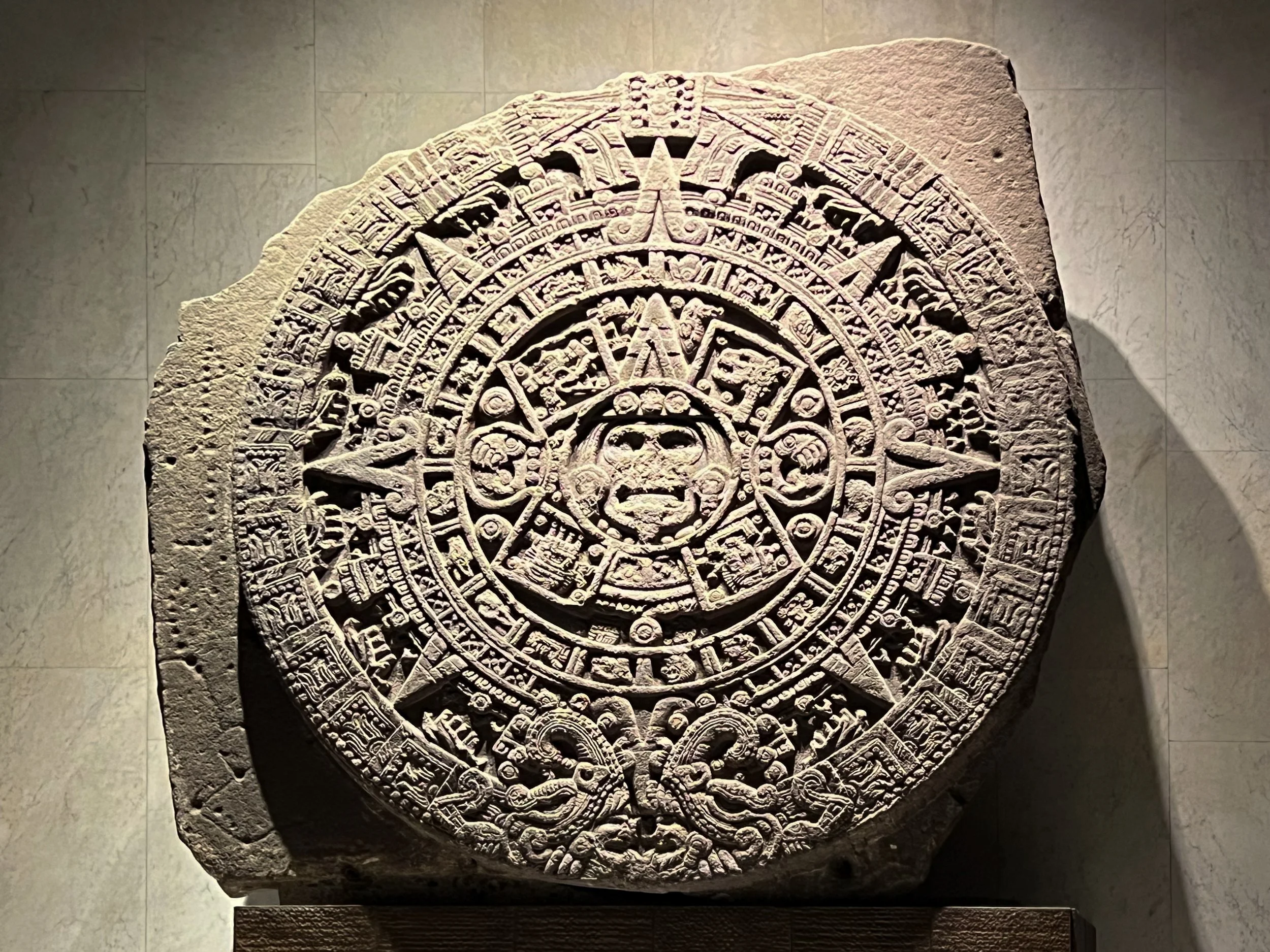
"The Sun Stone is one of the most important monuments of the Mexica worldview, and represents the creation of the Fifth Sun, the era in which we live. On its surface, the sculpture brings together symbols of the calendar, the cyclesof time, the four previous suns, and elements associated with sacrifice and the order of the universe." —Bloomberg Connects app (Mexica culture, 1200-1521 AD)
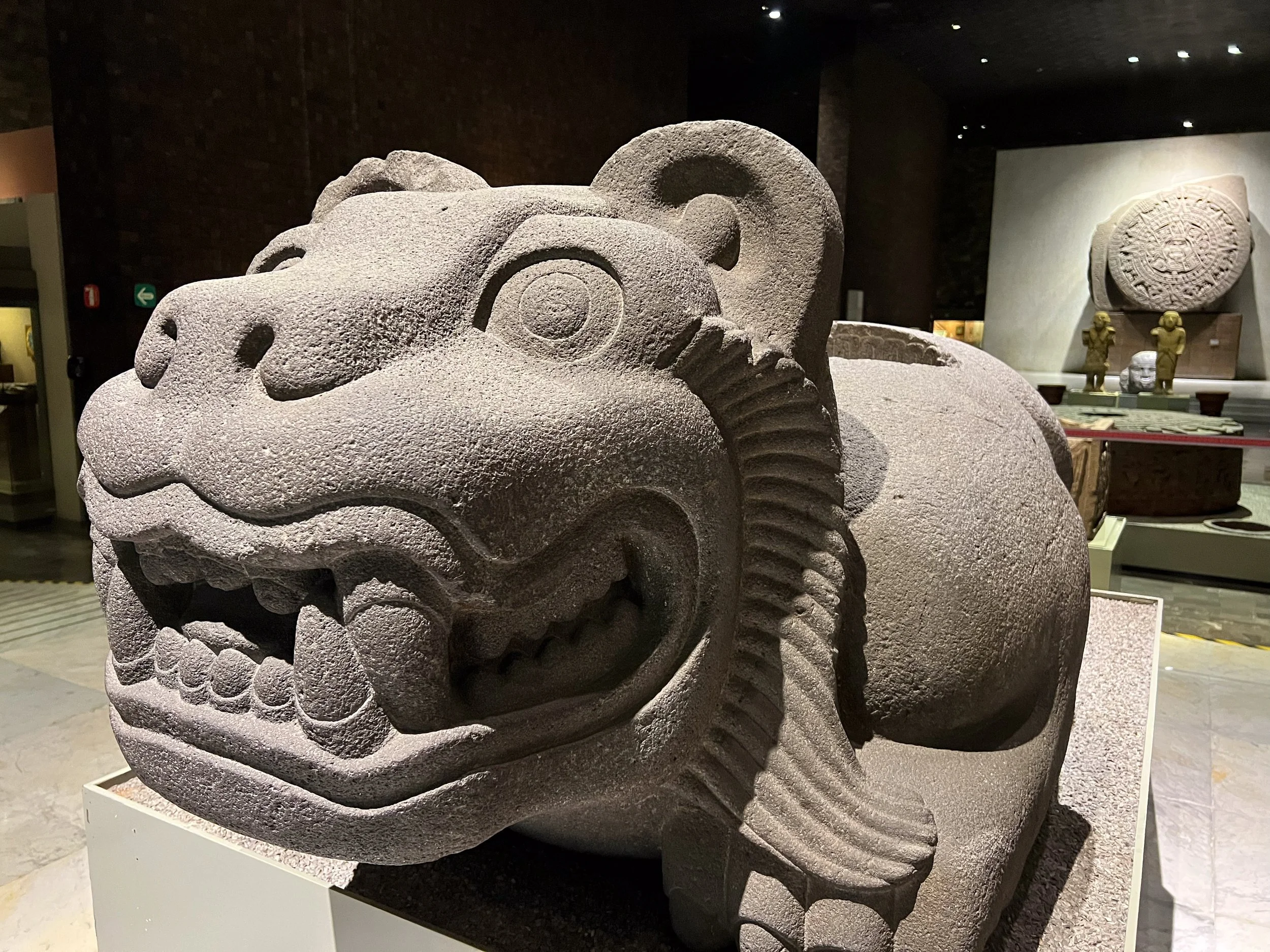
From the Bloomberg Connects app: "This cuauhxicalli, or 'eagle vessel', is a Mexica work in the shape of a jaguar associated with the earth, the night and warrior power. For the Mexica, these vessels were used in rituals to hold symbolic offerings as part of their vision of balance between the human world, nature, and the universe." (Mexica culture, 1200-1521 AD)
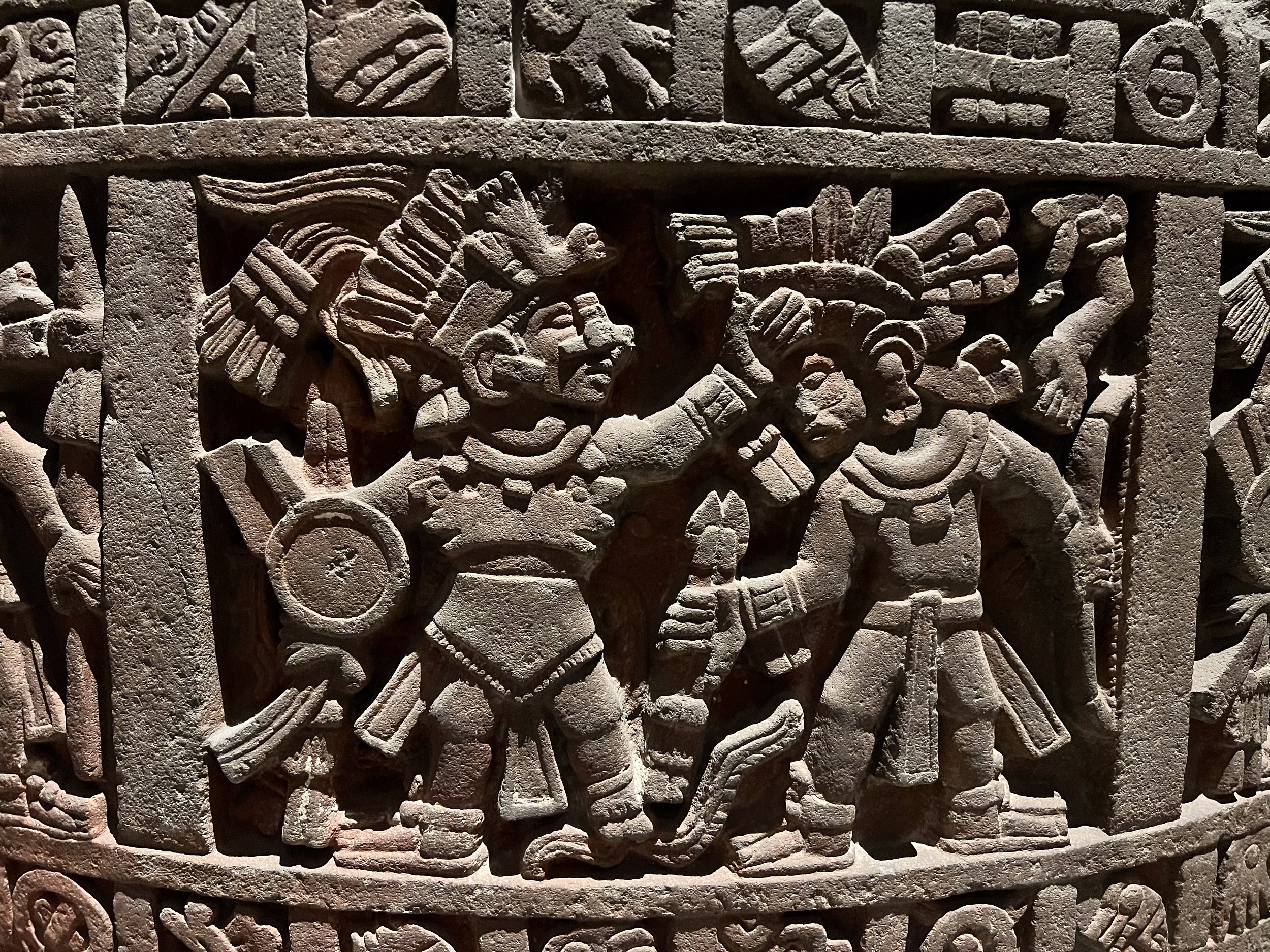
Detail of carvings on the side of a Mexica sacrificial stone.
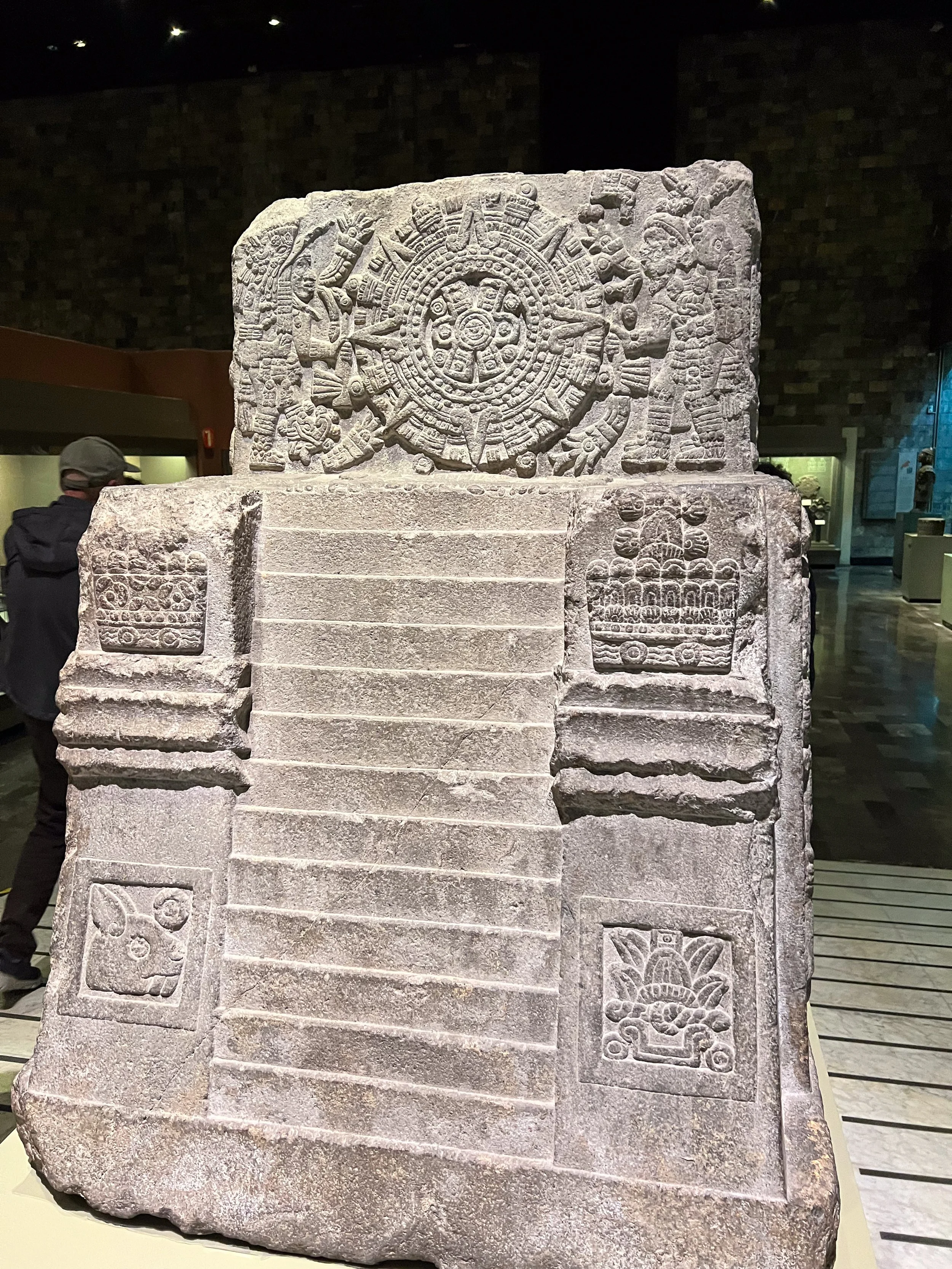
Teocalli of the Sacred War (Mexica culture, 1200-1521 AD). From Bloomberg Connects: "The scenes carved into this monument, which represents a temple, depict themes such as the beginning of the Mexica era with the image of the Fifth Sun, located at the top of the pyramid, and the symbol of the founding of their city in the middle of Lake Texcoco, which can be seen on the back of this sculpture."
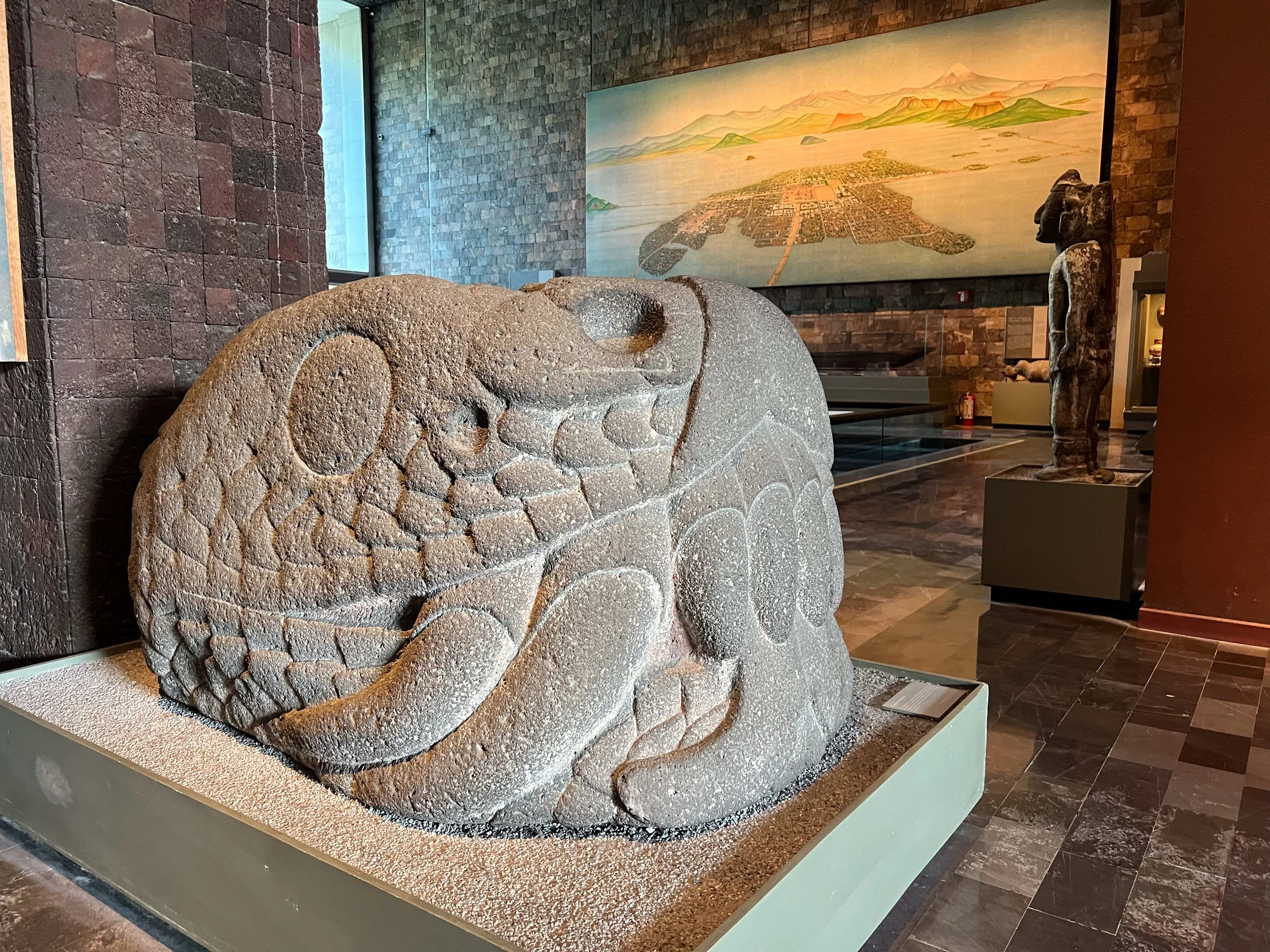
Giant snake head (Mexica culture).
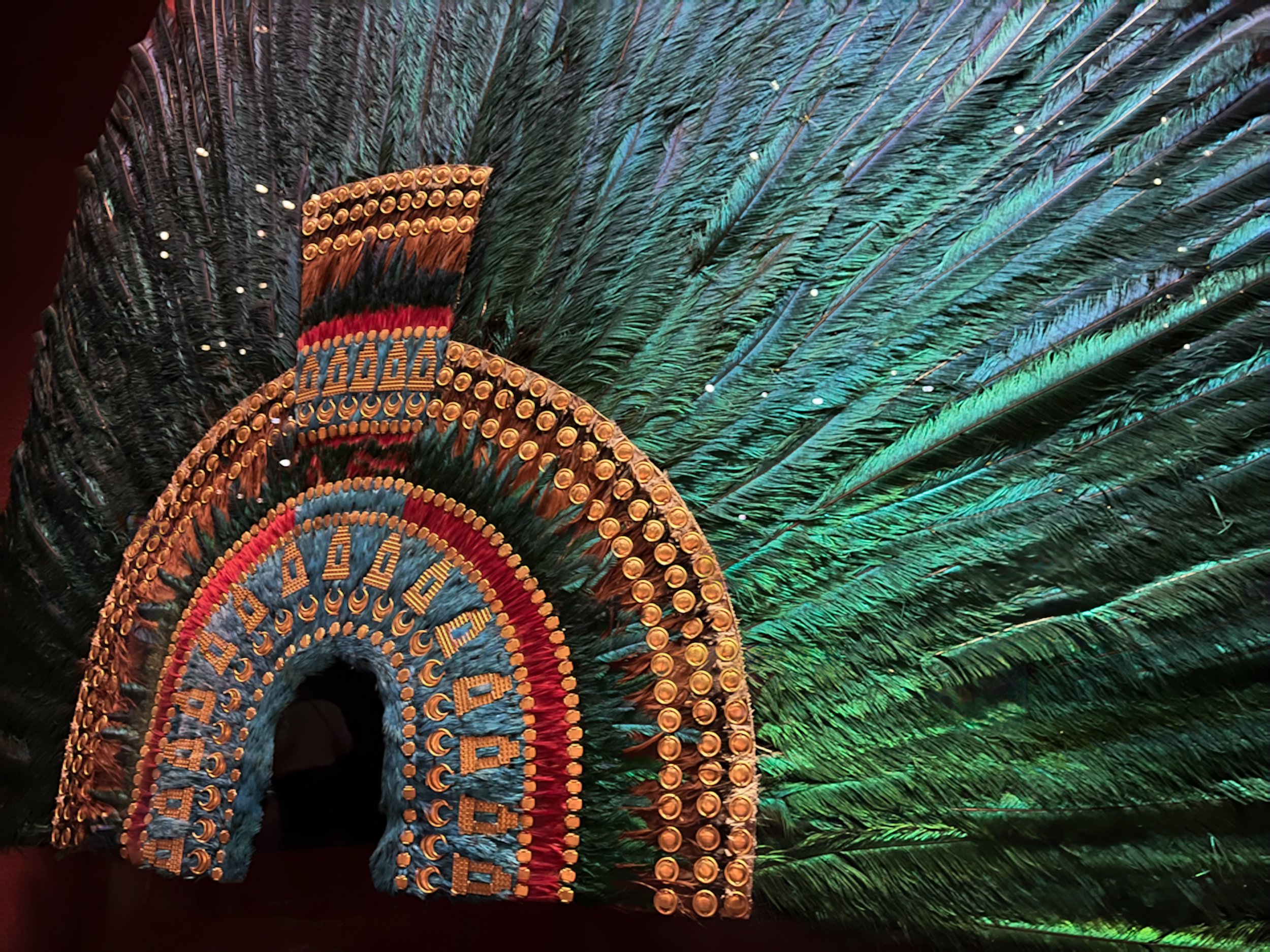
Queztal feather headdress, Mexica (Aztec) culture.
Biblioteca Vasconcelos and Museo Mural Diego Rivera
Biblioteca Vasconcelos is a magnificent oasis of peace and quiet encompassing over 400,000 square feet. And books. Many, many books. It opened in 2006 and was declared “one of the most advanced constructions of the 21st century” by Vincente Fox, Mexico’s president at the time. However, it closed in 2007 due to construction defects and re-opened 22 months later.
The Diego Rivera mural, “Sueño de una Tarde Dominical en la Alameda Central” (Dream of a Sunday Afternoon in the Alameda Central), is housed in a museum not too far away, near the Alameda Central Park itself.
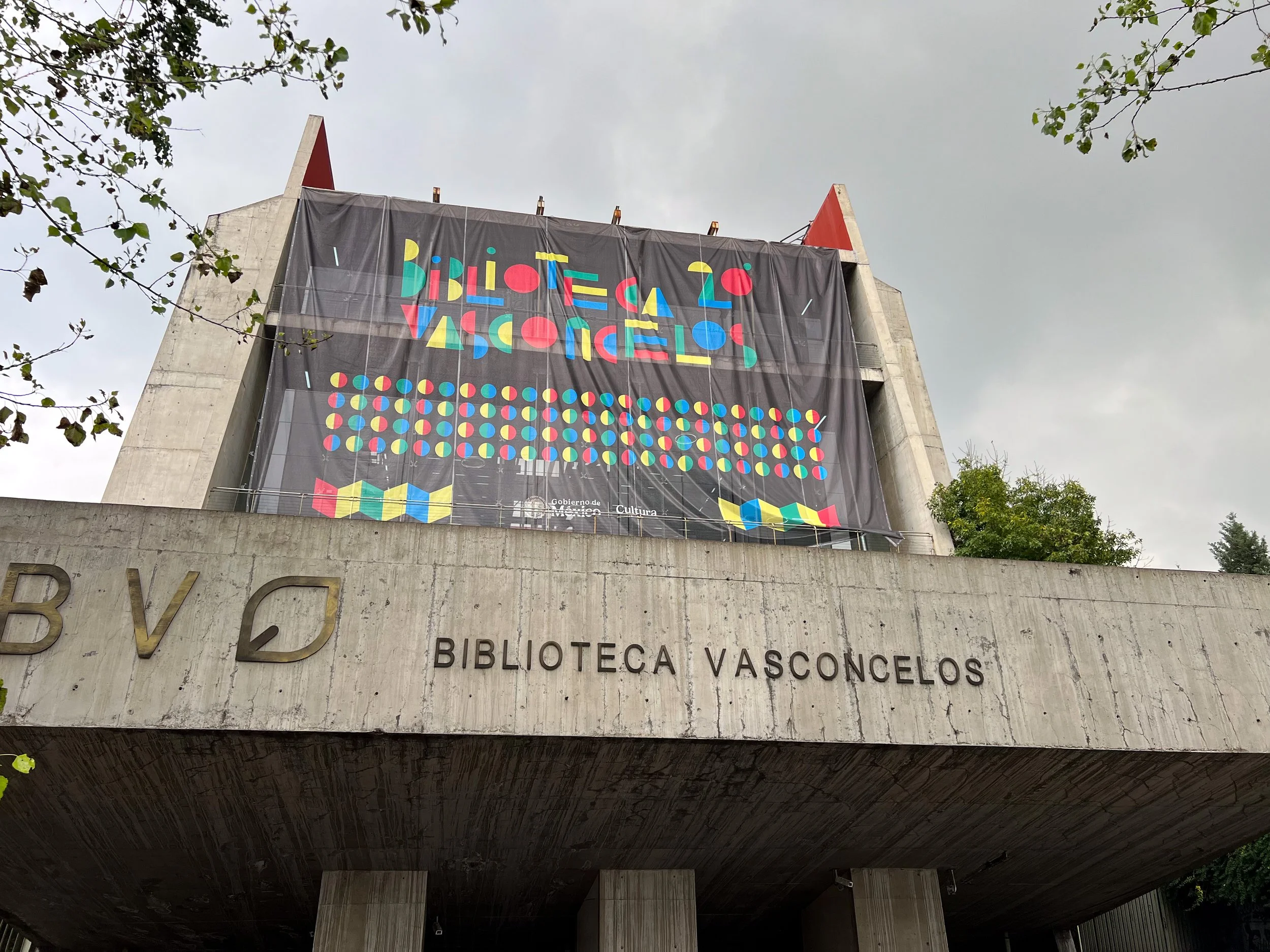
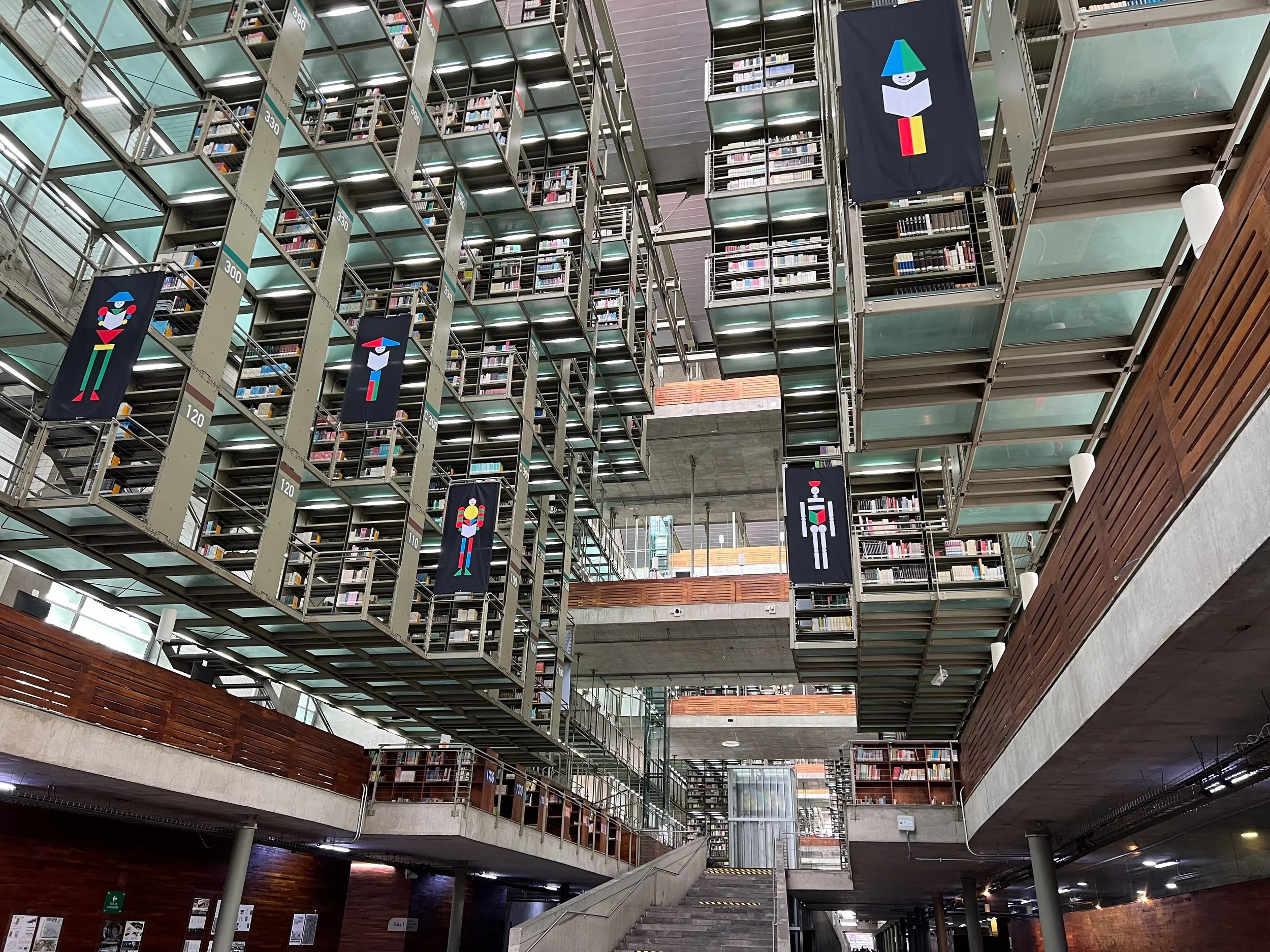
Biblioteca Vasconcelos
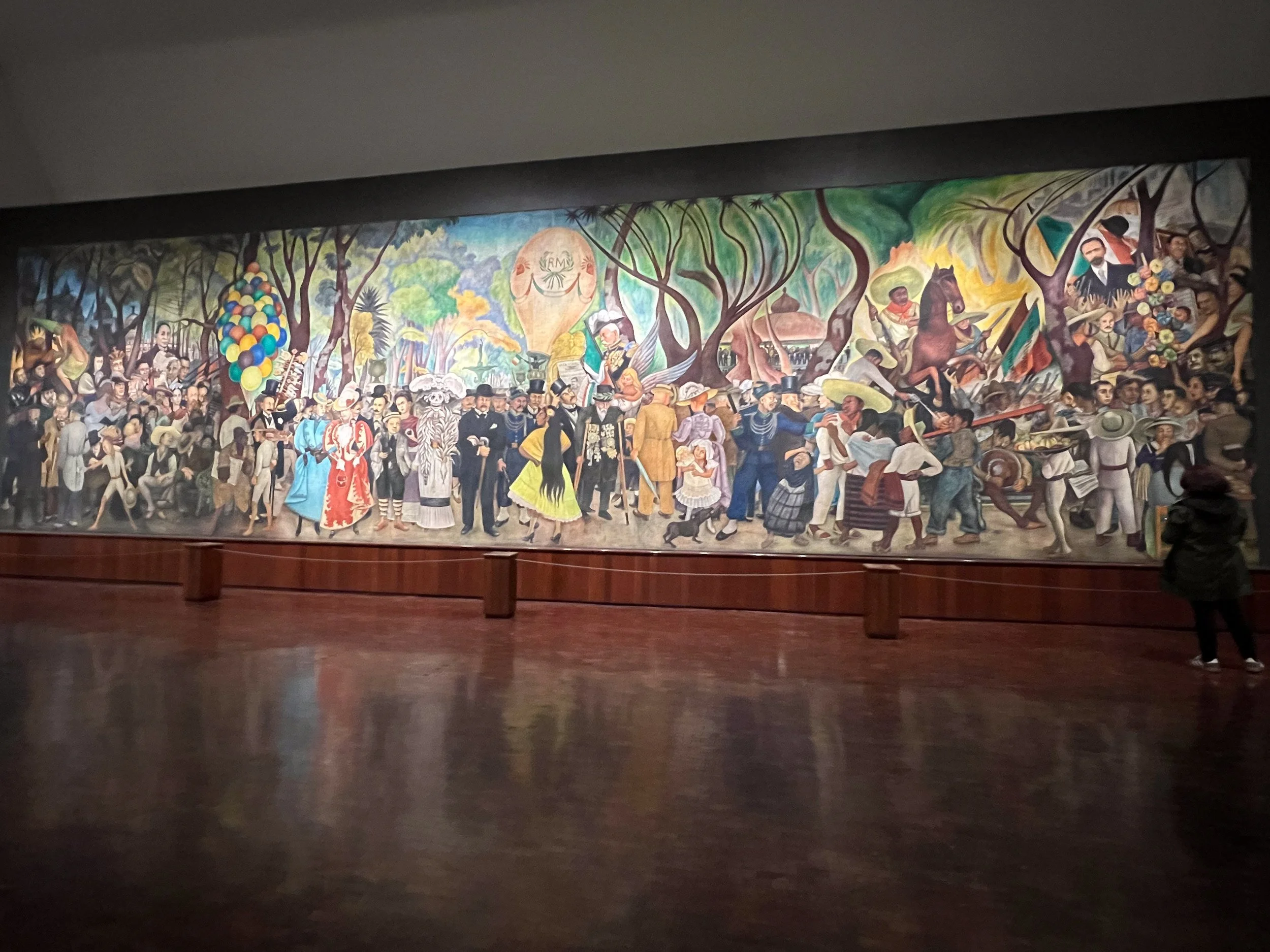
"Sueño de una Tarde Dominical en la Alameda Central" by Diego Rivera. The Museo Mural Diego Rivera exists only for this mural.
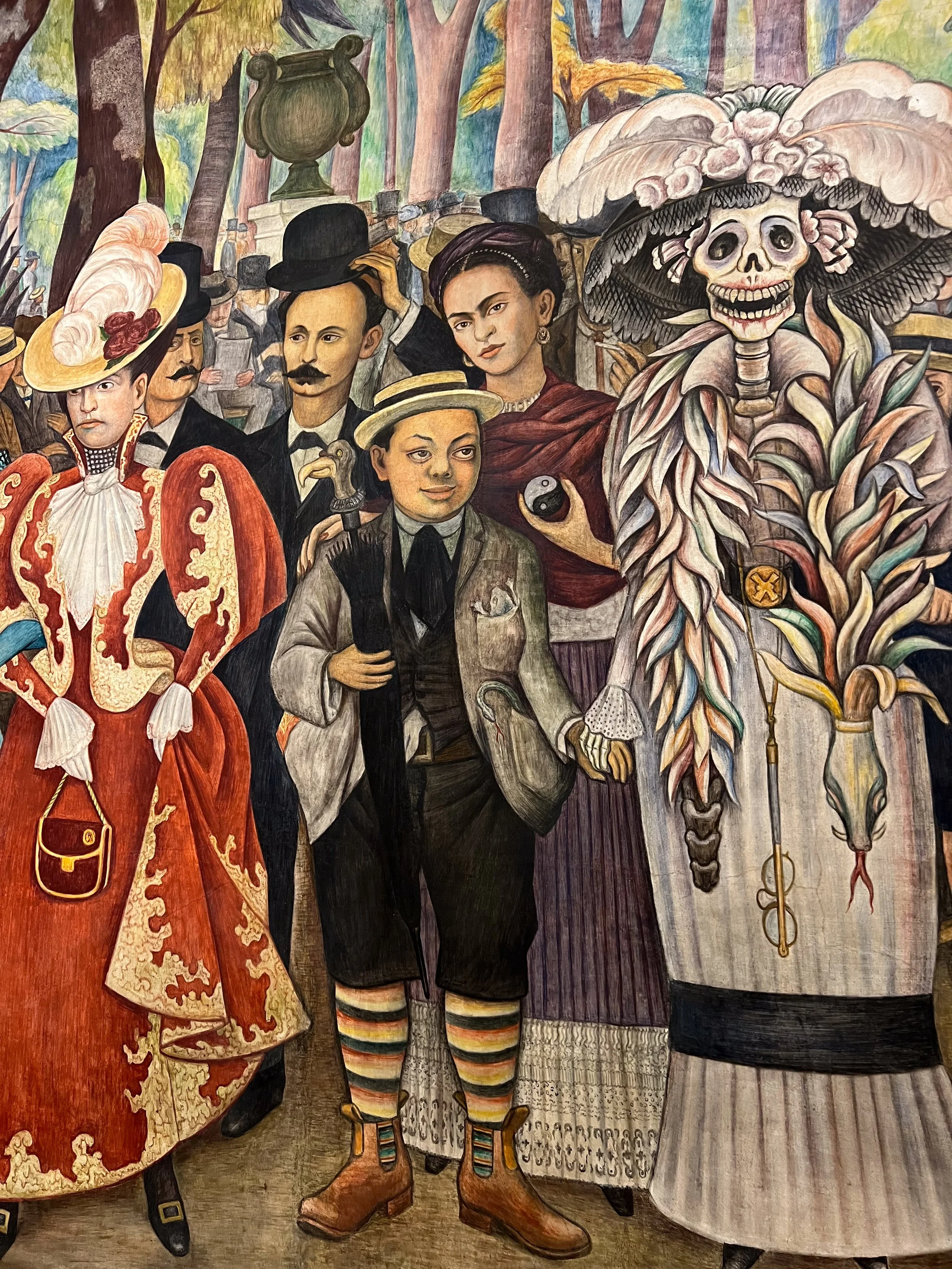
In this detail, at the center of the mural, you see Diego Rivera's self-portrait of himself as a child. He is holding the hand of "La Catrina," a figure representing death and social satire. Behind him stands Frida Kahlo, holding a yin yang symbol.
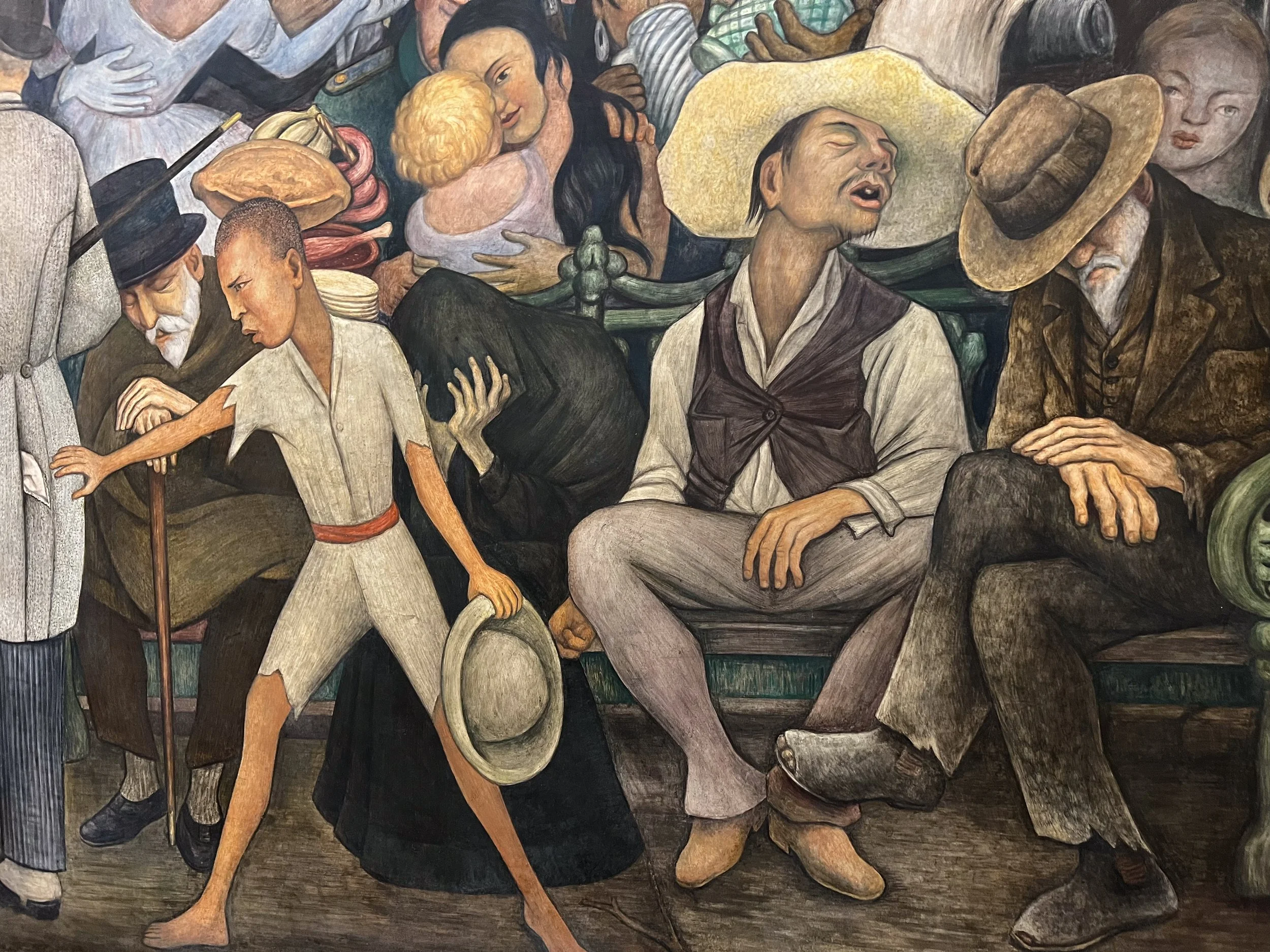
In this detail, a poor boy in ragged clothes is about to pick the pocket of a wealthy gentleman. Two men, one elderly with worn-out shoes, sit on a park bench, dreaming of better times.
Centró Historico
I took a walking tour of the Centró Historico, which has evolved from the main plaza of the city when it was ruled by the Aztecs.
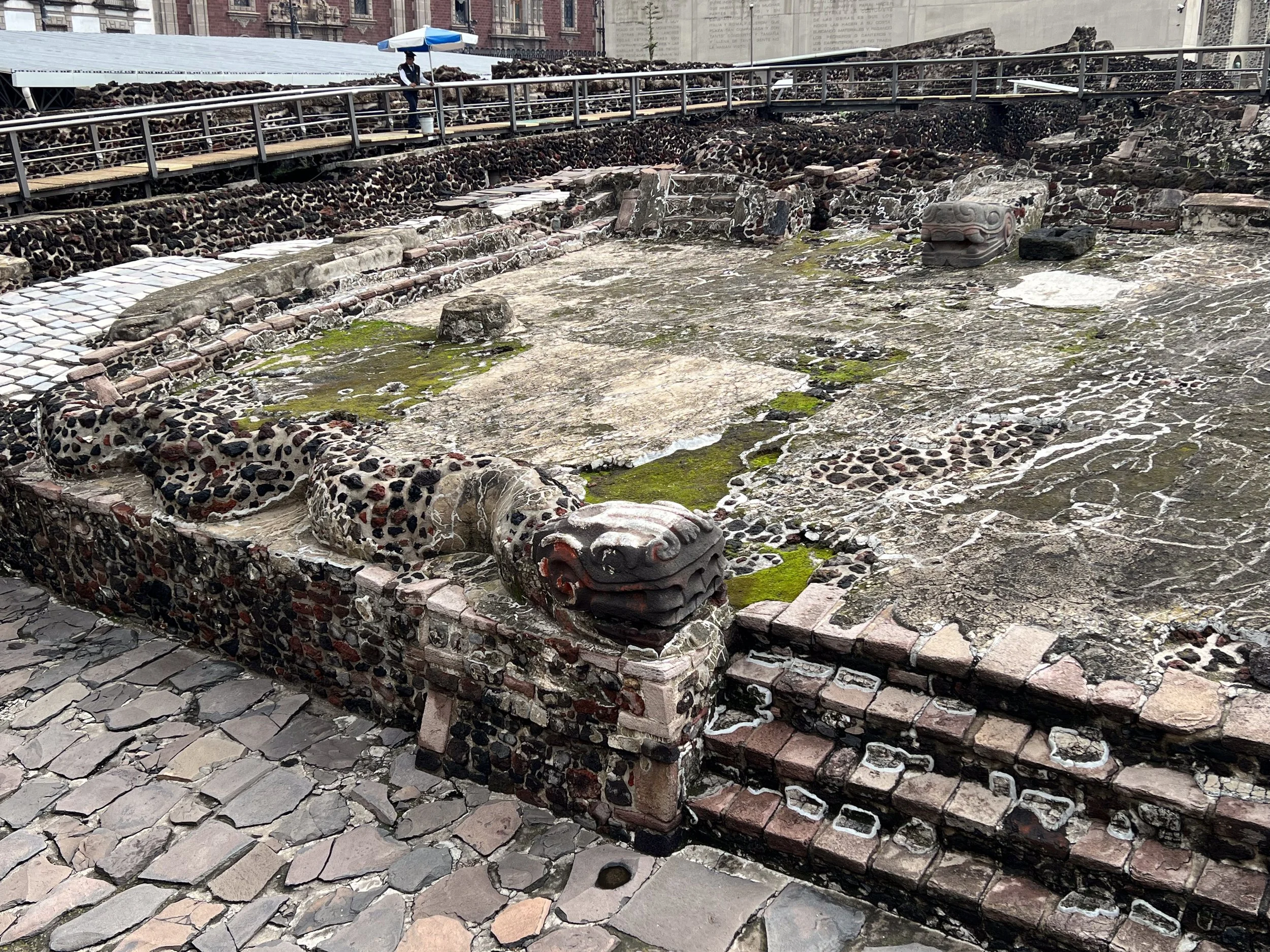
Snake figure in the ruins of the Aztec Templo Mayor. The Mexica (Aztec) founded Tenochtitlan (now Mexico City) in 1325, and construction of Templo Mayor (the main temple) began shortly thereafter. After the Spanish invasion in 1521, the temples were destroyed and the building materials were used to create the Spanish colonial city.
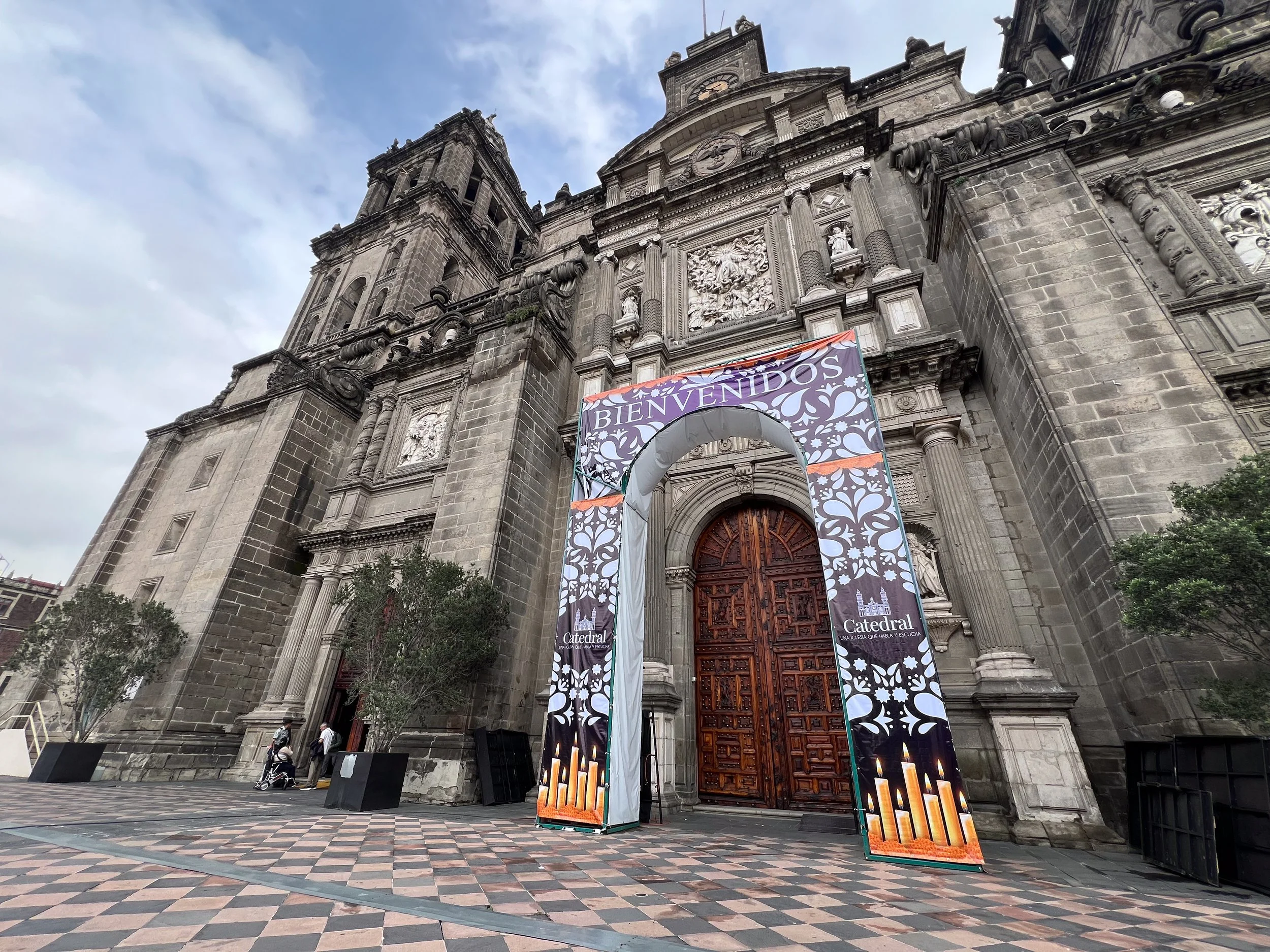
The Catedral Metropolitana, built on Aztec ruins. Because of the instability of the land on which it was built, it is sinking in 4 different directions, requiring constant monitoring and engineering intervention.
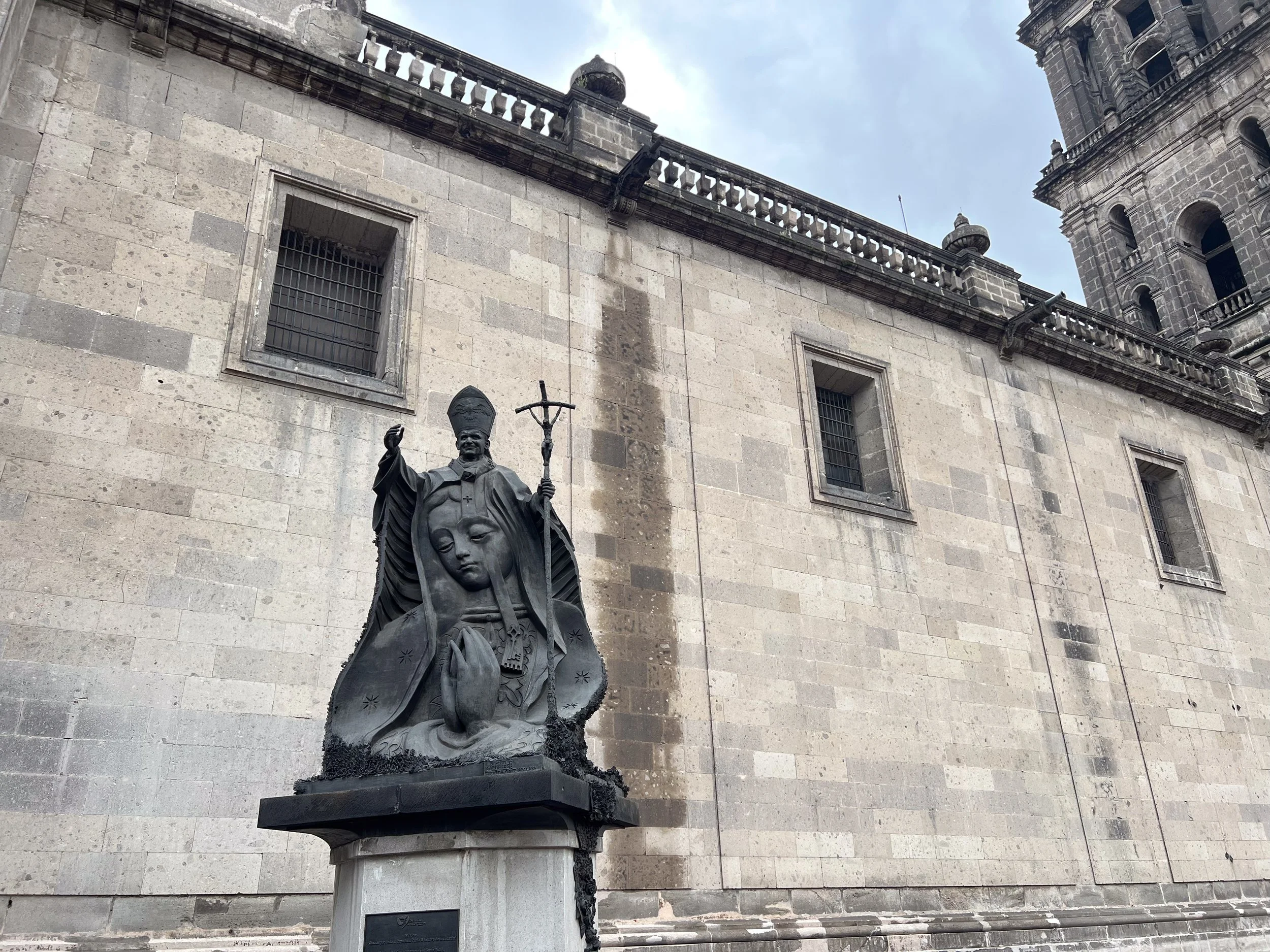
"Llaves de Fe," a sculpture commemorating Pope John Paul II's visit to Mexico City. There was a rift between the Mexican Catholic church and the Vatican, and this visit was to help build bridges.
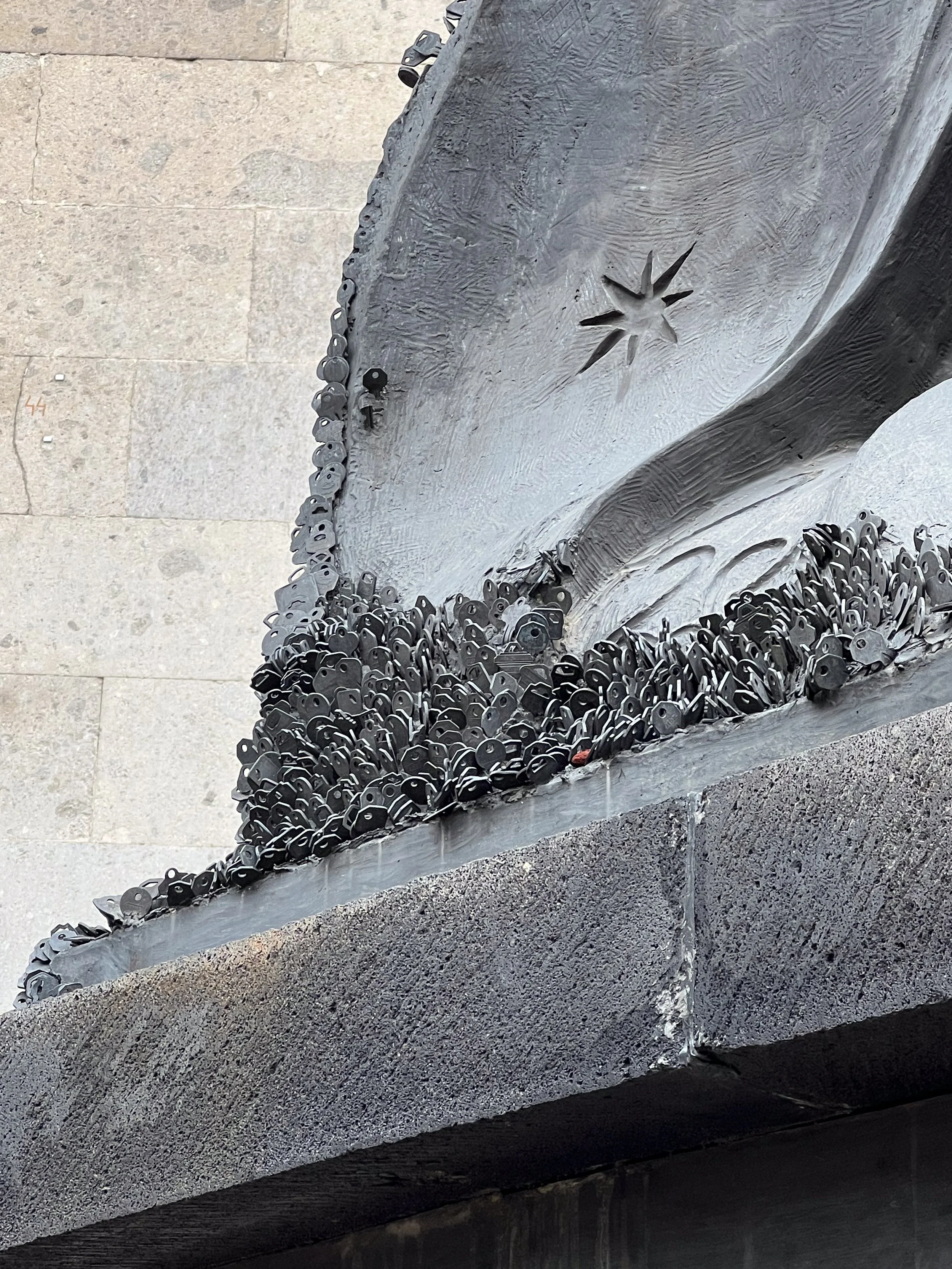
The statue is the work of artist Francisco Cárdenas Martínez. It was cast with more than seven million keys donated by the people of Mexico, and weighs over 5 tons. This close-up shows that the design incorporated some keys just as they were.
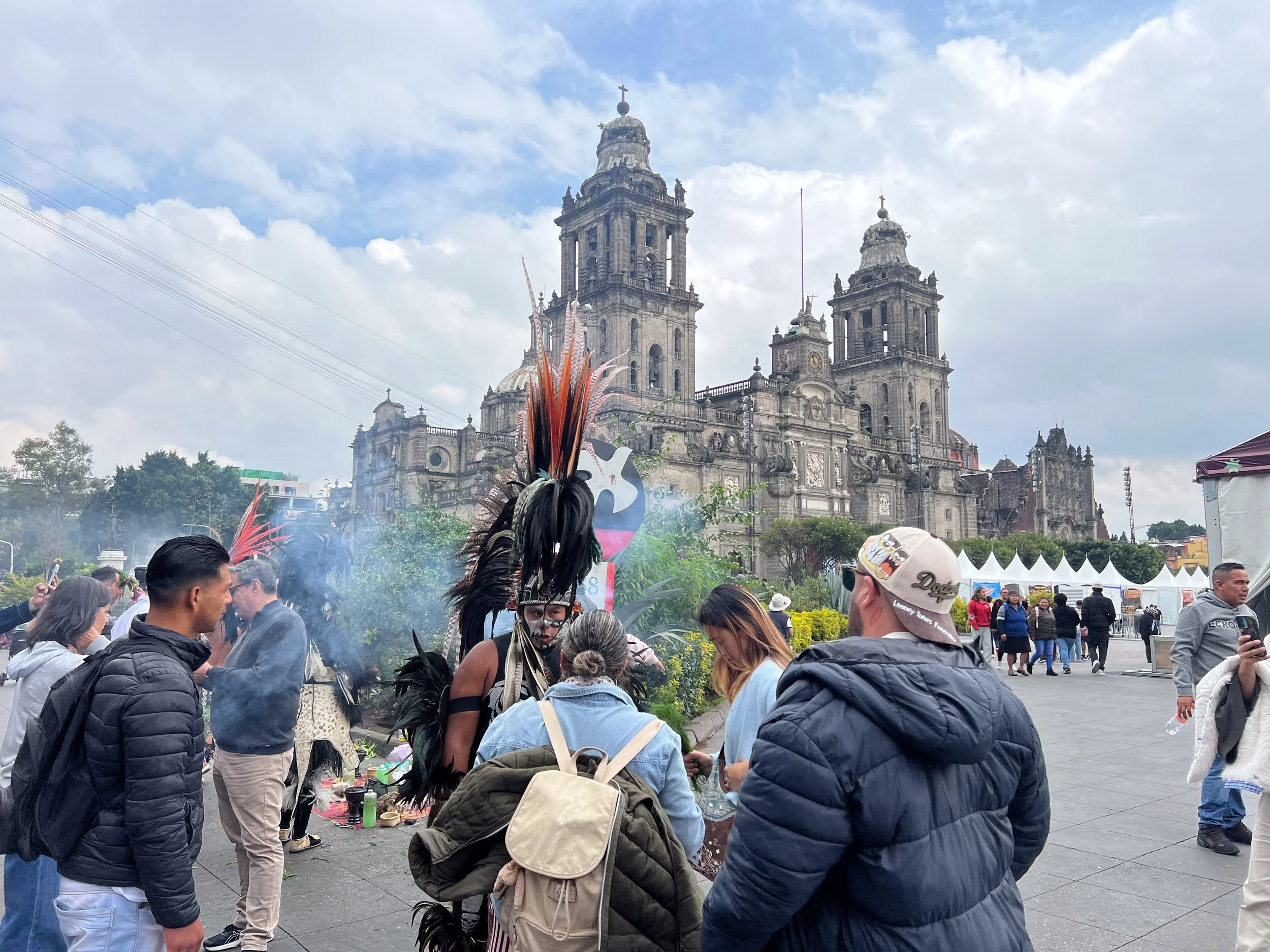
I was struck by the contrast between characters dressed up as Aztecs and performing smoke purifications rituals with the Catholic cathedral in the background.
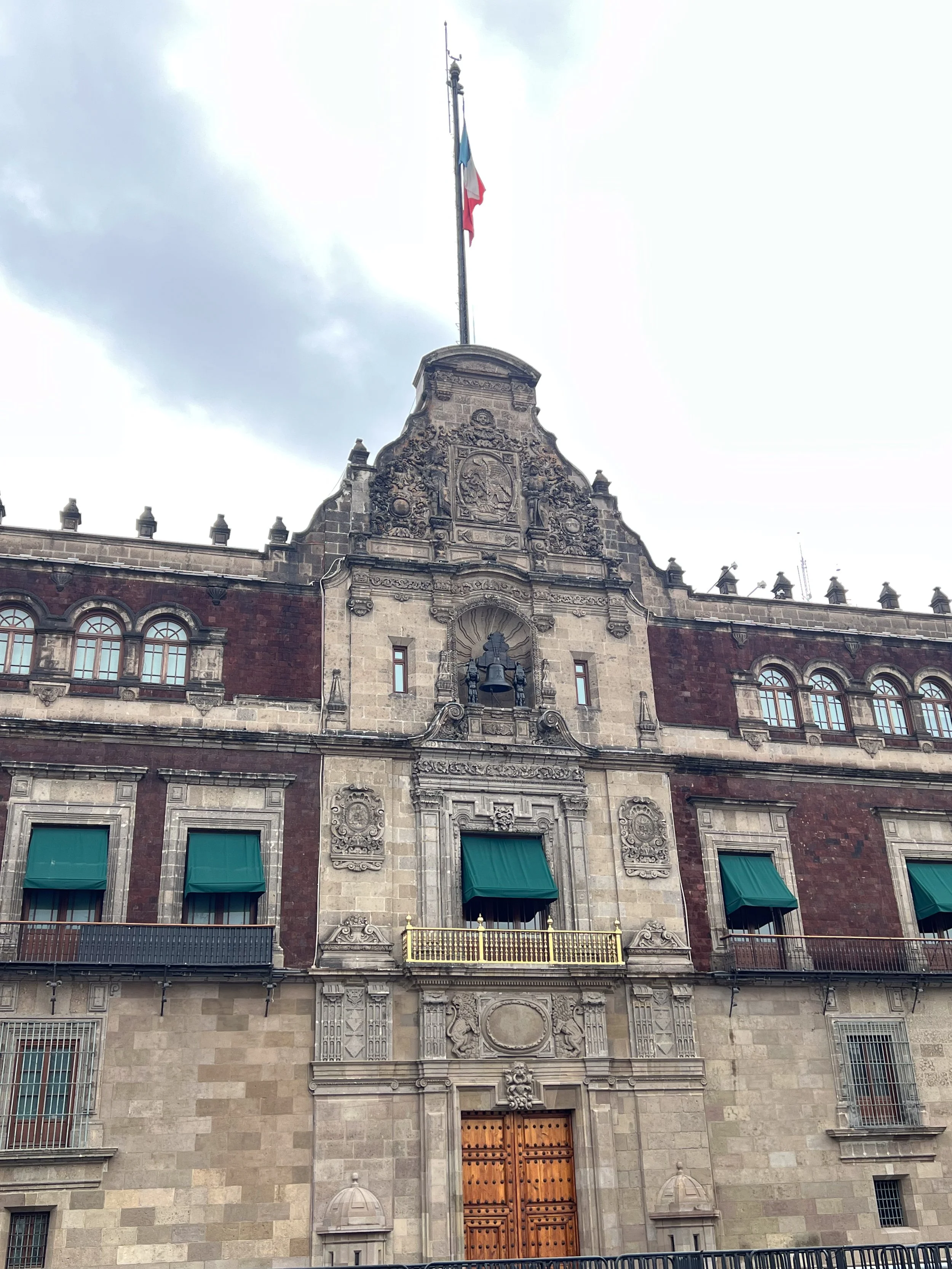
Palacio Nacional, the Zócalo.
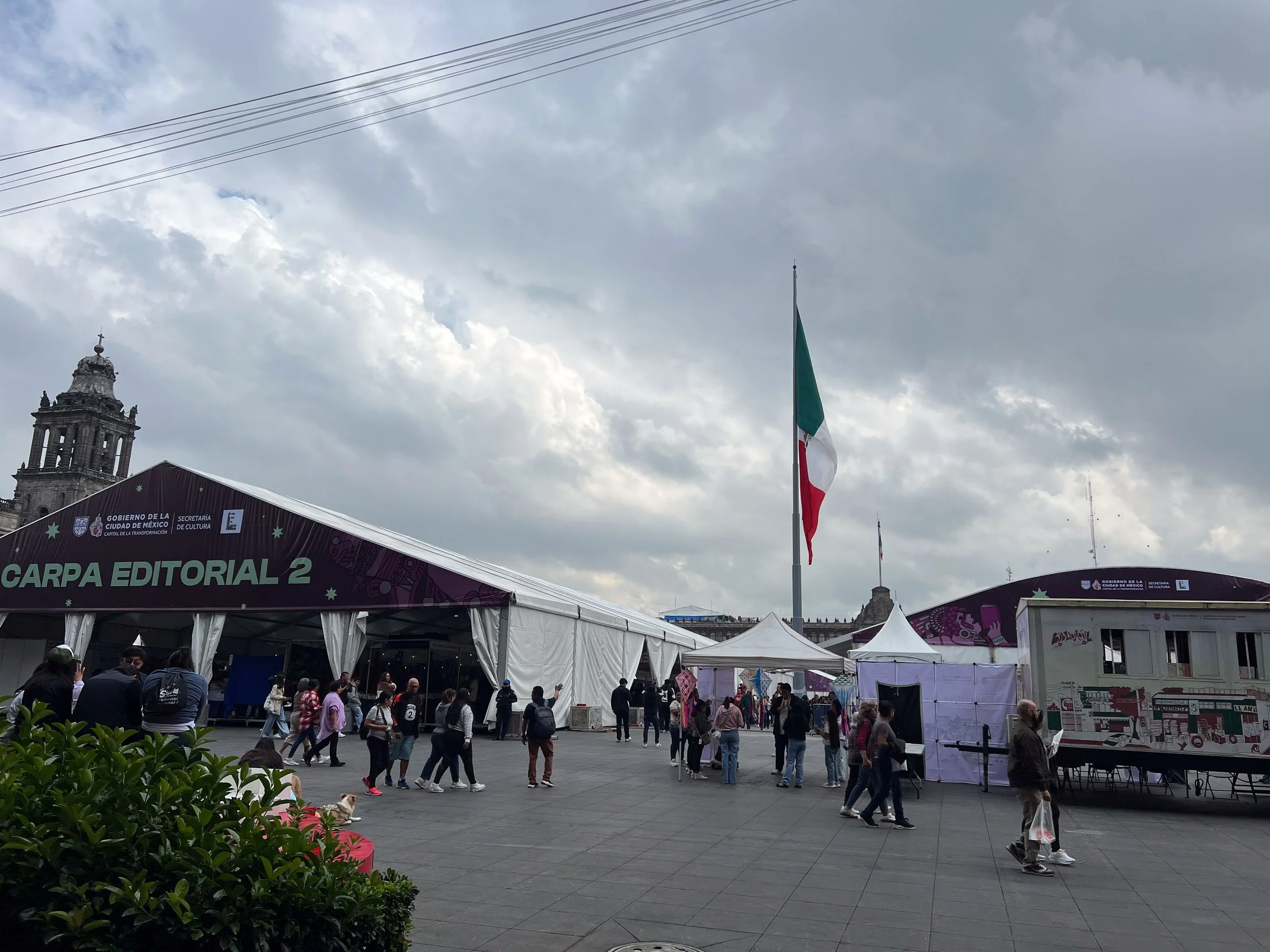
There was a massive book fair happening in the Zócalo plaza when I visited.
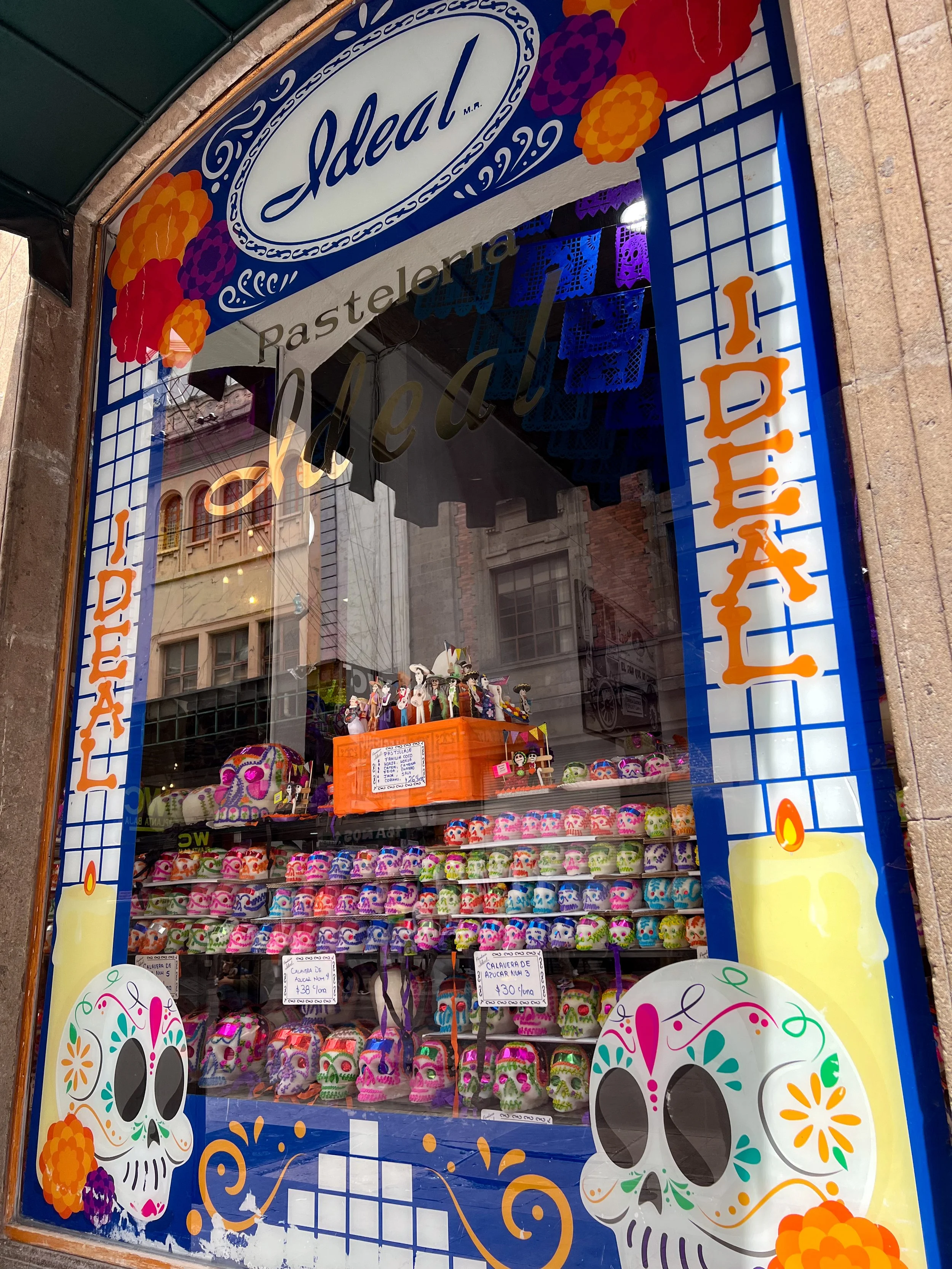
Pasteleria Ideal is ready for Día de los Muertos!
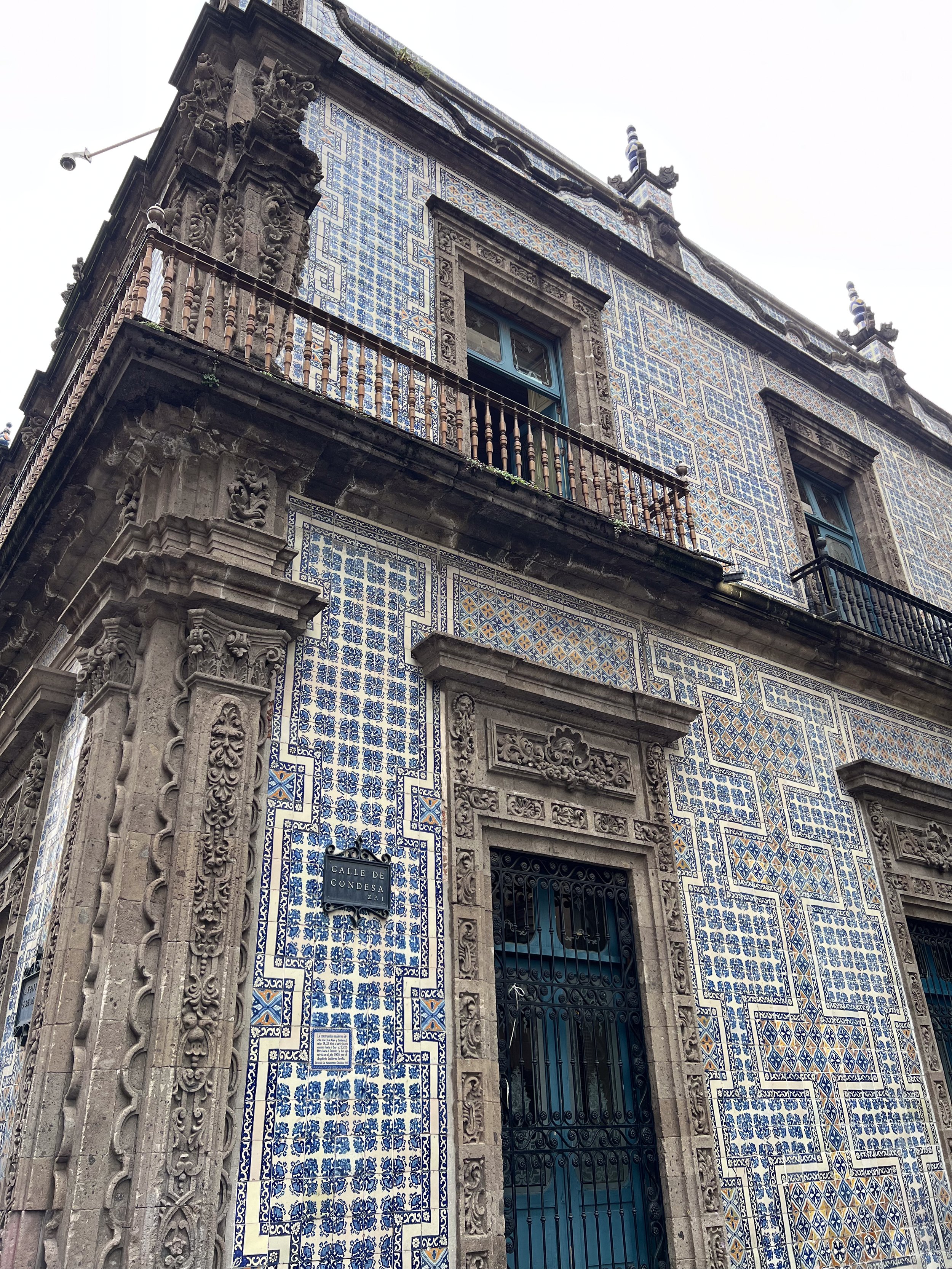
Casa de los Azulejos, an 18th century Baroque style palace decorated with Talavera tiles from the Puebla state.
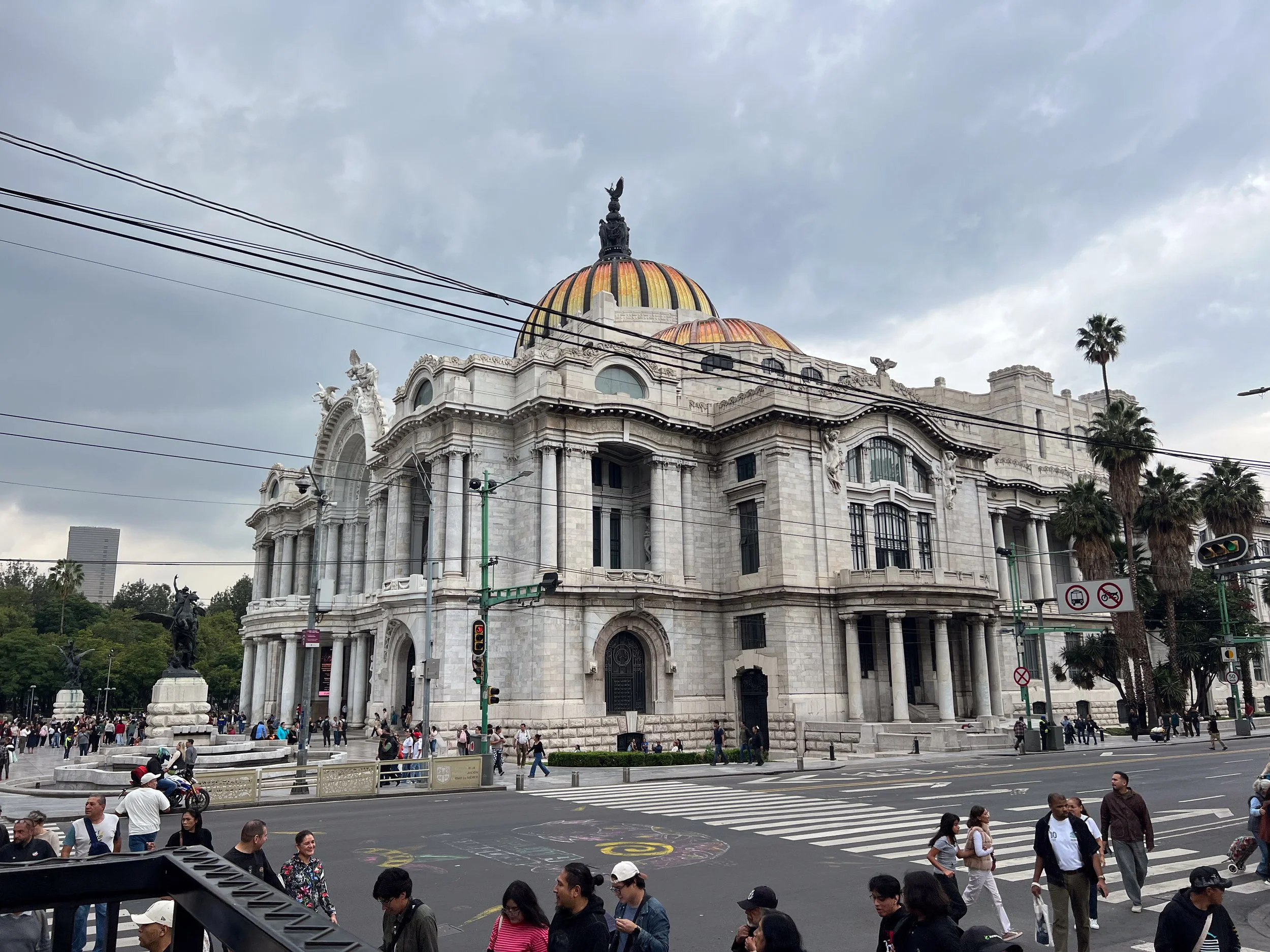
Palacio de Bella Artes
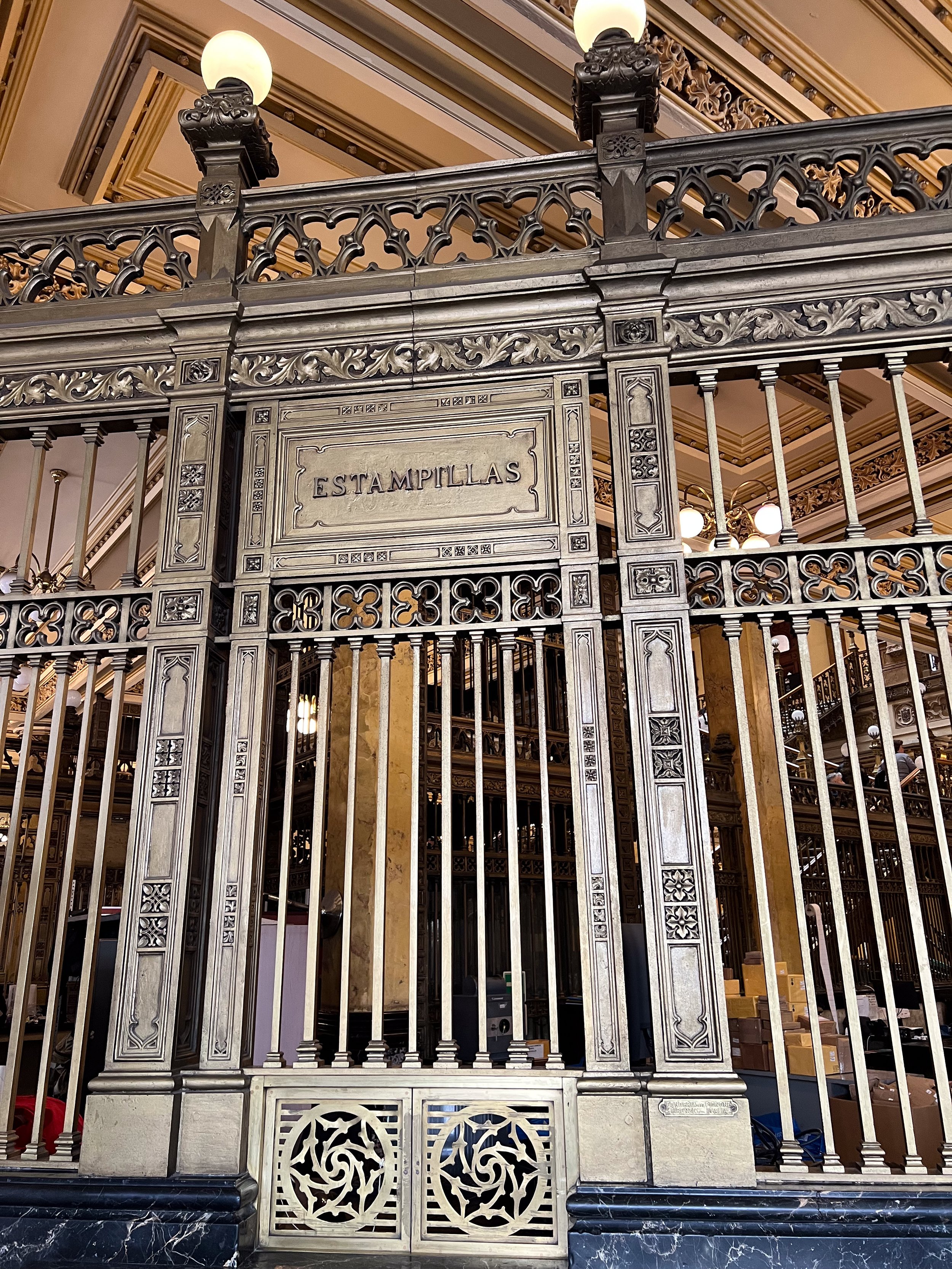
Palacio de Correos de México—not your average post office.
Museo Franz Mayer
The Franz Mayer museum is another private collection, showcasing decorative arts collected over 50 years by a wealthy (that really goes without saying, doesn’t it?) stockbroker, Franz Mayer. There is also a library and dedicated spaces for special exhibits. The building is 18th century, and at various times in its past has been a flour mill, a monastery, and a hospital. There is a beautiful inner courtyard with a small café, perfect for taking a break.
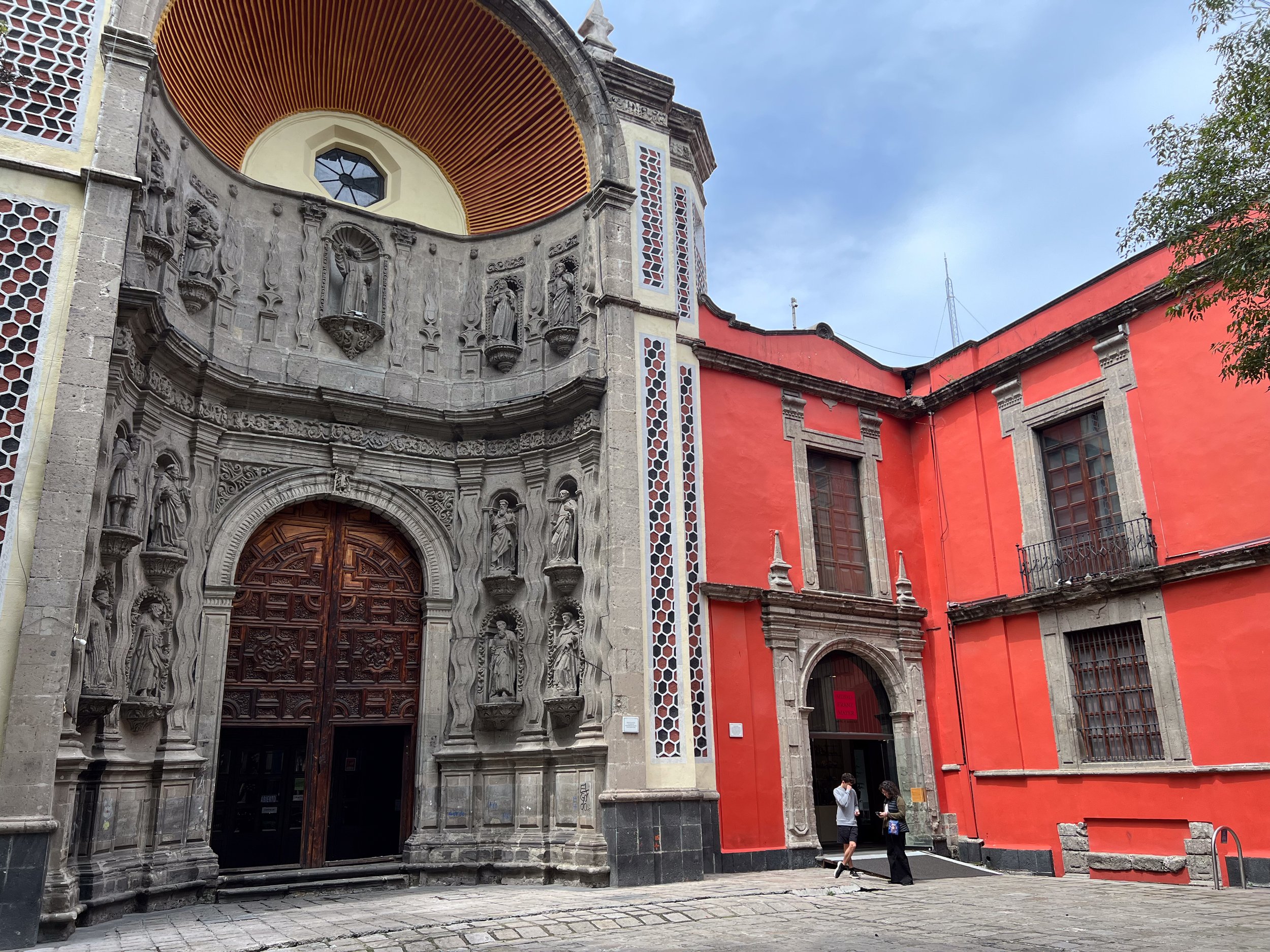
The museum is the red building in the corner.
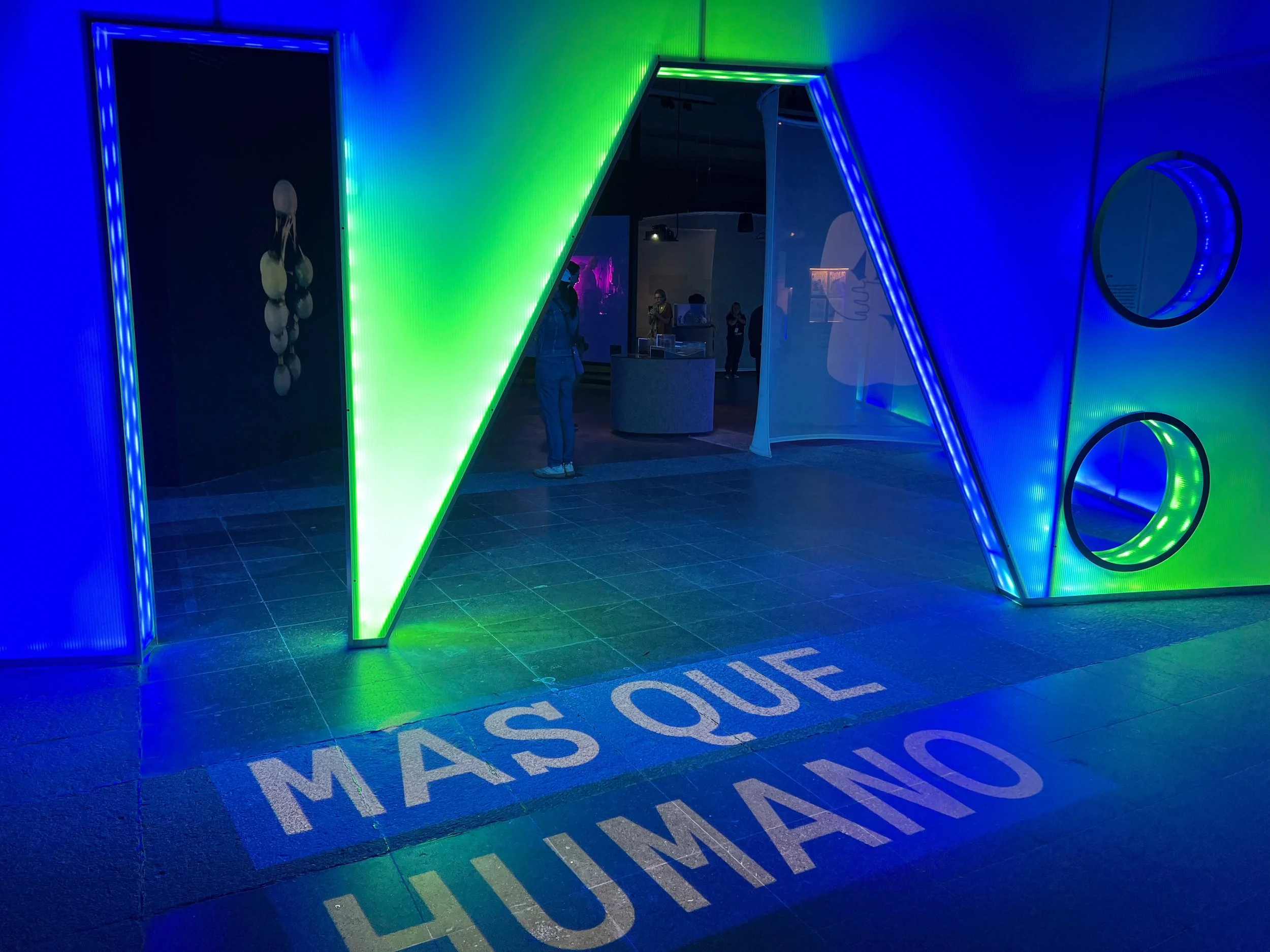
"More Than Human," the AI special exhibit.
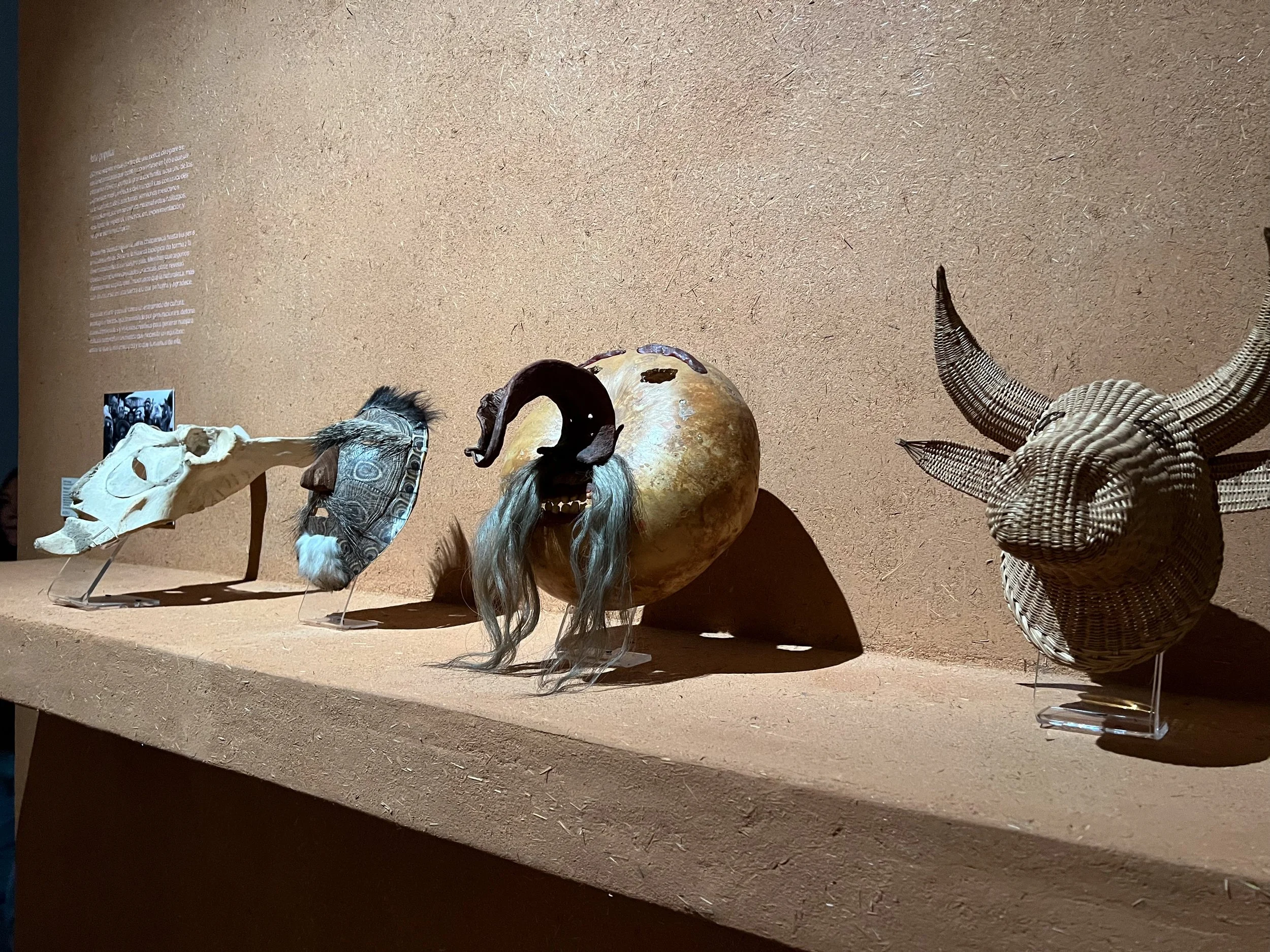
Works in the special biodesign exhibit, which is "an innovative look at design, exploring projects by emerging artists that integrate the past with the future, reminding us that design can be humane and aware of the interdependence and collaboration among all living beings."
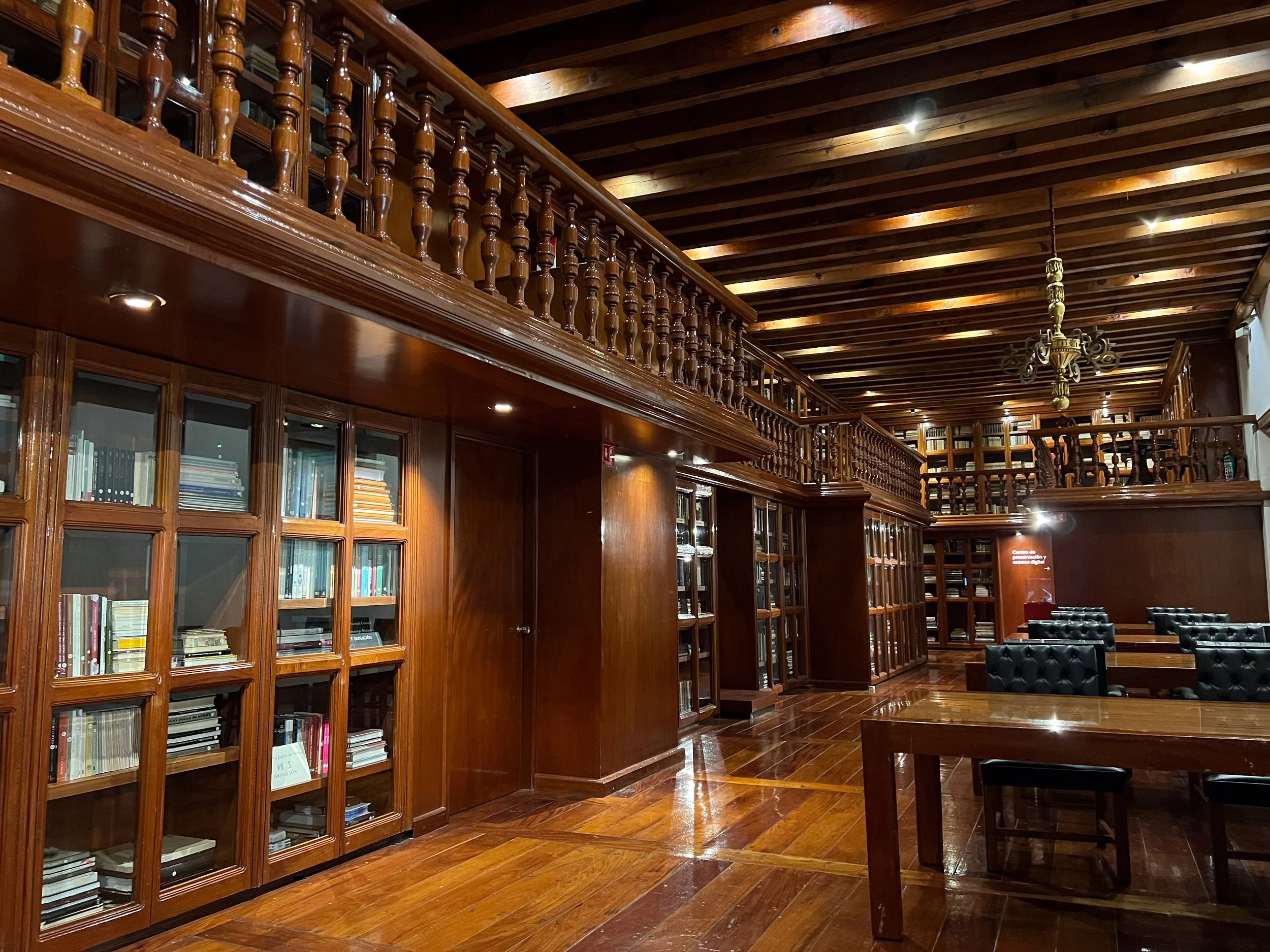
The library currently holds over 22,000 volumes.
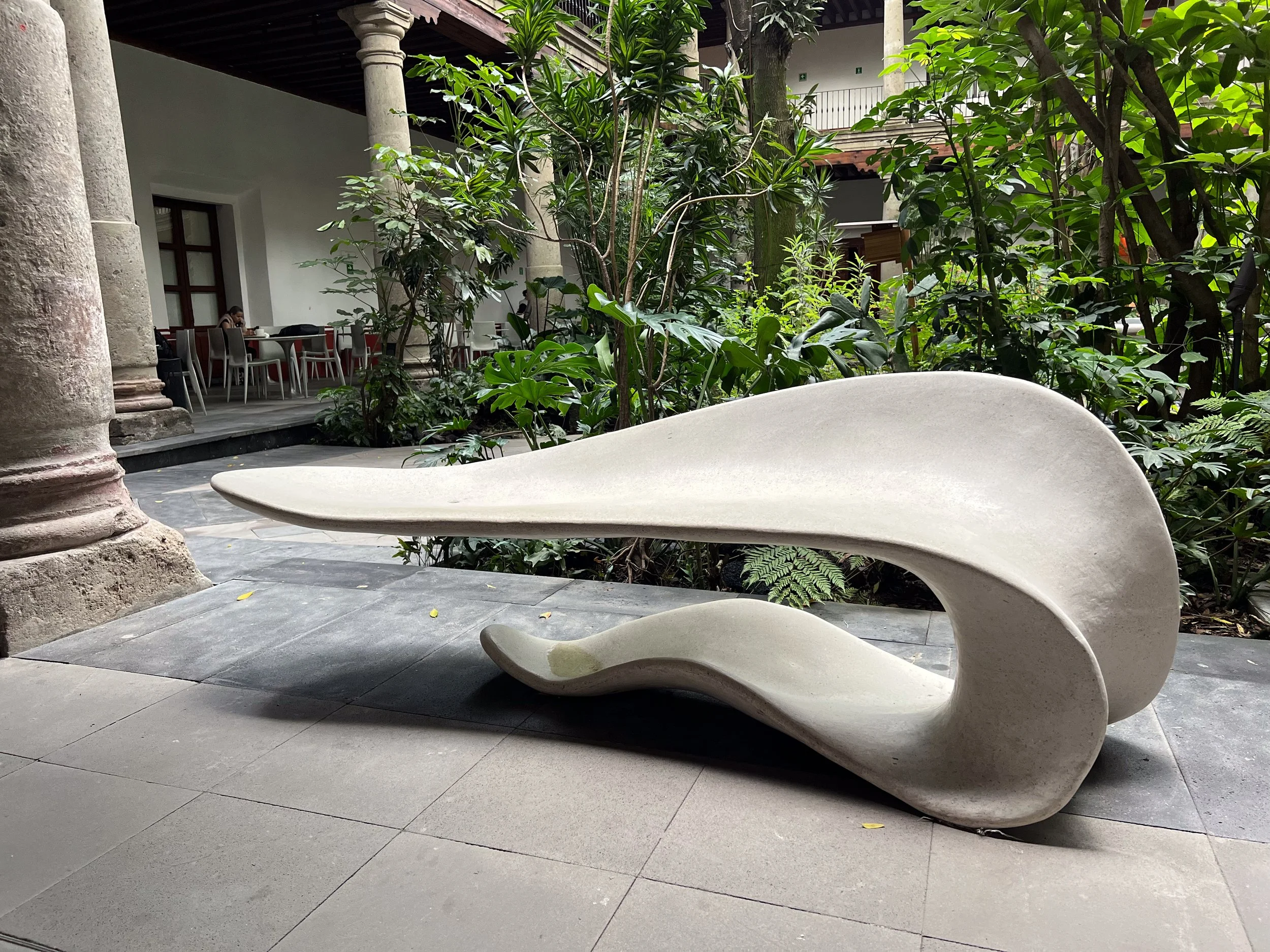
Art expressed in form and function.
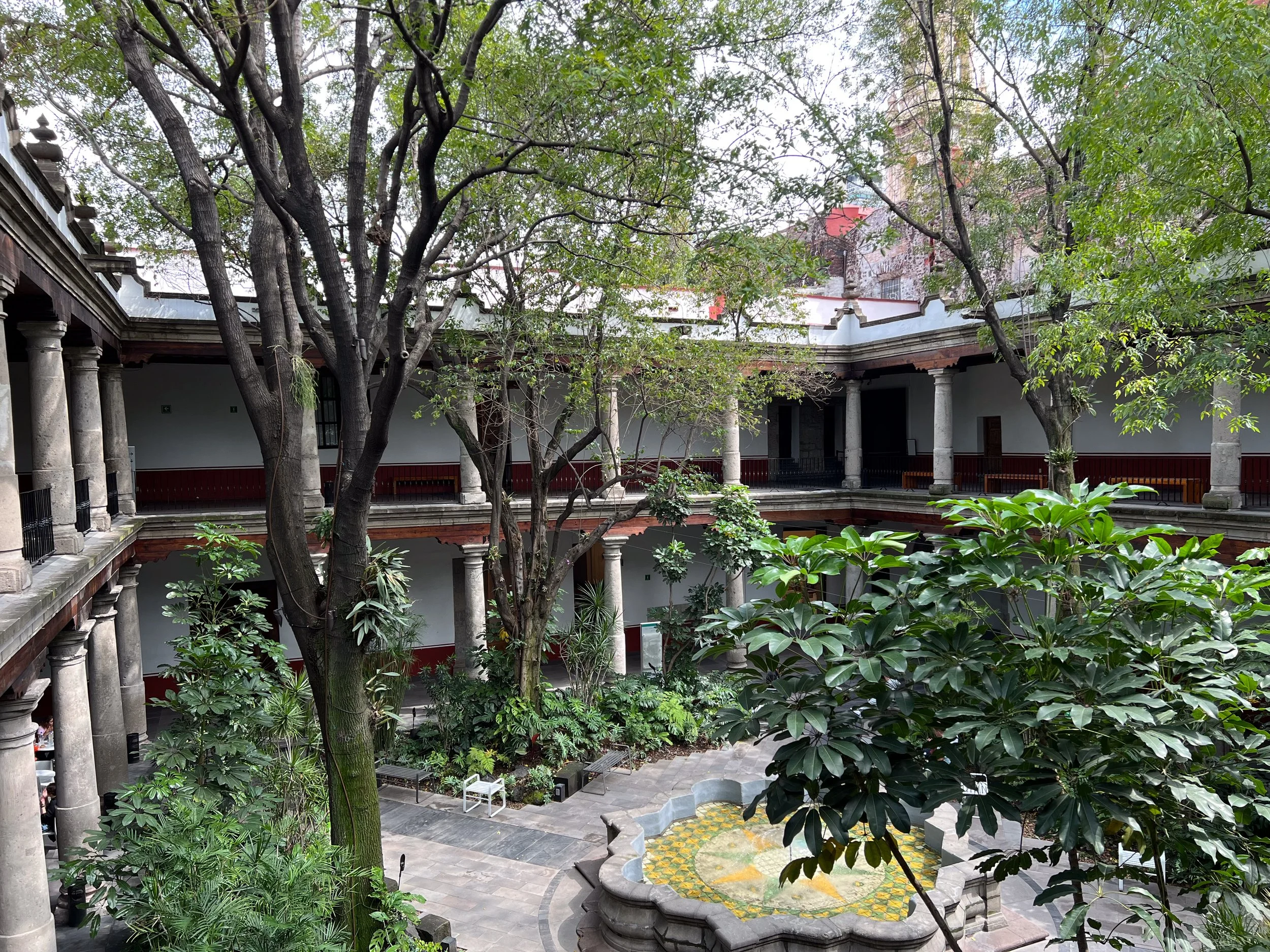
The lovely courtyard, a perfect place for a coffee break.
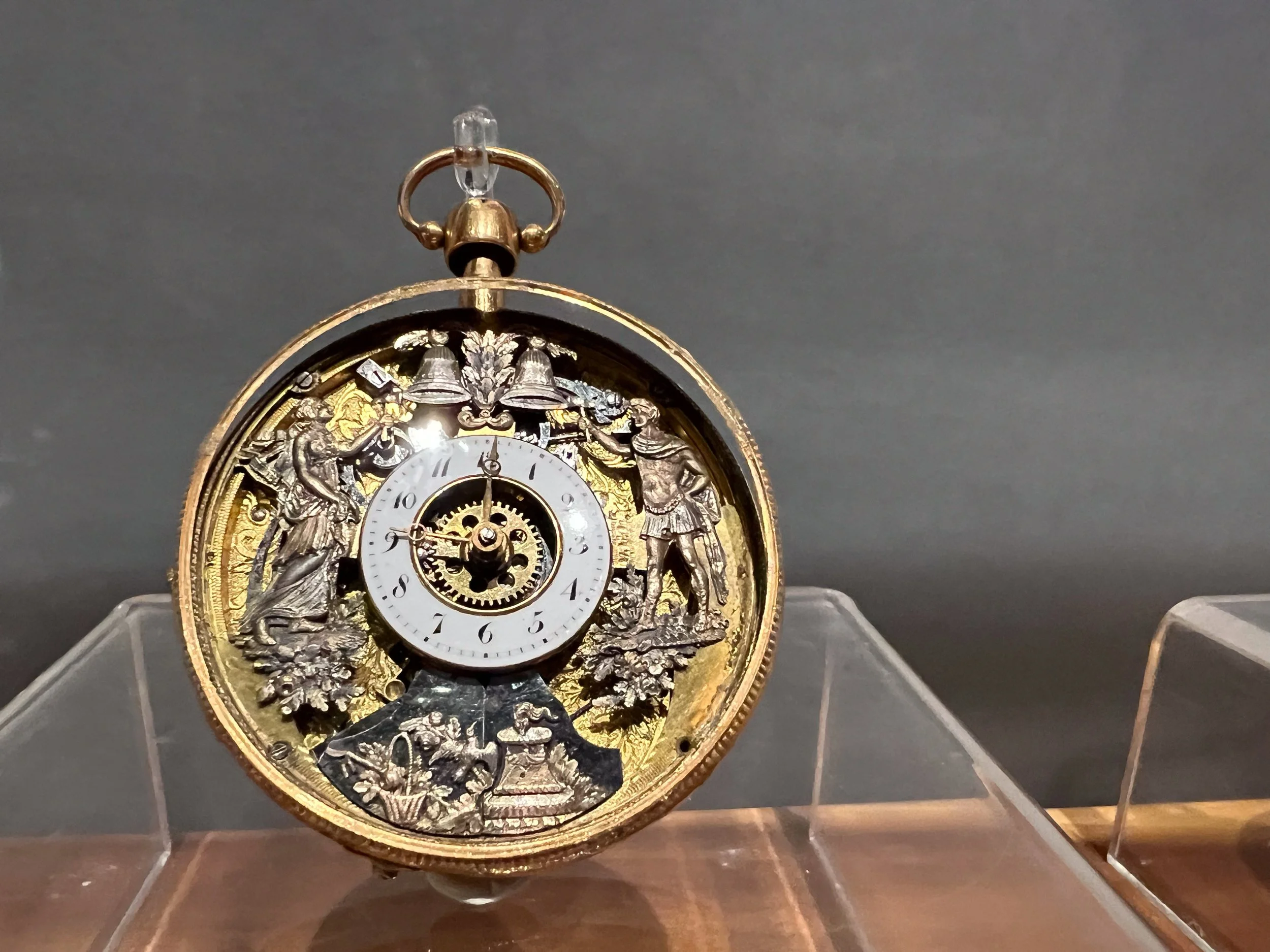
Exquisite example of craftsmanship.
Casa Azul
Casa Azul was where Frida Kahlo was born (in 1907) and grew up. She returned there for the last 13 years of her life, and shared the home with Diego Rivera. Rivera had paid off the family’s mortgage after his first marriage to Frida, in 1929. They divorced in 1939 and remarried in 1940. She led a complicated and remarkable life, and I am inspired to learn more about her. She died at Casa Azul in 1954, following one of the many illnesses she endured throughout her life, only 47 years old.
In 1957, shortly before his death, Diego Rivera donated the house and its contents to created a museum honoring Frida and her legacy.
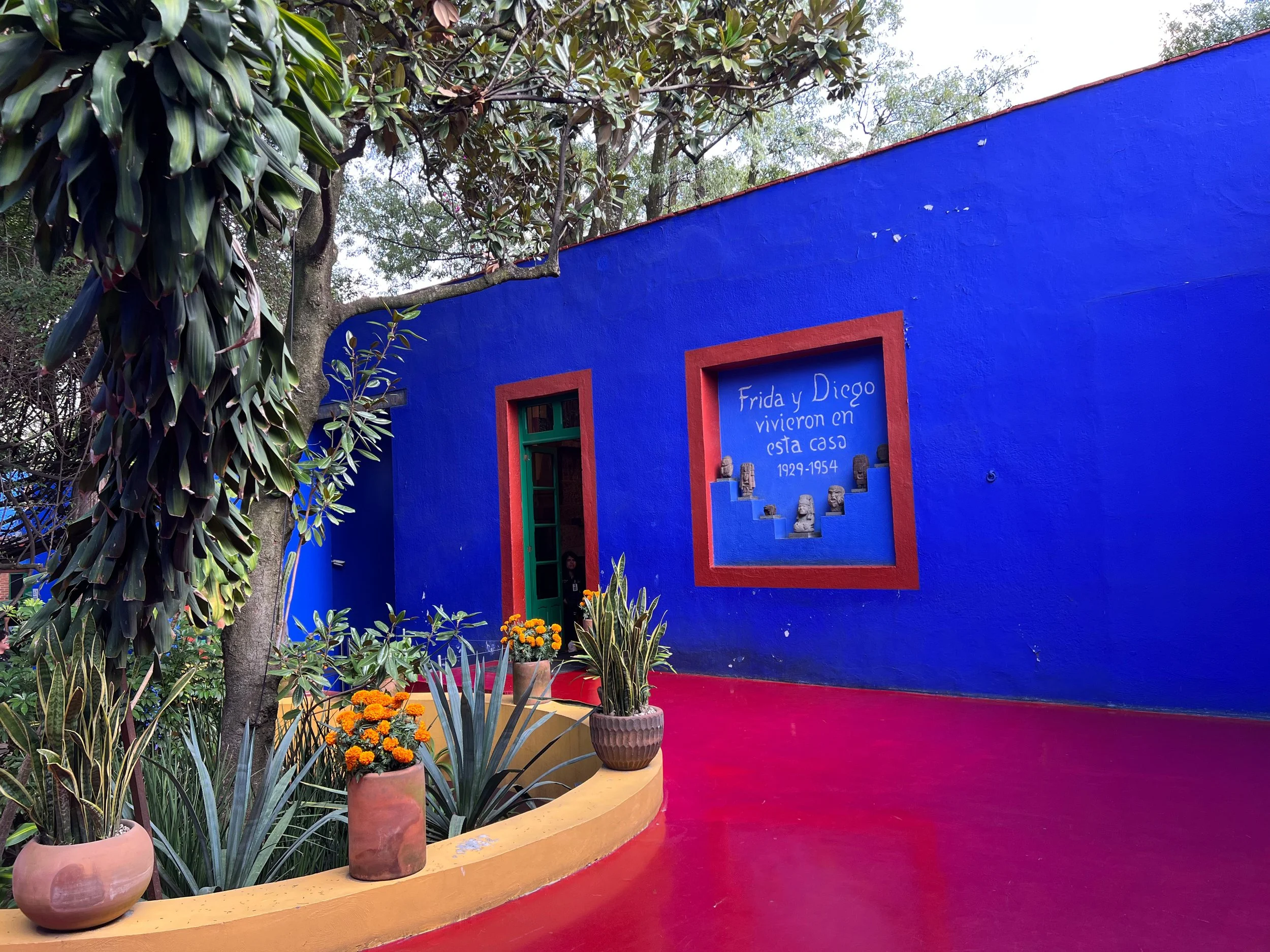
"Frida and Diego lived in this house 1929-1954."
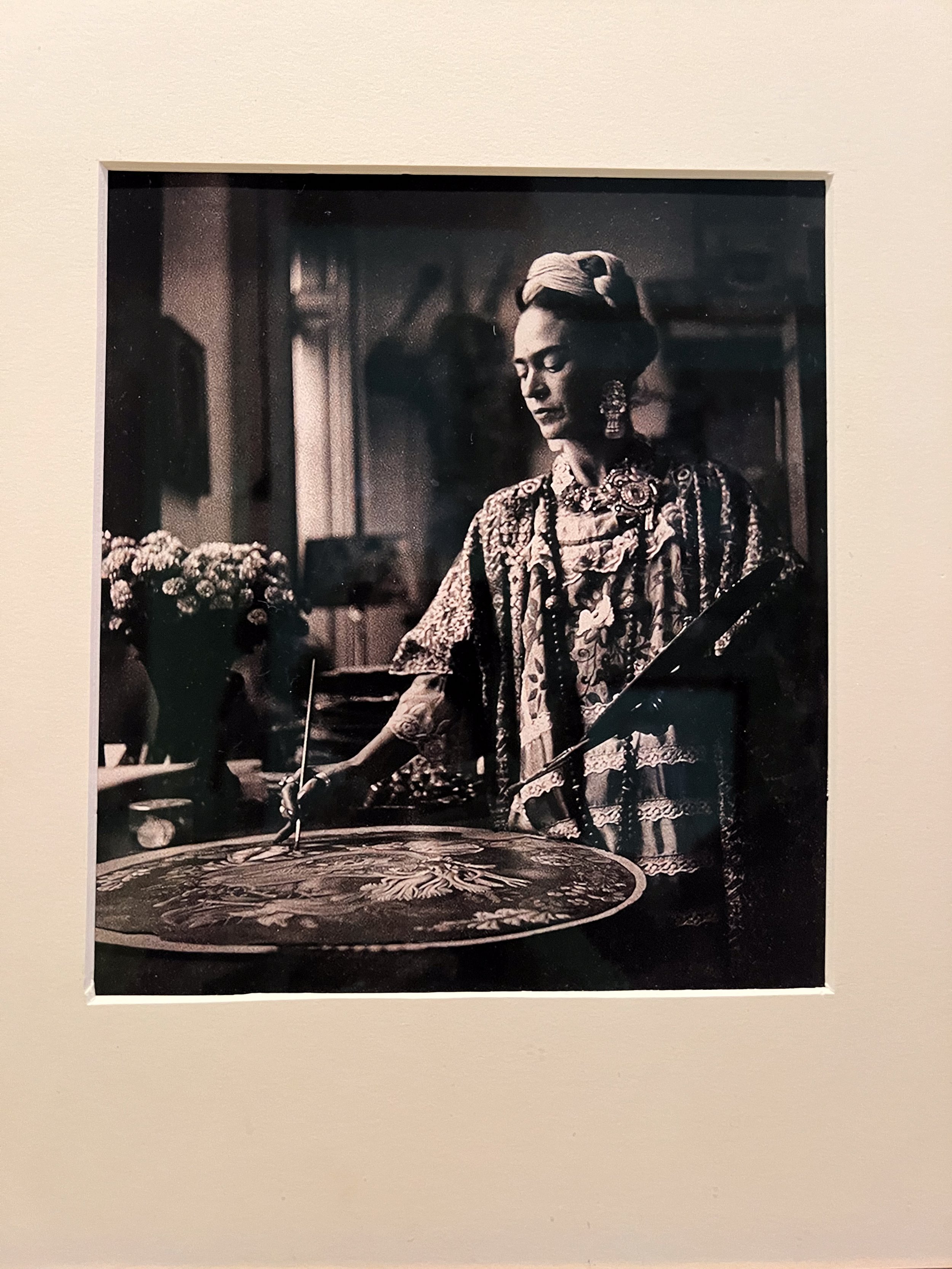
Frida at work on "Still LIfe (Round)."
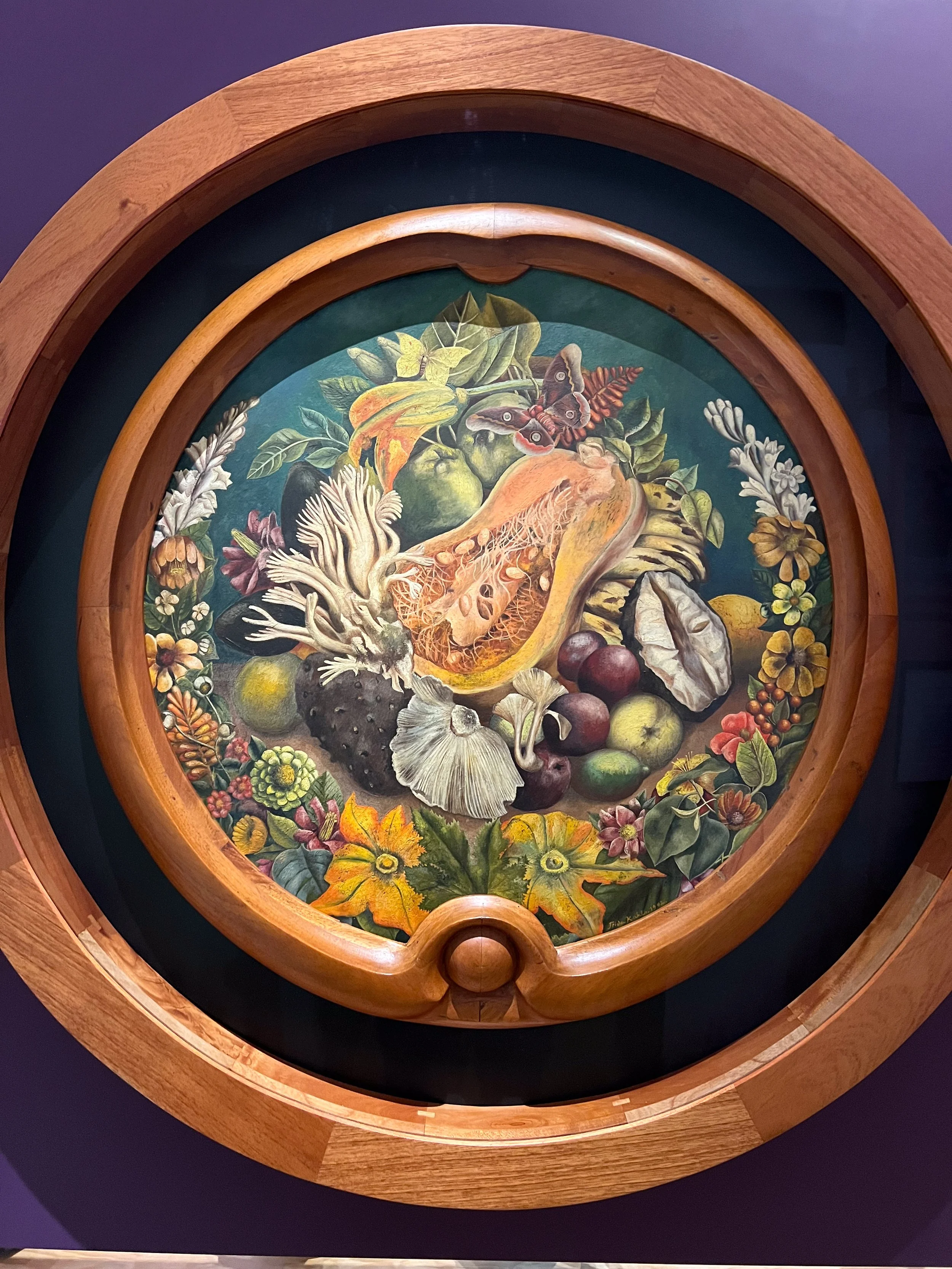
"Still Life (Round)"
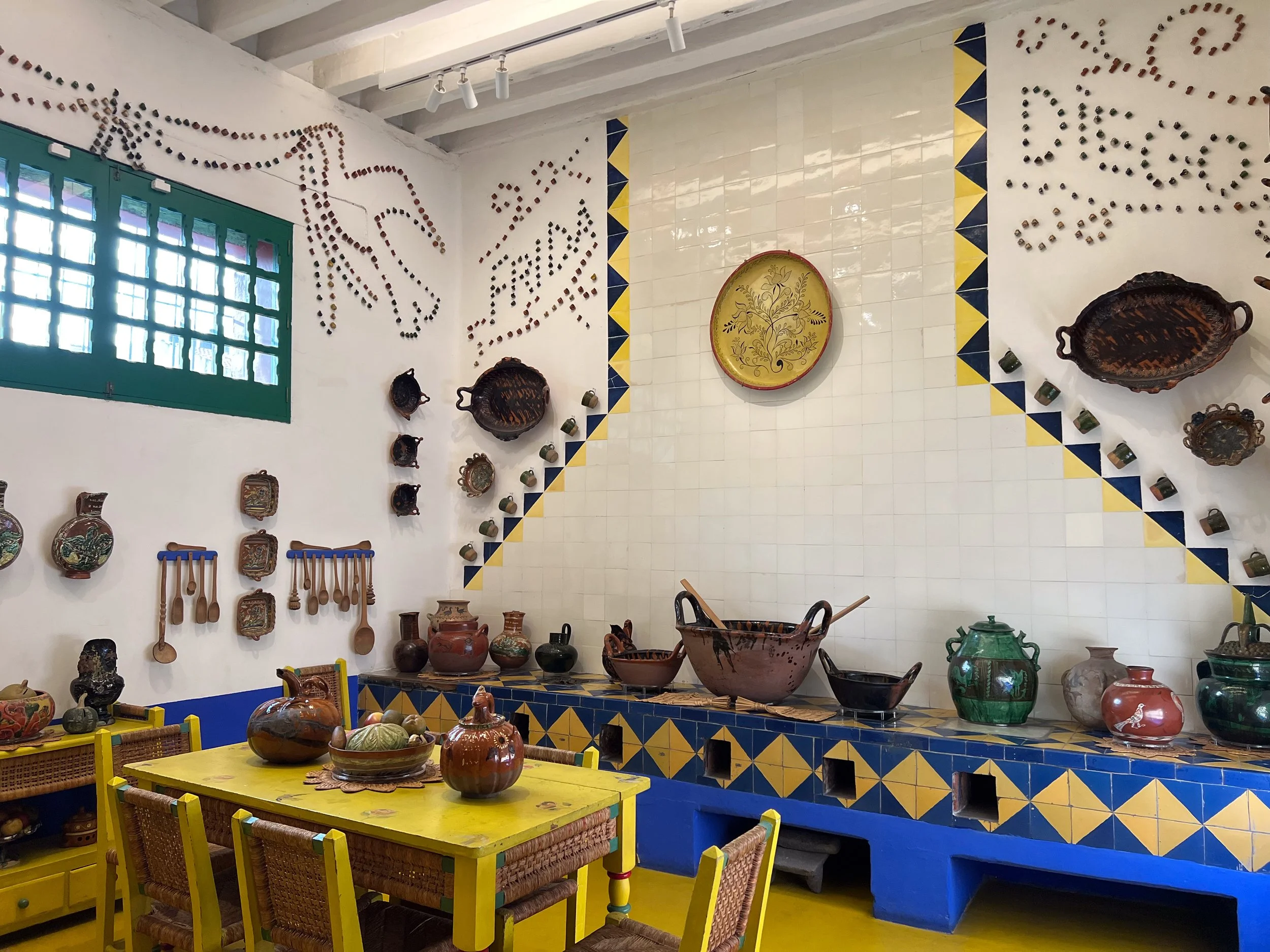
Kitchen at Casa Azul
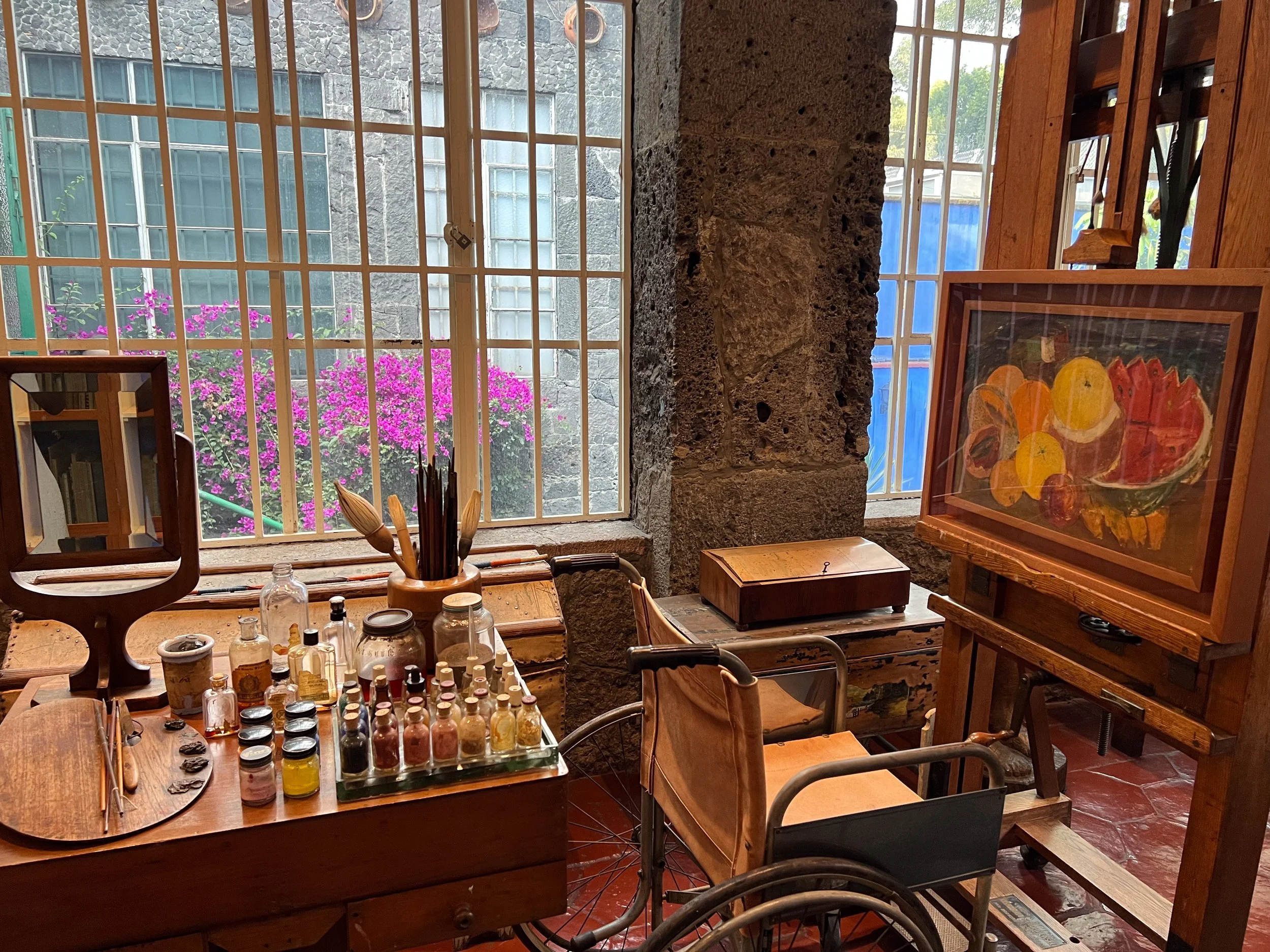
Frida's studio.
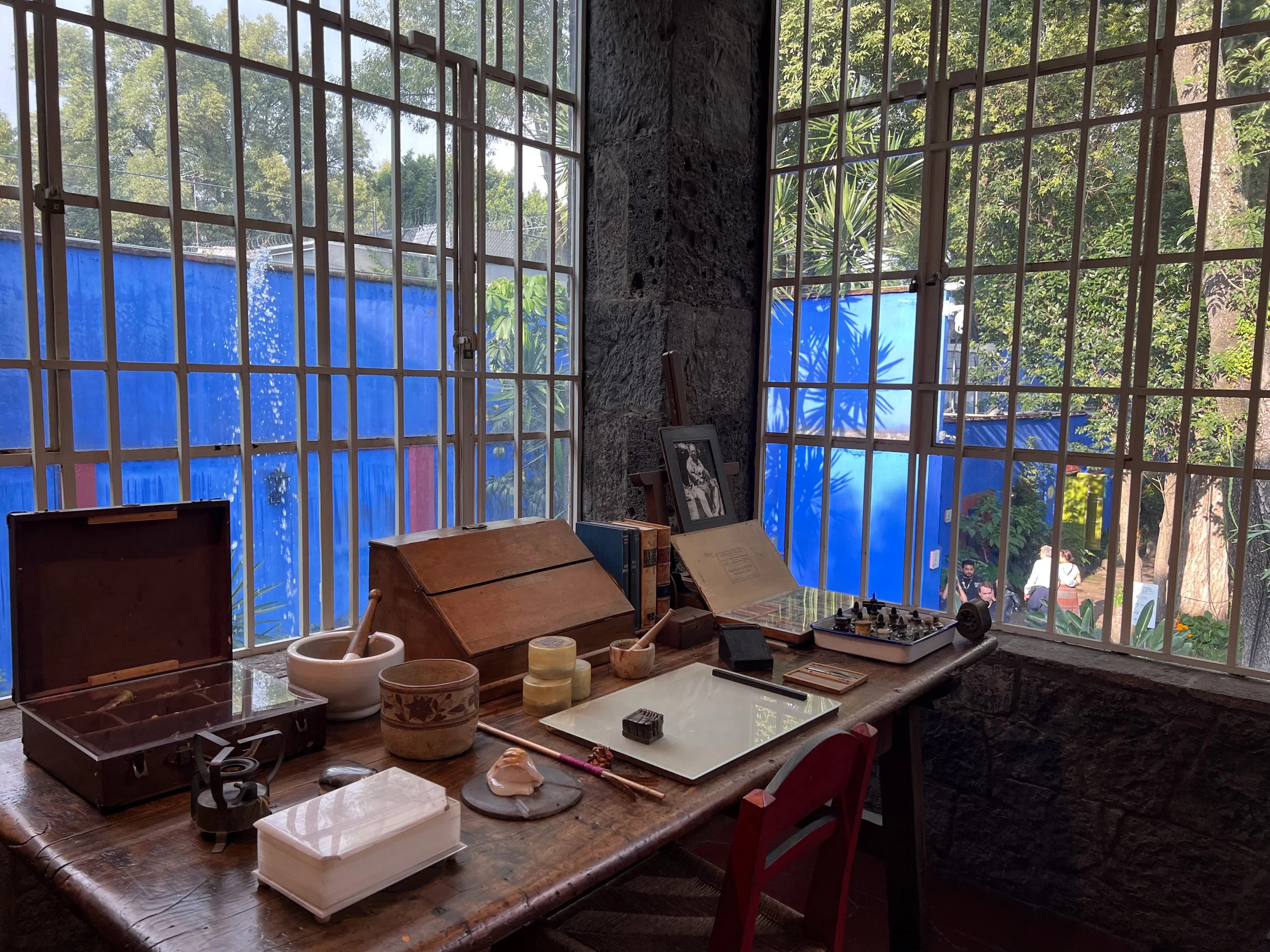
Diego's studio.
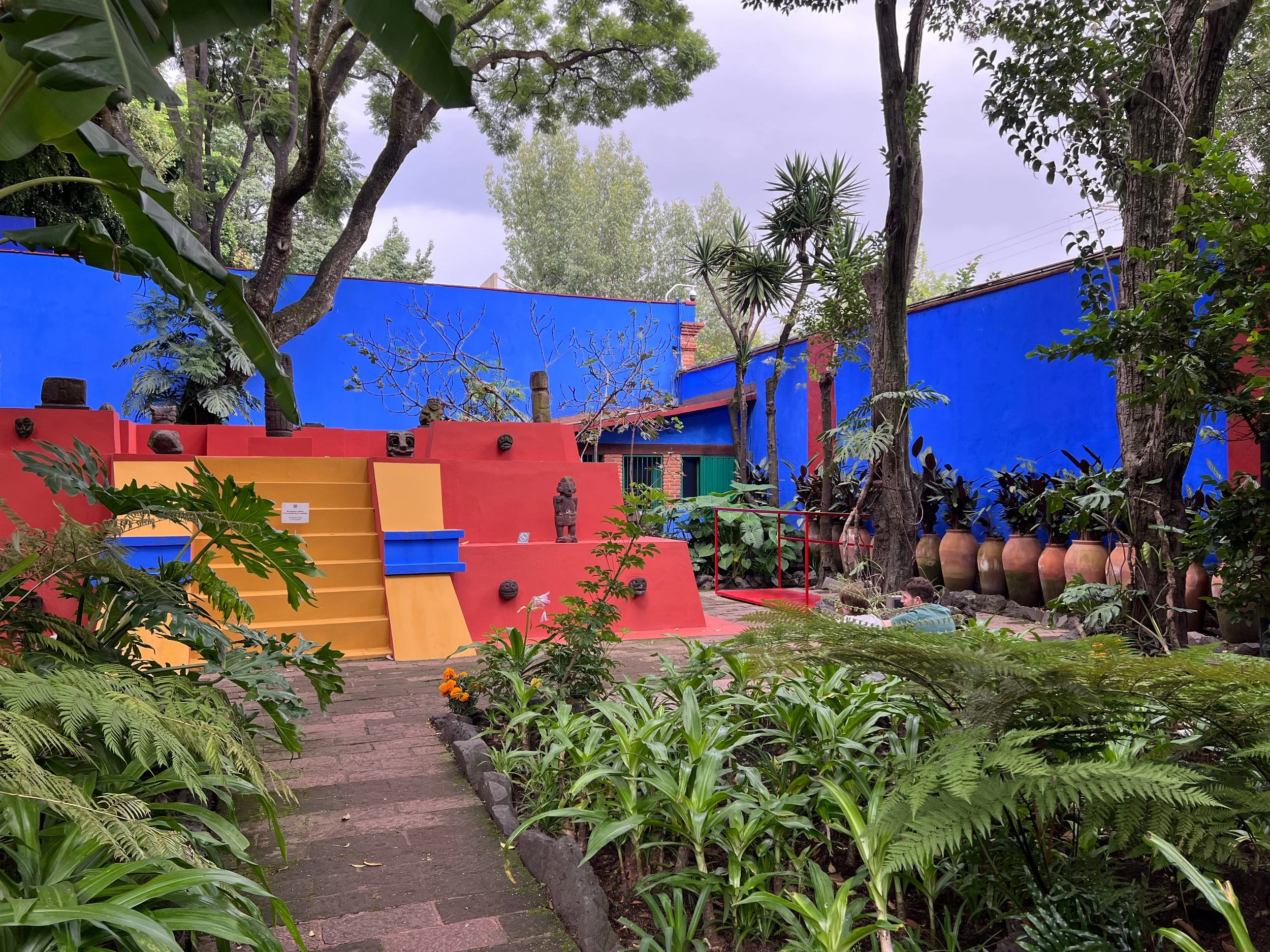
Pyramid, courtyard of Casa Azul.
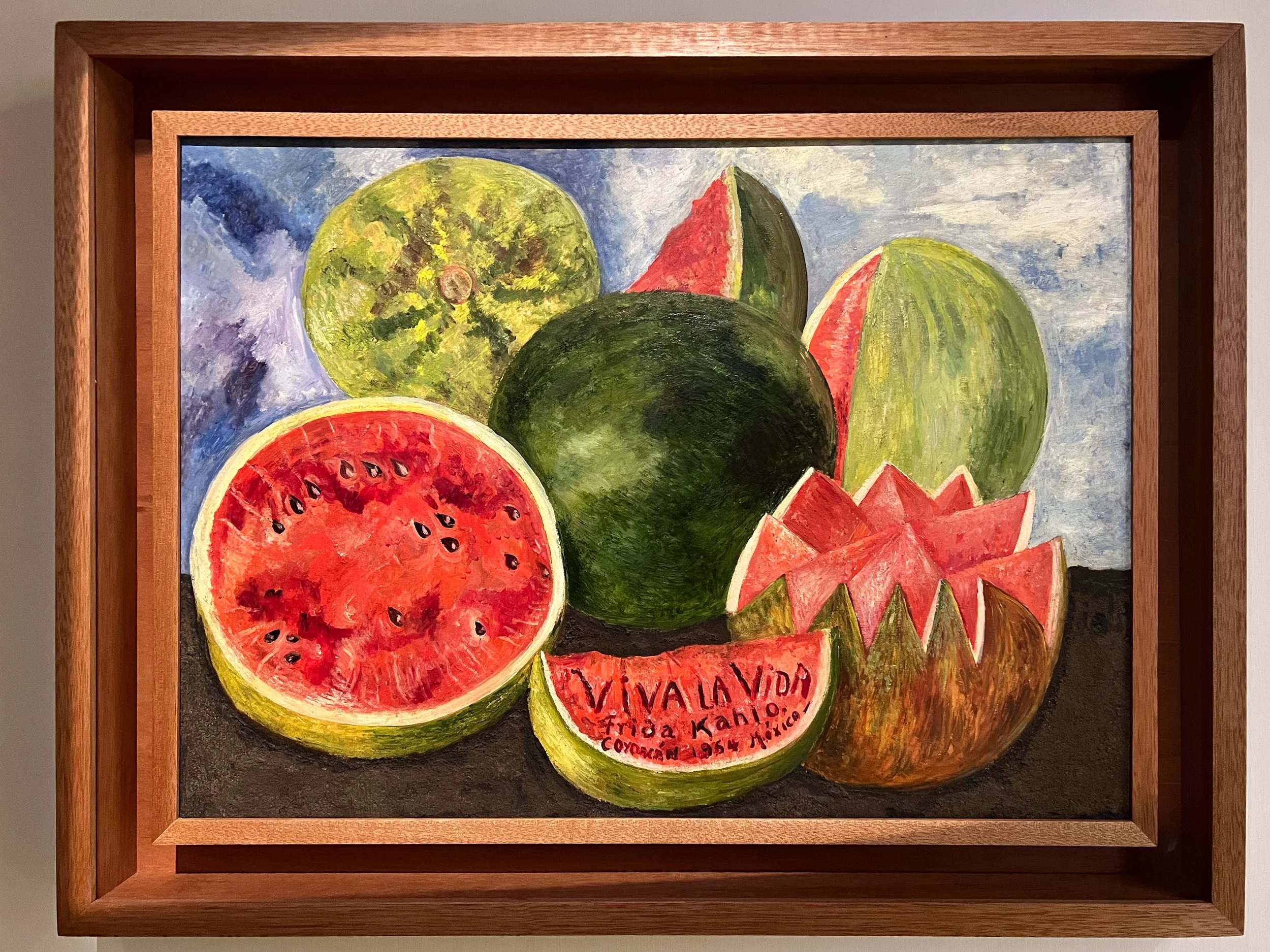
"Viva la Vida"
Random Scenes
What I didn’t take photos of (although I thought about it) were the treacherous, broken up sidewalks that constantly threatened to dump me off my knee scooter as punishment for a moment’s inattention.
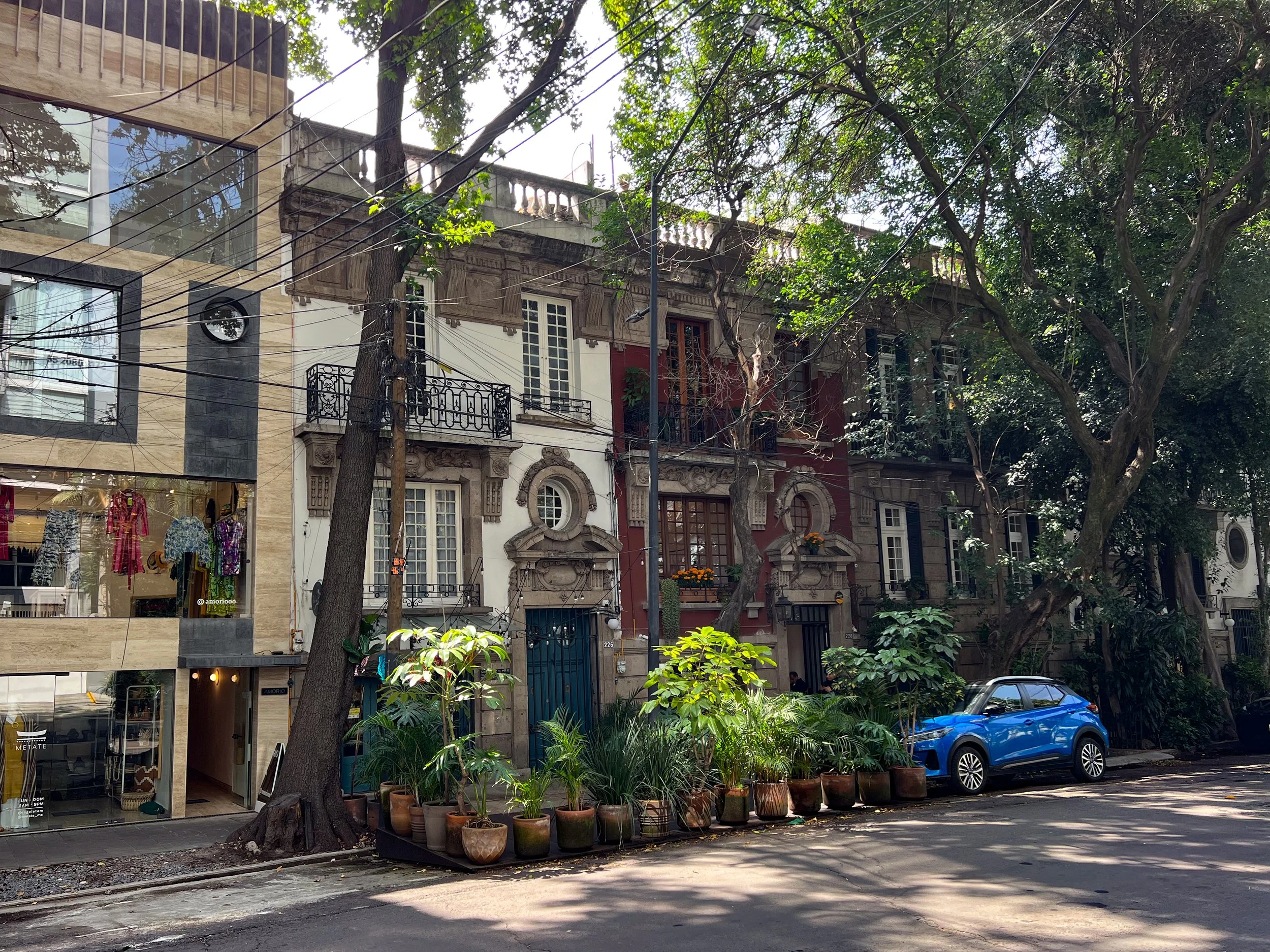
In the Condesa neighborhood.
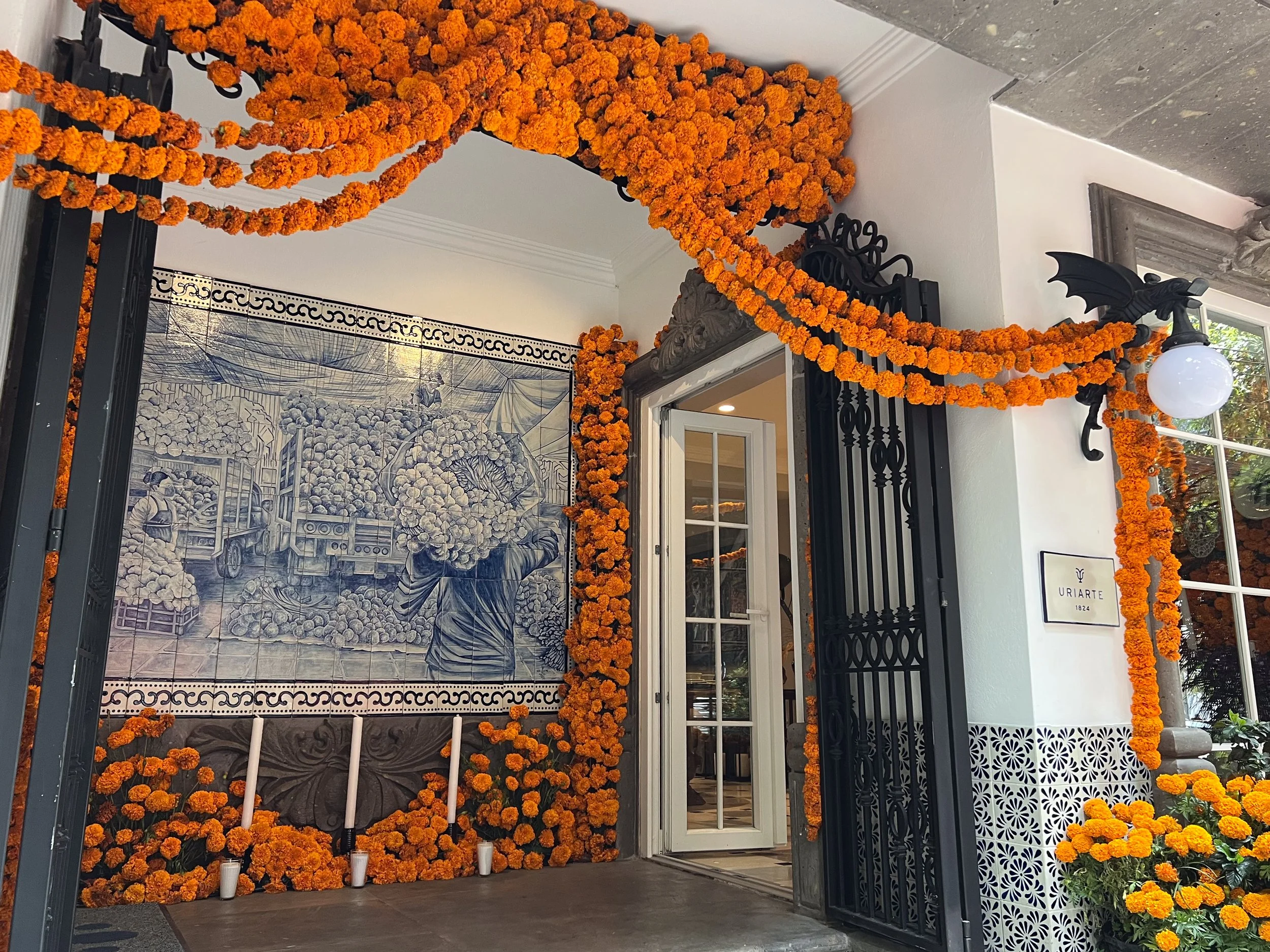
Marigolds are a traditional adornment for Día de los Muertos, which is November 2nd (not Halloween - a common misconception). The internet tells me that "Their bright orange and yellow colors mimic the sun, while their strong, spicy scent is believed to attract the souls of departed loved ones and guide them from the spirit world back to the living."
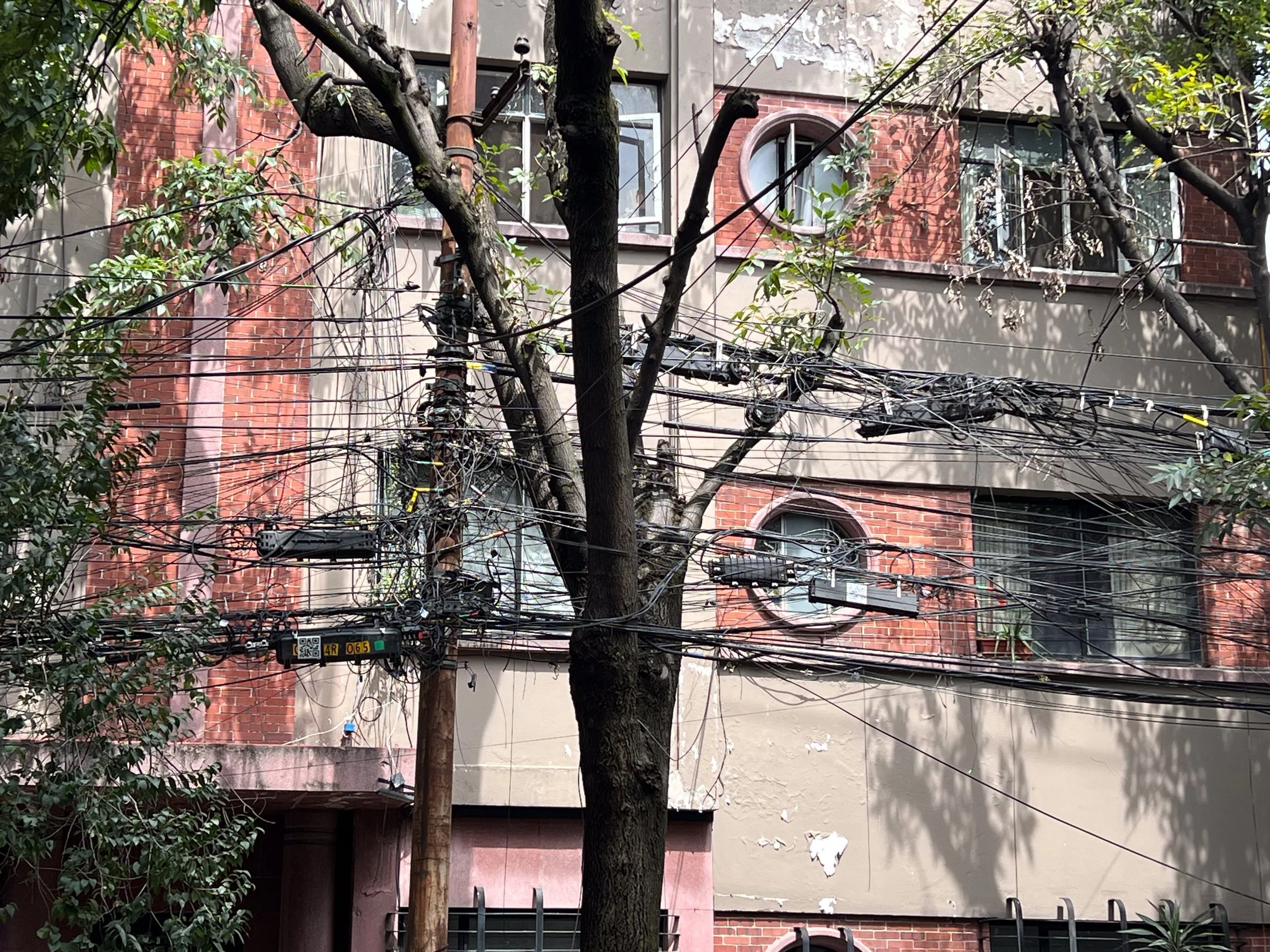
It's amazing the WiFi worked.
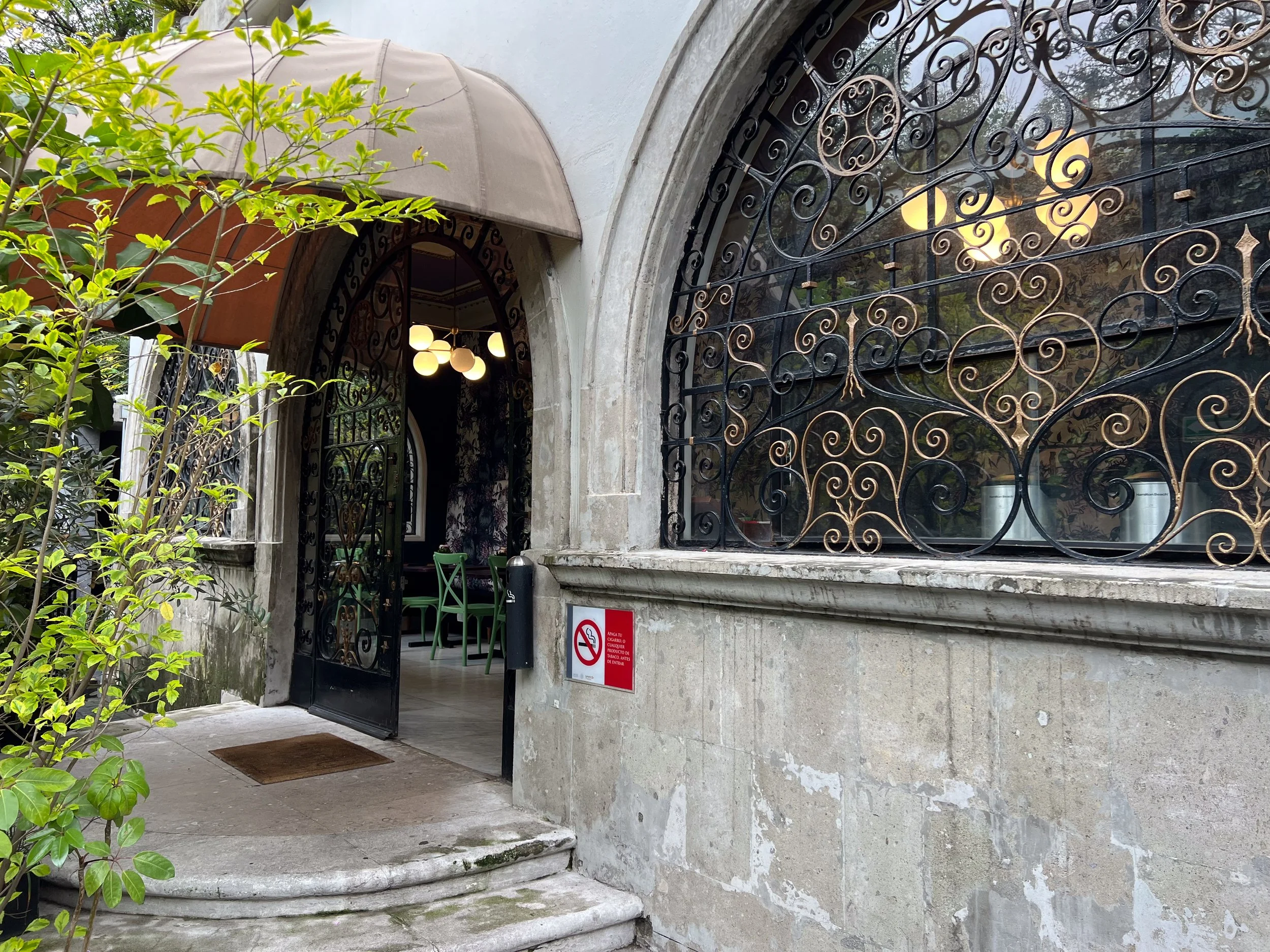
At Hotel Pug Seal Anatole France, where the students stayed, and where most of my classes were held.
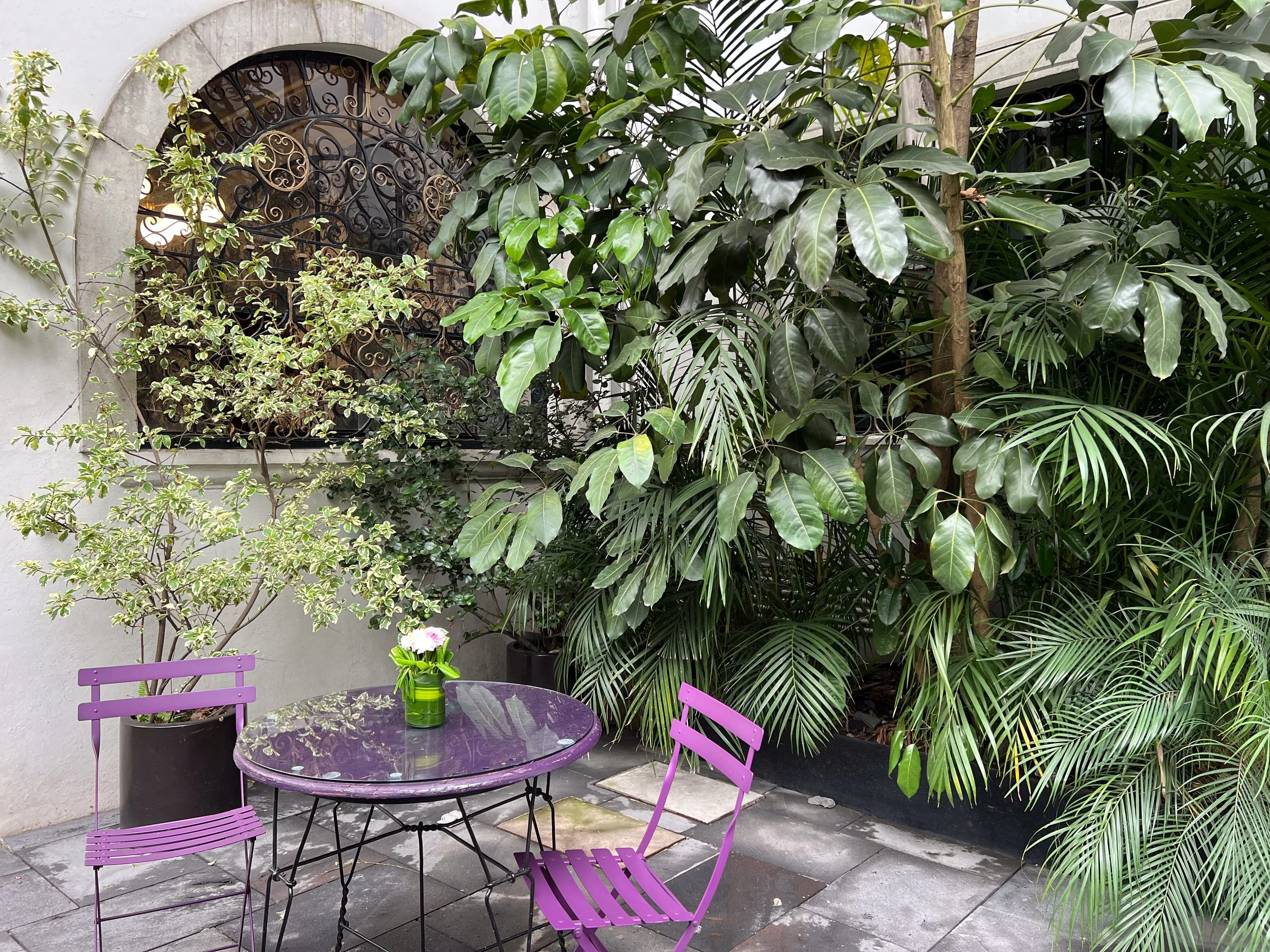
Also in the courtyard at Hotel Pug Seal Anatole France.
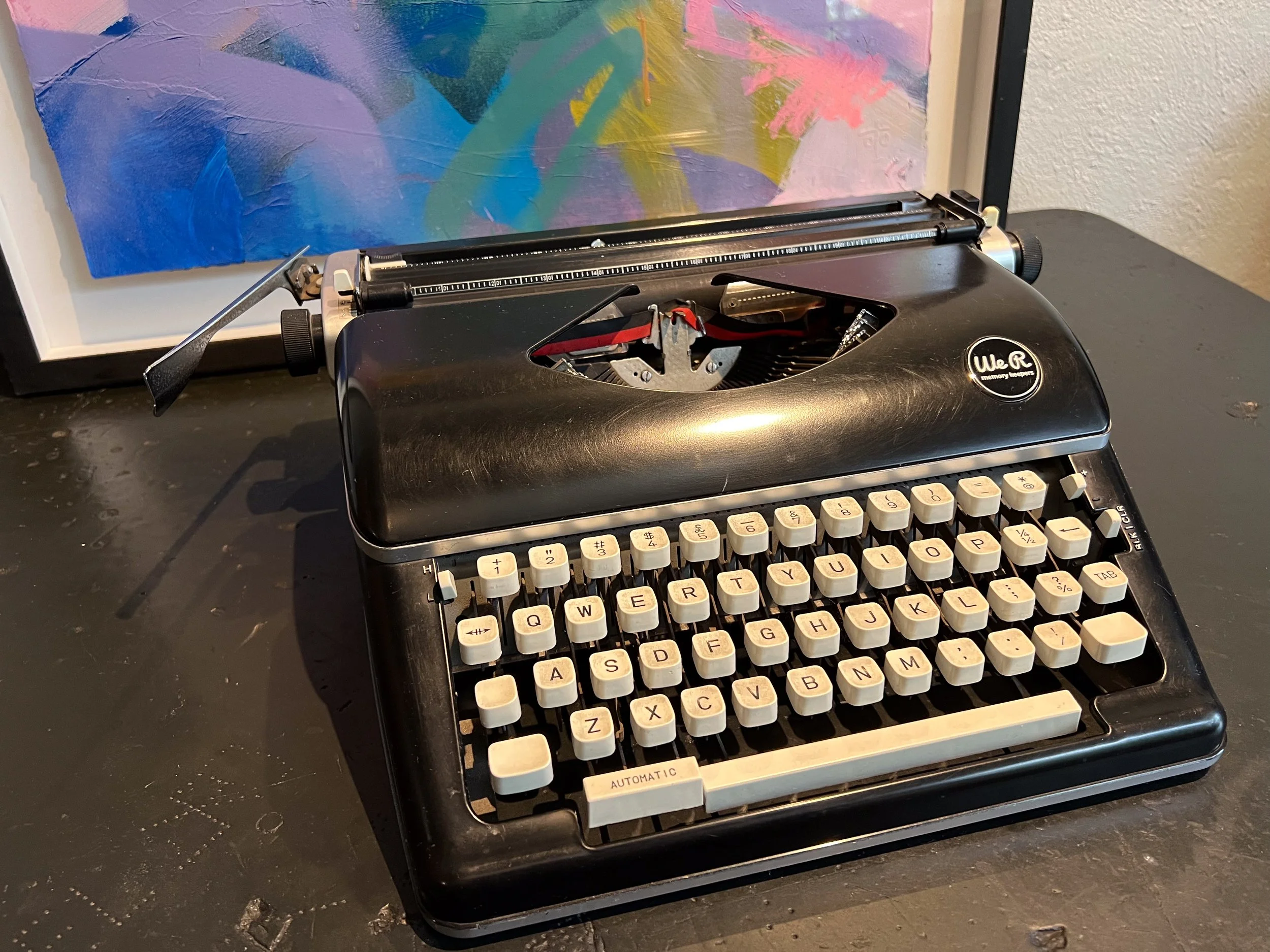
I love old typewriters - this was part of the retro decor at Hotel Pug Seal Anatole France.
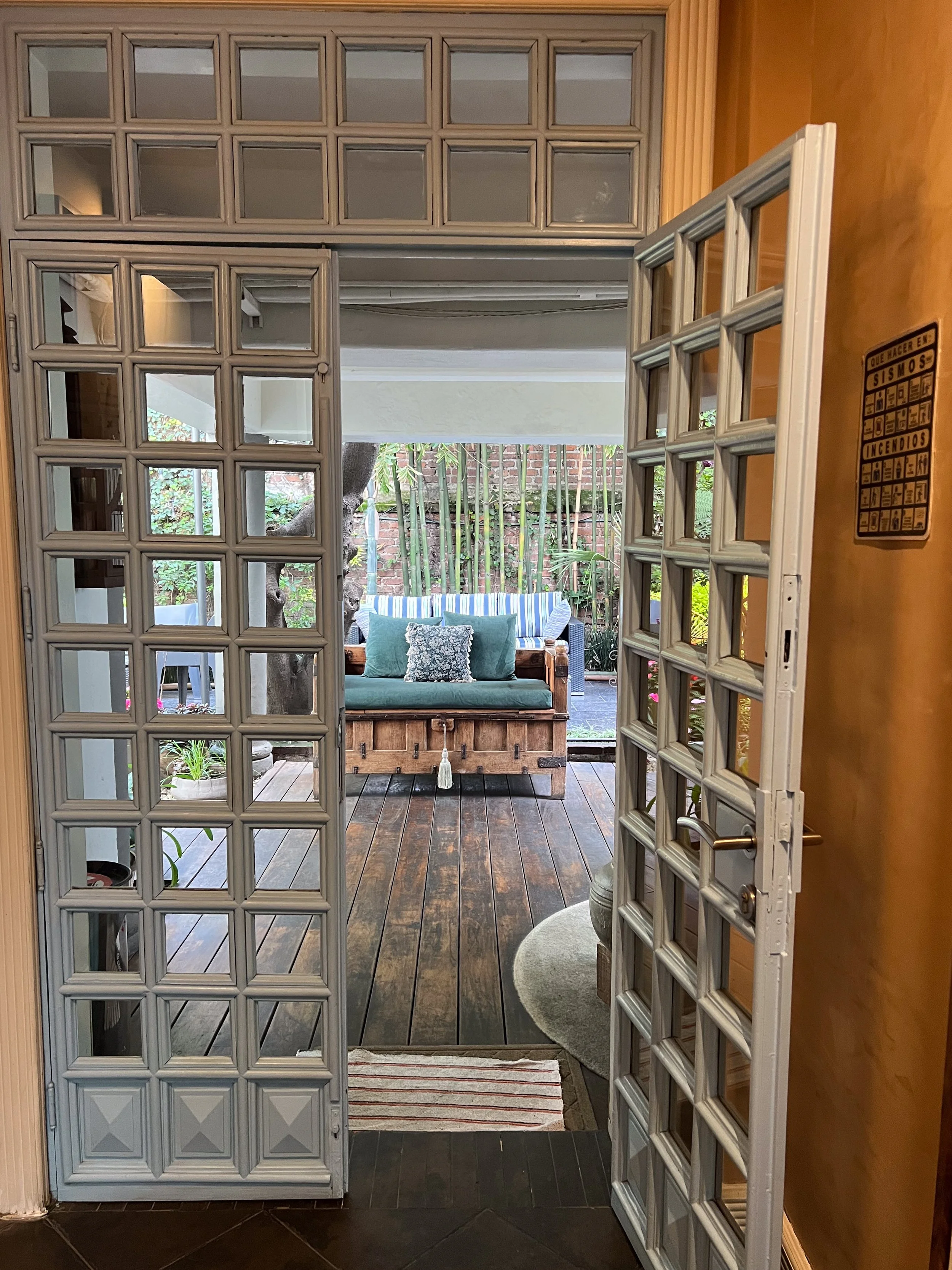
My second hotel, in the Condesa neighborhood, was Hotel Villa Condesa. Also a small, intimate boutique hotel.
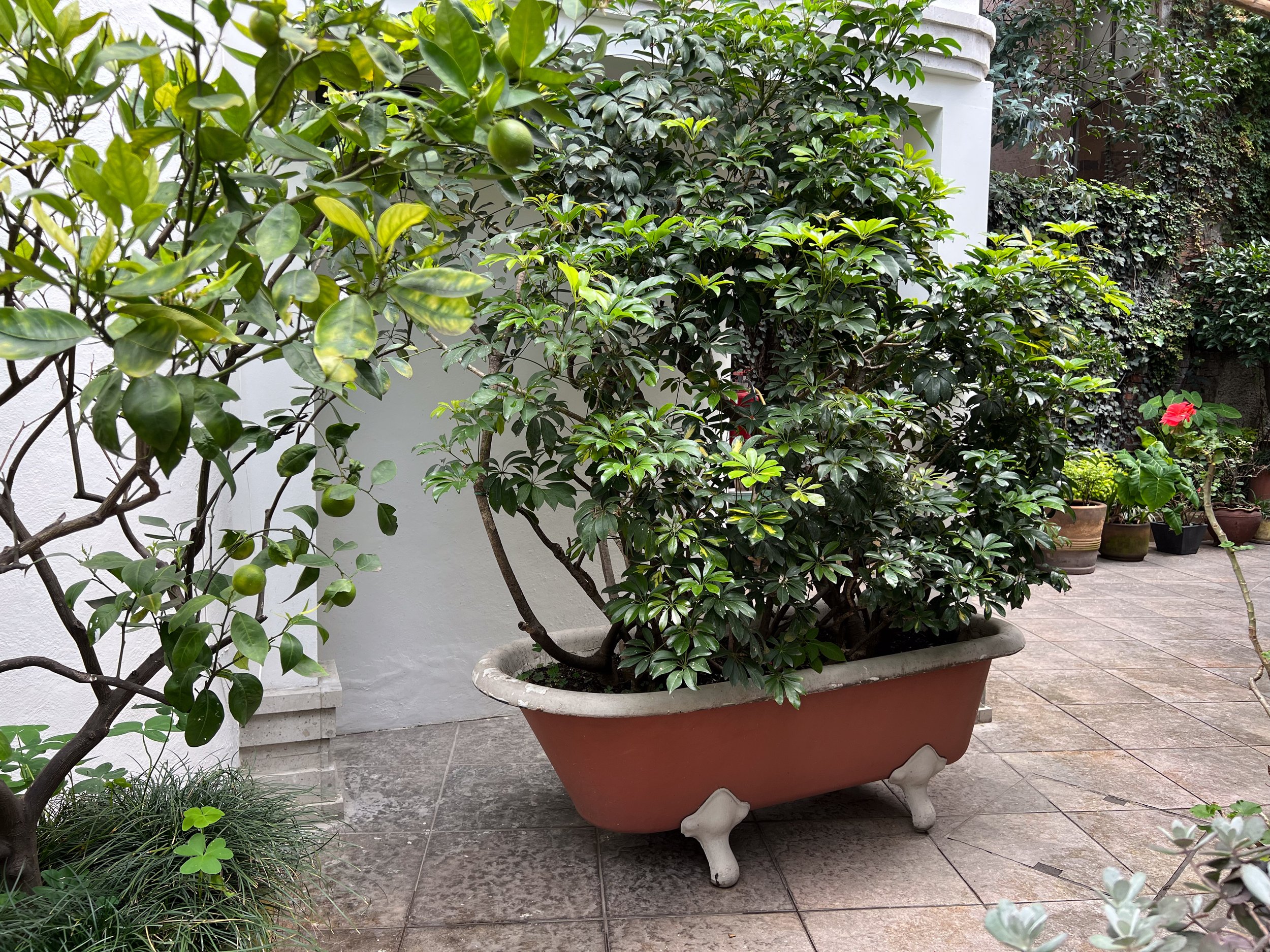
I'd rather have the bathtub to soak in, but I admire the novel use of it at Hotel Villa Condesa.